
TL;DR
- A complete funeral program template covers eight core sections: cover, obituary, order of service, pallbearers, musical selections, acknowledgments, committal, and a back-page tribute.
- Free options on Canva, Adobe Express, Microsoft Word, and Google Docs let families create a professional program in under an hour.
- Print 1.25 to 1.5 programs per expected guest on 80 lb matte or silk paper for the best look and feel.
- A growing number of families add a QR code to the funeral program that links to a full digital memorial with photos, videos, and written tributes.
- A thoughtfully designed program becomes a keepsake long after the service ends, preserving the person’s story for family and future generations.
Why a Funeral Program Template Matters
When someone you love has passed, the thought of designing a printed program on top of everything else feels impossible. A good funeral program template takes that weight off your shoulders. It gives you a structure to pour the life of your loved one into, a quiet guide through the order of a service, and a keepsake that guests will carry home and reread for years.
The National Funeral Directors Association reports that more than 1.3 million funerals and memorial services are held in the United States every year. Nearly every one of them uses a printed program. It is the single piece of the service that guests keep, long after the flowers have faded and the last casserole dish has been returned. That is why getting the program right matters.
This complete guide walks through every section a funeral program template should include, offers real funeral program examples, shows you where to find free templates, and explains how modern families are adding a QR code memorial to their programs so guests can scan in and experience the fuller story of a life lived. If you are planning a service right now, start with our what to do when someone dies checklist to get organized, then come back here for the program itself.
What Is a Funeral Program?
A funeral program, sometimes called an order of service or a memorial booklet, is a printed handout given to guests when they arrive at a funeral, memorial service, or celebration of life. It tells people what will happen during the service, honors the person who has died, and becomes a physical keepsake for family and friends.
Most programs are printed on a single folded sheet (a bi-fold) or as a small stapled booklet. They are typically 5.5 x 8.5 inches or 8.5 x 11 inches, landscape or portrait, depending on how much content you want to include. The style ranges from deeply traditional and religious to warm, photo-rich celebrations of life. A well-designed program respects the tone the family wants to set and reflects the personality of the person being remembered.
Quick definition: A funeral program is both a guide (what happens next) and a tribute (who this person was). The best programs do both with quiet dignity.
Key Elements Every Funeral Program Template Should Include
Whether you use a free funeral program template from Canva or build one from scratch in Google Docs, every strong program template covers the same core elements. Below is the checklist families and funeral homes use to make sure nothing essential is left out.
| Section | What It Contains | Typical Length |
|---|---|---|
| Cover page | Full name, photo, dates of birth and death, service date and location | 1 page |
| Obituary / life summary | Short biography covering family, career, faith, and passions | 200 to 500 words |
| Order of service | Chronological list of what happens during the service | 1 page |
| Pallbearers and officiants | Names of active pallbearers, honorary pallbearers, officiating clergy | Half page |
| Musical selections | Hymns, songs, and performers listed with their place in the service | Half page |
| Scripture and readings | Full text or citations of readings offered during the service | Half to full page |
| Acknowledgments | Thank you from the family to the people who have helped | Short paragraph |
| Back cover tribute | Poem, favorite quote, final photo, or QR code to a digital memorial | 1 page |
Any strong funeral service program template will make space for all eight of these sections, though you can condense them for a shorter service or expand them into a full booklet for a larger celebration of life. If the person had a long career, multiple children and grandchildren, or a rich community life, a 6 to 12 page booklet gives the story room to breathe.
Order of Service: A Step-by-Step Template
The order of service is the heart of the program. It tells guests what happens and when. Most traditional Christian and secular services follow a similar arc, though you should always adjust to reflect the faith tradition, the family’s preferences, and the officiant’s guidance. Here is a step-by-step order of service template you can adapt.
Sample order of service
- Prelude music (as guests arrive)
- Processional (family enters)
- Welcome and opening prayer
- Scripture reading or poem
- Hymn or musical selection
- Obituary read aloud
- Eulogy
- Family tributes and shared memories
- Second hymn or musical selection
- Message from the officiant or clergy
- Closing prayer and benediction
- Recessional music
- Committal (graveside or cremation reading)
- Repast or reception details
Not every service includes all fourteen parts. A simple memorial service program might have six or seven. A full church funeral might stretch to sixteen. The goal is to tell guests exactly what to expect so they can be fully present instead of wondering what is next.
Traditional vs Celebration of Life Programs
The tone of your program should match the tone of the service. A traditional funeral program leans into reverence, scripture, and formal hymns. A celebration of life program template is warmer and often more personal, with photo collages, favorite songs, shared stories, and lighter colors. Neither is more correct than the other. The right choice is the one that most honestly reflects the person being remembered.
For celebrations of life, families often swap out the formal order of service for a looser flow: welcome, photo slideshow, open mic for stories, a shared meal, and a final toast. The printed program still helps guests follow along, and it still becomes a keepsake they take home. For more inspiration on planning this kind of service, see our post on beautiful memorial page and service ideas.
Funeral Program Examples: Layouts That Work
Layout decisions shape how your program feels in a guest’s hands. Here are four funeral program examples that consistently work well, along with when each layout is the right choice.
Single-Fold Bi-Fold (8.5 x 11 Folded to 5.5 x 8.5)
The single-fold bi-fold is the most common funeral program layout in North America. One sheet of paper, folded in half, gives you four pages: front cover, obituary inside left, order of service inside right, and back cover for acknowledgments or a tribute poem. This layout is quick to design, inexpensive to print, and easy to handle at a service. It works for most funerals with services lasting 45 to 90 minutes.
Graduated Fold (Tri-Fold)
A graduated or tri-fold program uses a longer sheet folded twice to create a narrow strip with three panels on each side. It gives you more surface area without increasing page count, which is useful when you want to include additional photos, a longer obituary, or scripture passages in full. Tri-folds feel slightly more formal and elegant than a simple bi-fold.
Stapled Booklet (8 to 16 pages)
When a single folded sheet cannot hold everything, families turn to a stapled booklet. This funeral booklet template approach is ideal for longer celebration-of-life services, for military or first responder funerals with extensive honors, or when the family wants to include a full photo retrospective. A typical booklet is 5.5 x 8.5 inches, 8 to 16 pages, saddle-stitched (stapled at the spine).
Modern Card-Style (Single Sheet, Two-Sided)
A growing number of families choose a single-sheet, two-sided program, printed on heavy card stock. The front carries a large photo and the person’s name. The back carries a short order of service, a favorite quote, and often a QR code. This minimalist layout works beautifully for memorial services where the emphasis is on personal stories rather than formal liturgy.
Keepsake tip: Print a small number of premium programs on thicker card stock (100 to 130 lb) for immediate family members. The heavier paper makes them feel like keepsakes they will treasure, not disposable handouts.
How to Design a Funeral Program (DIY vs Printed)
You have three realistic paths for creating a funeral program: do it yourself using a free funeral program template, let the funeral home design one for you, or hire a specialty funeral program printer. Each has tradeoffs.
DIY with Free Templates
The easiest way to start is with a free template from one of the major design platforms. Canva has hundreds of customizable funeral program templates you can edit in the browser. Adobe Express offers similar options. Microsoft Word and Google Docs have basic templates you can use if you already have those tools open. These platforms let you drop in photos, change fonts and colors, and export a print-ready PDF without any design background.
Expect to spend 45 to 90 minutes on a DIY program if you have photos and the obituary ready. Keep fonts simple (one serif for headings, one sans-serif for body text), stick to two or three colors, and give photos plenty of white space.
Funeral Home Design Service
Most funeral homes offer in-house program design as part of their service package. You provide the photos, obituary, order of service, and any special inclusions. They handle layout, printing, and delivery. This is the least stressful option, especially in the days right after a loss. Costs typically run from $1.50 to $4.00 per program depending on page count and finishes.
Specialty Funeral Program Printers
Specialty vendors like FuneralPrints, Elegant Memorials, and FuneralProgram-Site offer template libraries, fast turnaround, and premium print finishes. They are a good middle ground: more polished than a DIY program, more affordable than bespoke design, and faster than waiting for a funeral home’s graphic design queue. Most deliver printed programs within 24 to 48 hours of order placement.
Modern Touch: Adding a QR Code Memorial to Your Program
The single biggest change in funeral programs over the past five years is the appearance of a small, unassuming square on the back cover: a QR code. Scan it with a phone camera and the program becomes a doorway to a full digital memorial with photos, videos, written tributes, and the family tree of the person being remembered. A good funeral memorial program template in 2026 leaves space for this code.
preserved on Linkora digital memorials by families who started with a QR code on the funeral program
The idea is simple. A printed program, no matter how beautiful, can only hold so much. A photo and a paragraph cannot capture a whole life. But a QR code on the back cover can link to a permanent digital memorial where family and friends can see dozens of photos, watch video tributes, read stories from people who could not attend the service, and even import a GEDCOM family tree. See a real example of what this looks like with our demo memorial page.
Adding a QR code is more accessible than families realize. Platforms like Linkora let you create a memorial page, pick a short custom URL, generate the QR code, and drop it into your program design in under ten minutes. There is no app for guests to download. They simply open their camera, point it at the code, and tap the link. Our complete guide to QR code memorials walks through the setup step by step.
If you represent a funeral home and want to offer this as part of your standard service package, we work with partners through our funeral home partner program. Many funeral directors now bundle a digital memorial with every program they print, adding meaningful value for families without adding complexity to their workflow.
Where to Place the QR Code on Your Program
The back cover is the most common placement, usually in the lower third, centered, with a short caption like “Scan to visit [Name]’s digital memorial” or “Share a memory.” Keep the code at least 1 x 1 inch to make scanning easy. Leave a quarter-inch of white space around it (the quiet zone) so phones read it cleanly even in the low light of a chapel or funeral home.
Writing the Obituary Section
The obituary inside the funeral booklet template is usually a condensed version of the full obituary that ran in the newspaper or online. Aim for 200 to 500 words covering the essentials: date and place of birth, parents, education, military service if applicable, career highlights, marriage and children, faith community, hobbies and passions, and surviving family members.
Write in the past tense. Use the person’s full name on first mention, then the first name or a familiar nickname for the rest of the paragraph. If you are struggling with the wording, our obituary writing kit provides fill-in-the-blank prompts that take the guesswork out of the process.
Hymns, Readings, and Music Suggestions
Listing musical selections in your program helps guests sing along or follow meaningfully during instrumental pieces. Here are the most commonly chosen hymns, scripture readings, and contemporary songs families use in the United States.
Traditional Hymns
Amazing Grace. How Great Thou Art. On Eagle’s Wings. Be Still My Soul. It Is Well With My Soul. The Old Rugged Cross. Abide With Me. In the Garden. These hymns have carried generations through grief and are instantly recognizable to most guests.
Scripture Readings
Psalm 23 (The Lord is my shepherd). John 14:1-6. Revelation 21:1-7. Ecclesiastes 3:1-8 (To everything there is a season). 1 Corinthians 13. Romans 8:38-39. These passages are read at most Christian funerals and carry deep familiarity for guests of faith.
Contemporary Songs
For celebrations of life and less formal services, contemporary selections often resonate more. Popular choices include “I Will Always Love You,” “Over the Rainbow,” “Tears in Heaven,” “My Way,” “What a Wonderful World,” and “You’ll Never Walk Alone.” Choosing a song the person actually loved always beats picking something generic. A short note in the program explaining why a specific song was chosen adds a personal touch that guests remember.
If your family wants help writing tributes that go alongside the program, our guide on beautiful things to say to honor a loved one offers prompts, examples, and framing you can borrow freely.
Practical Tips: Printing, Quantity, and Distribution
The printed program is the single most-handled piece of your service. Getting the physical details right matters more than families usually expect.
How Many Programs to Print
A safe rule of thumb is 1.25 to 1.5 programs per expected guest. If you expect 100 people, print 125 to 150 programs. The extra count covers guests who forget to pick one up, family members who want multiples as keepsakes, and friends who could not attend and will receive one by mail. Running out of programs during a service is something families remember with regret; printing a few extras is cheap insurance.
Paper Weight and Finish
80 lb matte or silk cover stock is the sweet spot for most funeral programs. Heavier than standard copy paper but still foldable by hand. Matte or silk finishes photograph better in group shots and feel less commercial than glossy paper. For premium keepsake versions for immediate family, step up to 100 to 130 lb card stock with a silk or soft-touch finish.
Color Printing vs Black and White
Full-color printing is worth the small extra cost. Photos look dramatically better in color, and printed black-and-white photos on folded programs often look muddy. If budget is tight, use color on the cover and back (where photos live) and black-and-white on the interior (where the order of service and obituary are text-heavy).
Distribution on the Day
Place programs on a small table near the entrance, with a trusted family friend or usher greeting guests. A short stack in the hands of an usher as guests walk in feels more personal than an unattended pile. Hold back a clearly marked stack of 10 to 20 programs for immediate family; they will be distracted on the day and you do not want them to miss out on their own keepsake.
Putting It All Together
A great funeral program template quietly carries the weight of a day that words alone cannot hold. It guides guests through the service, honors the person who has died, and becomes the single artifact most families keep long after the service ends. If you start with a proven memorial service program structure, add a QR code that links to a fuller digital memorial, and pay attention to paper and printing, the program itself will do much of the emotional work of the day.

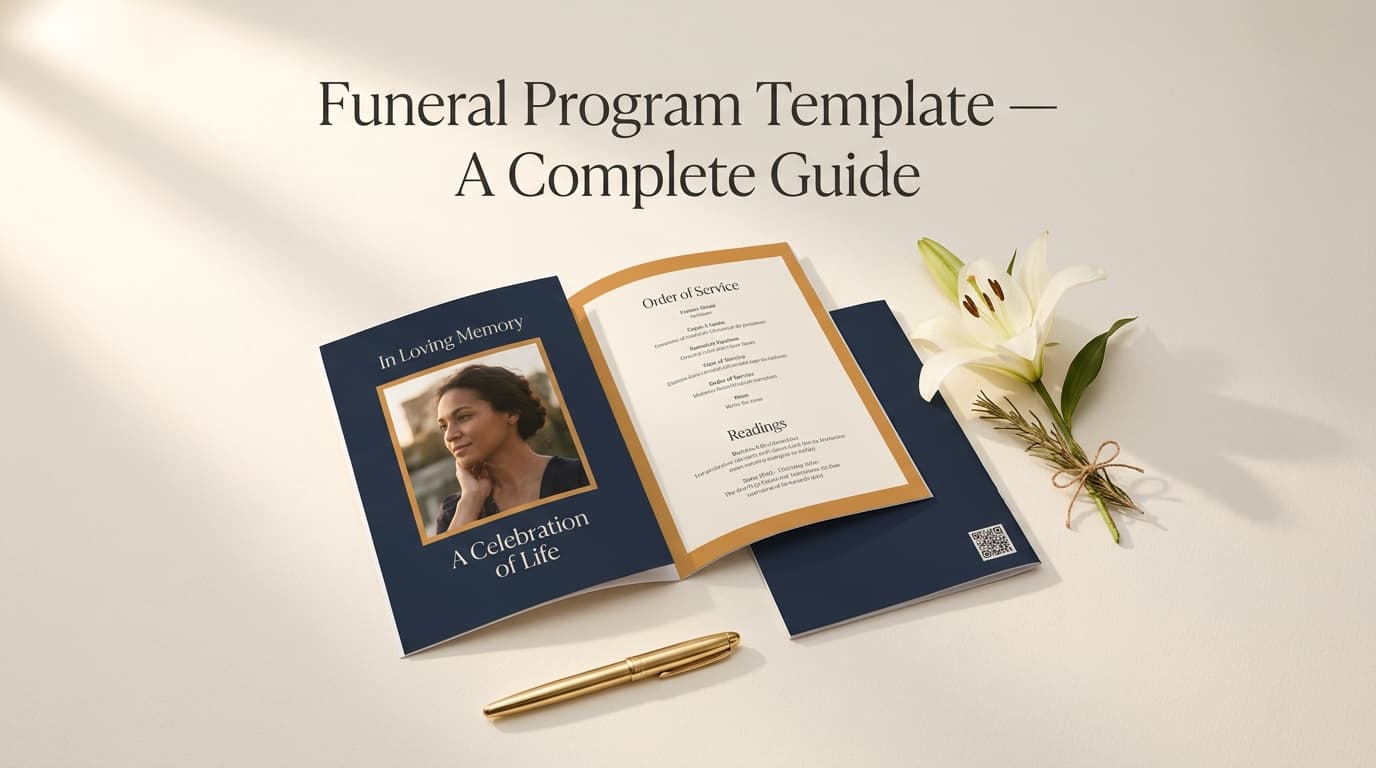
A complete funeral program template at a glance: every section, every layout, and the new QR code memorial standard.
FAQs: Funeral Program Templates
What should a funeral program template include?
A complete funeral program template includes eight core sections: a cover with the person’s name, photo, and dates; an obituary or life summary; the order of service; pallbearers and officiants; musical selections; scripture and readings; acknowledgments from the family; and a back cover with a tribute poem, quote, or QR code linking to a digital memorial.
Is there a free funeral program template I can edit?
Yes. Canva, Adobe Express, Microsoft Word, and Google Docs all offer free funeral program template libraries you can open in a browser, edit with your own photos and text, and export as a print-ready PDF. For a more polished look, specialty funeral program vendors offer inexpensive premium templates starting around $5 to $15.
How long should a funeral program be?
Most funeral programs are a single folded sheet producing four pages, which is plenty for a 45 to 90 minute service. For longer celebrations of life, military honors, or when the family wants a full photo retrospective, a stapled booklet of 8 to 16 pages works better. Keep the order of service on one clear page so guests can follow along at a glance.
Can I add a QR code to a funeral program template?
Yes, and it is becoming the standard for modern programs. Create a digital memorial page on a platform like Linkora, generate the QR code, and paste it onto the back cover of your funeral program template. Keep the code at least 1 x 1 inch with a quarter inch of white space around it so guests can scan it reliably with their phone cameras.
What’s the difference between a funeral program and an order of service?
The order of service is one section inside a larger funeral program. The program as a whole includes the obituary, photos, musical selections, acknowledgments, and often a tribute poem, while the order of service is specifically the chronological list of what happens during the ceremony. In British English, “order of service” is sometimes used interchangeably with the whole program.