
TL;DR — Headstone Ideas at a Glance
- Modern headstone ideas in 2026 blend timeless granite craftsmanship with personal storytelling — hobbies, photos, faith, and family heritage replace generic templates.
- Five core shapes drive most designs: upright monuments, flat (grass) markers, slant markers, bevel markers, and ledger stones — each with very different price points ($300–$15,000+).
- Granite still dominates (black, gray, mahogany, blue pearl), but families are mixing in bronze inlays, stainless lettering, raw natural stone, and colored glass for a more contemporary feel.
- The fastest-growing trend is QR code memorials etched or mounted onto the stone — turning a static marker into a scannable doorway to photos, videos, and life stories.
- Symbols (cross, angel, rose, tree of life), epitaphs, and laser-engraved portraits make the design uniquely theirs — but always check cemetery rules before you commit.
Why Headstone Ideas Matter More Than Ever in 2026
Choosing a headstone is one of the most permanent decisions a family ever makes. Unlike a card, a service, or even a casket, the stone you choose today will likely outlive your grandchildren. That weight is exactly why families are spending more time exploring headstone ideas before signing a monument contract — and why the design conversation has changed so much in the last few years.
According to monument-industry surveys, families today want headstones that tell a story rather than simply mark a date. A 2025 trend review from Hathaway Memorials highlights five fast-rising design trends — personalization through hobbies and portraits, sustainable and natural materials, mixed-material monuments, laser engraving, and integrated technology like QR codes. The shared thread is identity: the stone should look like the person, not like a template.
That is also why smart headstones and cemetery QR codes have moved from novelty to mainstream — they let a single granite marker hold a person’s name and dates, while a scannable plaque opens up an entire digital memorial of photos, videos, and tributes. We’ll get to that section in detail below.
A note on terminology. “Headstone,” “gravestone,” “tombstone,” and “monument” are used almost interchangeably today. Cemeteries sometimes use “monument” for anything upright and “marker” for anything flat or flush with the ground. Whichever word your family prefers, the ideas below apply.
The 5 Headstone Shapes Every Family Should Know
Before you pick a color, a symbol, or an epitaph, the most important decision is the shape — because shape determines cost, visibility, cemetery eligibility, and how much room you have to personalize. Here are the five most common headstone ideas grouped by shape, with 2026 price ranges drawn from monument retailers nationwide.
Price ranges synthesized from THGA’s 2026 headstone pricing guide, Brown Memorials, and SilkStone Memorials. Cemetery installation typically adds another $300–$800.
When Each Shape Works Best
An upright headstone is the classic choice for traditional cemeteries — it gives you the largest canvas for a portrait, symbol, or scripture verse, and it stands tall enough to find at a distance. A flat marker, by contrast, is mandatory in many “memorial park” style cemeteries that maintain a uniform lawn. Keep flat markers simple: name, dates, one symbol, and a short epitaph. Slant and bevel markers are a comfortable middle ground — more visible than flat, less expensive than upright. And a ledger stone is the right pick when you want to write a full life — a paragraph of biography, a long scripture passage, or a multi-generation family record.
Granite Colors and What They Say
Once you’ve picked a shape, granite color is the next big design decision. Color drives mood and also drives how well lettering shows up — a critical factor most families don’t think about until they see the proof.
Black granite is classic and formal, providing the sharpest possible contrast for inscriptions and portraits. Milano Monuments notes that darker granites like Jet Black and Impala Black look best with skin-traced lettering, while lighter granites like Bethal White and Barre Grey are most legible with deeper V-sunk lettering.
Popular granite color palette
- Jet Black / Absolute Black — formal, dignified, premium feel; best for portraits and detailed laser etching.
- Bahama Blue / Blue Pearl — shimmering depth; striking for nautical, military, or “favorite color” tributes.
- Mahogany / Indian Red — warm and earthy; pairs well with floral motifs and natural settings.
- Bethal White / Cloud White — soft and peaceful; traditional Christian and angelic imagery looks beautiful on white.
- Barre Grey / Sierra Grey — the most popular neutral; balances cost, readability, and longevity.
- Forest Green / Verde — uncommon and memorable; meaningful for outdoor enthusiasts and military green-uniform tributes.
Personalization Ideas That Actually Mean Something
The best modern headstone ideas aren’t about being “different” for its own sake. They are about capturing one specific person. The categories below give you concrete ways to do that without overwhelming the stone.
1. Portraits and laser-engraved photos
Laser engraving has transformed what’s possible on granite. According to Monuments of the South, modern lasers can reproduce photo-realistic portraits, handwritten signatures, and intricate scenes directly onto the stone. Black granite holds laser detail beautifully, which is why most laser portraits are done on dark stones.
2. Hobbies, professions, and passions
Carvings or etchings of fishing boats, motorcycles, golf clubs, a chef’s hat, a violin, a tractor, a stethoscope — small but specific objects make a stone feel like the person. Avoid the temptation to add four or five hobbies; one well-chosen image carries more emotional weight than a crowded panel.
3. Faith and traditional symbols
Religious and cultural symbols carry centuries of meaning. A short reference list from Capital Grave Markers and Stoneletters:
4. Epitaphs that don’t sound like everyone else’s
An epitaph is the short phrase or quote beneath the dates. The most memorable epitaphs are short, true, and a little surprising. Borrow from a person’s actual sayings (“Coffee first.”), a beloved scripture, a song lyric, a line they wrote in a letter, or a single defining word (“Builder.”, “Mother.”, “Storyteller.”). If you’re stuck, our guide to eulogy examples for every relationship often holds a phrase that translates beautifully to stone.
5. Natural, raw-edged stone
An emerging trend is the use of unpolished granite or boulders with one polished panel for the inscription. These designs feel organic, almost like the marker grew out of the ground itself, and pair beautifully with green-burial sections and rural cemeteries.
QR Code Headstones: The Biggest Modern Trend
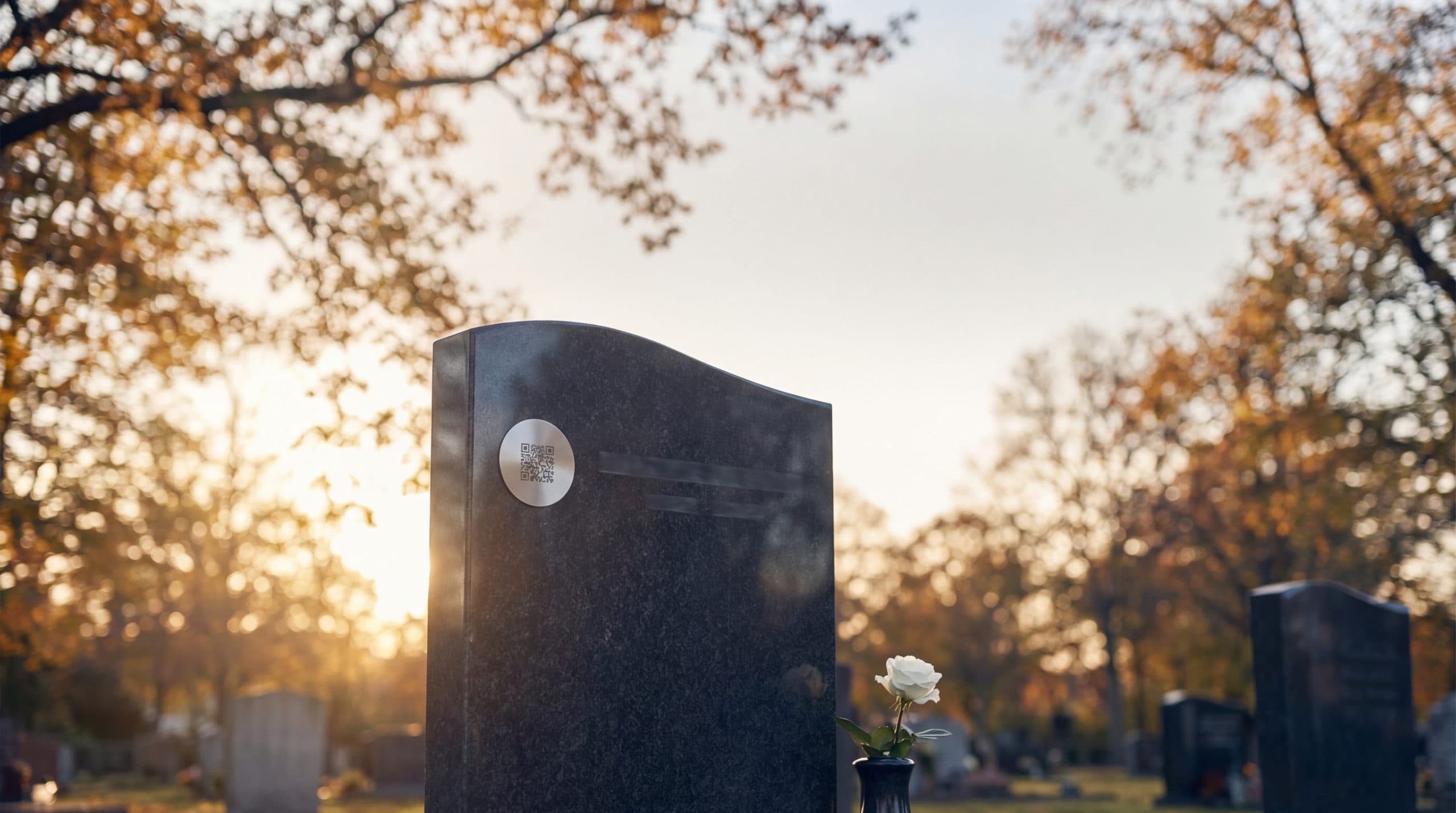
If there is one design idea reshaping monuments in 2026, it is the integration of a small QR code memorial plaque onto the stone itself. The plaque is laser-engraved or UV-printed on weatherproof stainless steel, bronze, or porcelain — and when scanned with any smartphone camera, it opens a private memorial page with photos, videos, life stories, and tribute messages.
expected lifespan of a stainless-steel laser-engraved memorial QR plaque
A scannable plaque does something a granite stone alone cannot — it carries the whole person. A passerby reads a name and two dates on the stone, then scans the plaque and sees their wedding photo, their kids, their voice on a video, their grandmother’s handwritten recipe. That is the bridge between physical and digital remembrance, and it is the reason families are increasingly choosing QR codes on headstones as the centerpiece of their modern design.
How it physically attaches. Most modern plaques are 1.5″–3″ in diameter and adhere to polished granite with a marine-grade epoxy, or are countersunk into a small recess cut by the monument dealer at fabrication. Cemeteries that previously banned “non-stone additions” are increasingly approving QR plaques because they are flush, low-profile, and don’t damage the stone.
Linkora’s own QR memorial plaque guide walks through material durability, mounting, and the trade-offs between bronze, stainless, and porcelain. For a side-by-side comparison of what each platform offers, see our roundup of the best digital memorial platforms in 2026.
What the digital page should contain
A well-built digital memorial doesn’t try to do everything. The pages families love most include a hero photo, a 2–4 minute video tribute, a written life story, a photo gallery organized by decade, and an open space for visitors to leave their own messages. Our companion guide on what to put on a memorial web page covers exactly what to include and what to skip.

A visual guide to the five most common headstone shapes, 2026 price ranges, and the rise of the QR memorial plaque.
How to Design a Headstone: A 7-Step Roadmap
Once you’ve explored the headstone ideas above, the actual design process moves more quickly than most families expect. Here is the order monument dealers recommend:
- Confirm cemetery rules first. Every cemetery has rules about size, shape, materials, colors, and additions like QR plaques. Get the written specs before you fall in love with a design.
- Set a realistic budget. Decide the all-in number including the marker, foundation, installation, and any extras like a vase or porcelain photo. Most families land between $1,500 and $4,500.
- Pick the shape. Use the five-shape table above. Cemetery rules will narrow this fast.
- Pick the granite color. Visit the monument dealer in person if you can — color samples online never quite match the real stone in sunlight.
- Draft the inscription. Identity line (name, middle name or initial, surname) + life dates + one short epitaph. Read it out loud to family before approving.
- Choose one or two design elements. A symbol, a portrait, a hobby etching — but resist crowding the stone.
- Decide on a QR memorial plaque. If you want the stone to carry the full story, add a scannable plaque now while the monument is being fabricated. Retrofitting later is possible but harder.
Headstone Ideas by Relationship
The right design often depends on who the headstone is honoring. A quick set of starting points:
For a parent or grandparent
Upright granite, classic symbol (cross, angel, or tree of life), a short epitaph in their own words, and a QR plaque linking to a multi-generation family memorial. See our piece on meaningful ways to remember someone who has passed for inspiration that extends beyond the stone itself.
For a spouse (companion headstone)
Double-width upright, often with both names on the front and a shared symbol — interlocking rings, two doves, a sunset. Many couples now pre-design these together, leaving the second date open.
For a child
Smaller upright or slant marker, soft imagery (lamb, rosebud, butterfly), and almost always a QR memorial — for families who want a private digital space to keep the child’s story alive without it being public.
For a veteran
Branch insignia, service dates, and the standard-issue VA headstone is provided free for eligible veterans. Many families also add a private monument with personal touches in addition to (not instead of) the VA marker.
For someone whose family lives far away
This is where a digital memorial truly shines. A QR plaque on the stone lets relatives anywhere in the world “visit” the grave from their phone, leave a tribute, and stay connected to the memorial across generations.
For monument dealers and funeral homes: families are asking for QR-enabled memorials by name now, and partnering with a digital memorial platform is one of the highest-margin add-ons you can offer. Our guide for monument dealers walks through pricing, fulfillment, and how to introduce it without disrupting your sales process.
Frequently Asked Questions
How much does a headstone cost in 2026?
Most families pay between $1,000 and $3,000 for a standard granite headstone with installation. Flat markers start around $300–$500, upright monuments run $1,500–$6,000, and large ledger stones can reach $15,000 or more. Personalization (portraits, custom carvings, mixed materials, QR plaques) adds $100–$1,500 depending on complexity.
Can I design a headstone myself?
Yes. Most monument dealers offer free design consultations where you bring inscription wording, symbols, and any photos, and they render a proof for your approval before fabrication. You should still confirm cemetery rules and lettering style with the dealer — they know which carving methods work best on the granite color you’ve chosen.
Do cemeteries allow QR codes on headstones?
Most cemeteries now allow QR memorial plaques, though rules vary. Some require the plaque to be flush with the stone, a certain color, or a specific size. Always confirm in writing before installation. The QR plaque does not damage the headstone — modern plaques are typically epoxied to a polished panel or countersunk during fabrication.
What’s the difference between a headstone, a monument, and a marker?
In everyday use the words overlap, but in the monument industry a “marker” usually refers to a flat or low-profile stone, while a “monument” refers to a larger upright design. “Headstone” and “gravestone” are generic and apply to either. Always ask your cemetery which term they use in their rules so you’re shopping for the right product.
How long does it take to design and install a headstone?
From design approval to installation, expect 8–16 weeks for a standard granite monument. Custom carvings, imported granite, and large ledger stones can extend the timeline to 4–6 months. Many cemeteries also restrict installation in winter months when the ground is frozen. Order earlier rather than later, but know that there is no “wrong” time to commission a stone — many families wait six months to a year, which gives space to settle on a design that genuinely fits.
Bringing the Stone and the Story Together
The strongest headstone ideas in 2026 don’t come from a catalog. They come from listening — to the person who’s gone, to the family they left, and to the stories that should outlive the granite. A well-designed headstone gets the basics right (shape, color, inscription, a meaningful symbol), and then it does one more thing: it points to the full story.
That’s exactly what a Linkora QR memorial is built to do. Pair a beautifully designed monument with a private, family-controlled digital memorial, and you have something that honors the past while staying alive for every visitor who comes after.