
TL;DR
- Traditional newspaper obituaries cost $200 to $1,500+ and are limited to a few paragraphs of text that run for one or two days.
- QR code memorials create permanent, multimedia tribute pages with unlimited photos, videos, stories, and family contributions accessible to anyone with a smartphone.
- Digital obituaries now account for over 65% of all death notices, and online obituary services are rapidly replacing newspaper-only announcements.
- The best approach for most families is a hybrid one: publish a traditional obituary for immediate announcement, then create a QR code memorial for lasting remembrance.
- Linkora makes it easy to create a QR code memorial that connects physical monuments to rich digital tribute pages, no app required.
Rethinking How We Remember: Online Obituary Services vs. Physical Tributes
When someone we love passes away, one of the first decisions families face is how to share the news and honor that person’s memory. For generations, the answer was straightforward: place an obituary in the local newspaper. But today, online obituary services have fundamentally changed the landscape of remembrance. Digital obituaries now account for over 65% of all death notices, and online obituary platforms attract more than 120 million monthly visitors.
This shift raises an important question that more and more families are asking: should you go with a traditional newspaper obituary, a QR code memorial, or both? The answer depends on your family’s needs, budget, and vision for how you want to preserve your loved one’s story. In this guide, we break down every meaningful difference so you can make the right choice during an already difficult time.
What Is a Traditional Obituary?
A traditional obituary is a written notice published in a newspaper, typically within days of a person’s passing. It serves two main purposes: announcing the death to the community and providing details about memorial services or funeral arrangements. Most obituaries include the person’s name, age, date of death, surviving family members, and a brief summary of their life.
While obituaries have deep cultural roots, they come with inherent limitations. Newspaper space is expensive, so families often have to condense a lifetime into a few paragraphs. A standard obituary might allow 150 to 300 words. There is no room for photos beyond a single headshot, no option for video or audio, and no way for friends and family to add their own memories. Once the newspaper is recycled, the obituary largely disappears unless the family saves a clipping. Some papers do maintain online obituary databases, but access may be limited or paywalled.
If you are looking for help putting the right words together, our guide on how to write a tribute for someone who passed away walks through the process step by step.
What Is a QR Code Memorial?
A QR code memorial is a digital tribute page linked to a physical QR code, usually etched or attached to a headstone, monument, or memorial plaque. When visitors scan the code with their smartphone, they are taken to a rich multimedia page that tells the full story of the person’s life. No app is needed. Just point a phone camera at the code, and the digital memorial page opens instantly.
Unlike a newspaper obituary that runs once, a QR code memorial is a living document. Families can add photos, videos, audio recordings, written stories, a family tree, and more at any time. Friends and extended family can contribute their own memories and tributes. The result is a comprehensive portrait of a person’s life that goes far beyond what any newspaper column could ever contain.
As part of the growing digital memorial movement, platforms like Linkora connect QR memorial plaques directly to these interactive tribute pages, bridging the physical and digital worlds of remembrance.
Americans are projected to scan QR codes in 2026, making the technology familiar and accessible to most families
QR Code Memorial vs Traditional Obituary: A Side-by-Side Comparison
To help you understand the real differences between these two approaches to online obituary services and traditional remembrance, here is a detailed comparison across the factors that matter most.
| Feature | Traditional Obituary | QR Code Memorial |
|---|---|---|
| Cost | $200 – $1,500+ (per publication) | One-time setup, often under $100 |
| Content Limit | 150-300 words, 1 photo | Unlimited text, photos, videos, audio |
| Duration | 1-2 days in print | Permanent (as long as platform exists) |
| Reach | Local newspaper readership | Anyone with a smartphone, worldwide |
| Multimedia | Text only (maybe 1 photo) | Photos, videos, audio, family trees |
| Updates | Cannot be changed once published | Editable and expandable anytime |
| Interactivity | None | Family and friends can contribute |
| Physical Connection | Newspaper clipping | Etched on headstone or plaque |
Cost Comparison: Online Obituary Services vs. Newspaper Pricing
One of the starkest differences is cost. The average newspaper obituary in the United States costs between $200 and $500, but that number climbs quickly in major markets. The New York Times charges around $263 just for the first few lines, and a full obituary in the Los Angeles Times typically runs $1,000 to $1,500. These are one-time publication fees. If you want the obituary to appear in multiple newspapers, you pay each one separately.
A free online obituary through basic platforms offers limited features, and most families find they need more space and functionality. QR code memorial platforms like Linkora offer a much more cost-effective alternative with a one-time setup that includes unlimited content, multimedia support, and permanent hosting. When you consider the lasting value of a digital memorial that grows over time versus a newspaper column that runs for a single day, the economics clearly favor the digital approach.
Content and Multimedia Capabilities
A traditional headstone might accommodate a name, birth and death dates, and a short epitaph. A newspaper obituary adds a paragraph or two. But neither can capture the sound of someone’s laugh, the way they told a story, or the warmth in their voice. An online obituary maker or QR memorial platform changes that entirely.
With a QR code memorial, families can upload thousands of photos spanning a lifetime, embed video interviews and audio recordings, write detailed biographical narratives, and invite dozens of family members and friends to add their own memories. The page becomes a collaborative celebration of a life, not just a brief announcement of a death. For families looking for beautiful memorial page ideas, the possibilities are practically limitless.
Reach and Accessibility
A newspaper obituary reaches the people who happen to read that particular paper on that particular day. With declining newspaper subscriptions, that audience is shrinking every year. Online obituary databases preserve some of this content, but many are behind paywalls or have limited search functionality.
A QR code memorial, on the other hand, is accessible to anyone in the world with a smartphone. Family members overseas, old college friends, military comrades, and future generations of descendants can all visit the memorial anytime. When the QR code is etched into a headstone or placed on a cemetery monument, it creates a physical-digital bridge that makes remembrance both tangible and boundless.
Longevity and Preservation
Newspaper clippings yellow and crumble. Physical papers get lost in moves or natural disasters. Even online newspaper archives can disappear when publishers change platforms or go out of business. Traditional obituaries are fundamentally ephemeral.
Digital memorials, when hosted on dedicated platforms, are built for permanence. QR codes are an ISO international standard that has existed since 1994 and has only grown in adoption over three decades. Because QR codes are simply encoded URLs, even as scanning technology evolves, the underlying memorial pages remain accessible through direct web links. For families thinking about digital legacy planning, a QR code memorial is one of the most future-proof ways to preserve a loved one’s story.
Key Insight: The global digital legacy market was valued at $22.46 billion in 2024 and is projected to reach $78.98 billion by 2034, growing at 13.4% annually. Families are clearly investing in digital preservation as a complement to, or replacement for, traditional memorial formats.
Why Families Are Choosing QR Code Memorials Over Traditional Online Obituary Services
The trend toward digital memorials is not just about technology. It is about meeting real emotional needs that traditional formats cannot address. Research from grief studies supports what families are discovering on their own: maintaining a continuing bond with the deceased is a healthy and important part of the grieving process. Digital memorial pages provide a dedicated space for this ongoing connection.
Here is what families consistently report as the biggest advantages of QR code memorials over conventional online obituary services:
Family collaboration. Multiple family members can contribute photos, stories, and tributes to the same memorial page. Grandchildren can add memories decades after a grandparent’s passing. This collaborative aspect transforms a memorial from a single author’s perspective into a rich, multi-voice portrait of a life.
No app required. Visitors simply scan the QR code with their phone camera. There is nothing to download, no account to create, and no tech expertise needed. This makes the memorial accessible to visitors of all ages and technical comfort levels.
Privacy controls. Unlike a newspaper obituary that is public by default, families using platforms like Linkora have complete control over who can view and contribute to the memorial. This is particularly important for families who want to share personal photos and stories but only within a trusted circle.
Evolving tribute. A traditional obituary is frozen in time. A QR code memorial grows and evolves as family members add new memories, anniversary tributes, and milestone reflections over the years.
These advantages explain why the funeral technology industry is experiencing rapid growth, with over 1.7 million digital funeral and memorial events taking place globally each year.
When a Traditional Obituary Still Makes Sense
Despite the clear advantages of digital memorials, traditional newspaper obituaries still have their place. There are situations where a printed obituary is the right choice, or at least an important complement to a digital memorial.
For communities where the local newspaper is still a central gathering point, a printed obituary ensures that neighbors, church members, and community acquaintances learn about the passing and funeral arrangements. Older generations who may not use smartphones regularly are more likely to see a newspaper notice. Some families also value the formality and tradition of a newspaper obituary as a cultural or religious practice. An online obituary template can help structure the announcement, and many families find it useful to create obituary online before submitting to the newspaper to ensure accuracy and completeness. The printed version carries its own weight in certain contexts.
The key takeaway is that choosing a traditional obituary does not mean you cannot also create a digital memorial. In fact, the most thoughtful approach often combines both.
How to Create a QR Code Memorial for Your Loved One
If you are ready to create a lasting digital tribute, the process is simpler than you might expect. Unlike a traditional obituary maker online that only generates text, Linkora is an online obituary creator that specializes in connecting physical monuments with interactive digital memorial pages. Here is how it works:
Step 1: Claim a memorial. Visit Linkora and set up a memorial page for your loved one. You will enter basic information like their name, dates, and a brief description.
Step 2: Add content. Upload photos, videos, and audio recordings. Write stories and biographical details. Invite family members to contribute their own memories and tributes.
Step 3: Connect to a physical monument. Linkora provides a QR code that can be etched into a headstone, engraved on a smart headstone, or attached to a memorial plaque. When visitors scan the code at the gravesite, they are taken directly to the full digital memorial.
Step 4: Share and grow. Share the memorial link with family and friends who cannot visit in person. Continue adding content over time. The memorial becomes a living repository of memories that future generations can explore and contribute to.
For more detailed guidance on how to create a digital memorial page that truly honors a life, our step-by-step guide covers everything from choosing the right photos to writing meaningful tributes.
The Best of Both Worlds: Combining Obituaries with QR Code Memorials
For many families, the ideal approach is not an either-or decision. You can use a traditional obituary for its intended purpose, an immediate community announcement of a passing and funeral details, while also creating a QR code memorial for long-term remembrance and storytelling.
Here is what this hybrid approach looks like in practice:
Publish a concise newspaper obituary with essential details: name, dates, surviving family, and service information. Keep it brief to manage cost, typically 150 to 200 words.
Include the memorial URL in the obituary so readers know there is a fuller tribute available online. A simple line like “Visit [memorial link] to share memories and view photos” bridges the two formats beautifully.
Create a comprehensive QR code memorial on a platform like Linkora with all the photos, videos, stories, and family contributions that would never fit in a newspaper column. Connect the QR code to the loved one’s monument or headstone.
This combination gives you the community reach of a traditional obituary and the depth, permanence, and interactivity of a digital memorial. It respects tradition while embracing the tools that help families preserve the full richness of a life lived. When looking for the right words to include, our guide on beautiful things to say when someone dies can help you find language that feels both respectful and personal.
You might also consider giving a remembrance gift that includes a QR memorial plaque, a thoughtful way to combine a meaningful present with lasting digital preservation.

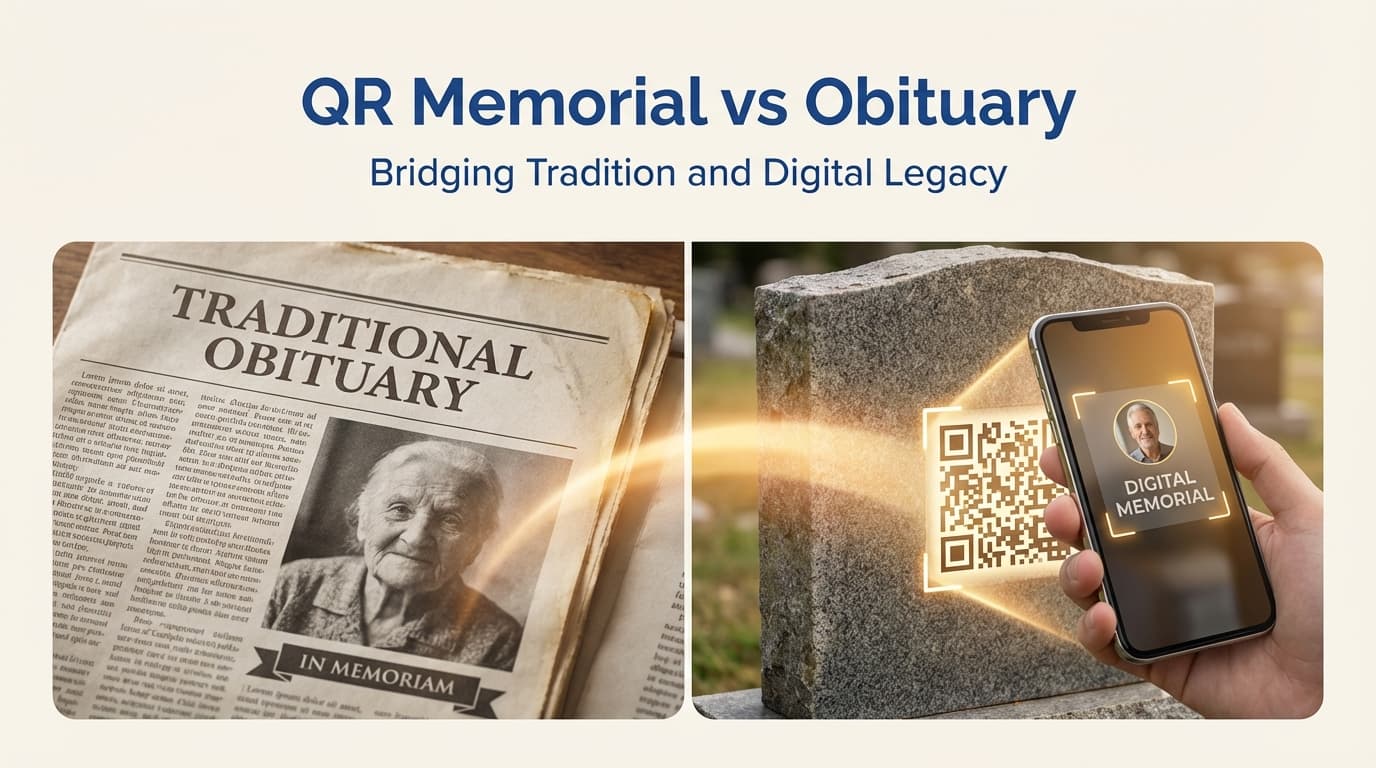
Side-by-side comparison of QR code memorials and traditional newspaper obituaries across key factors that matter to families.