
TL;DR
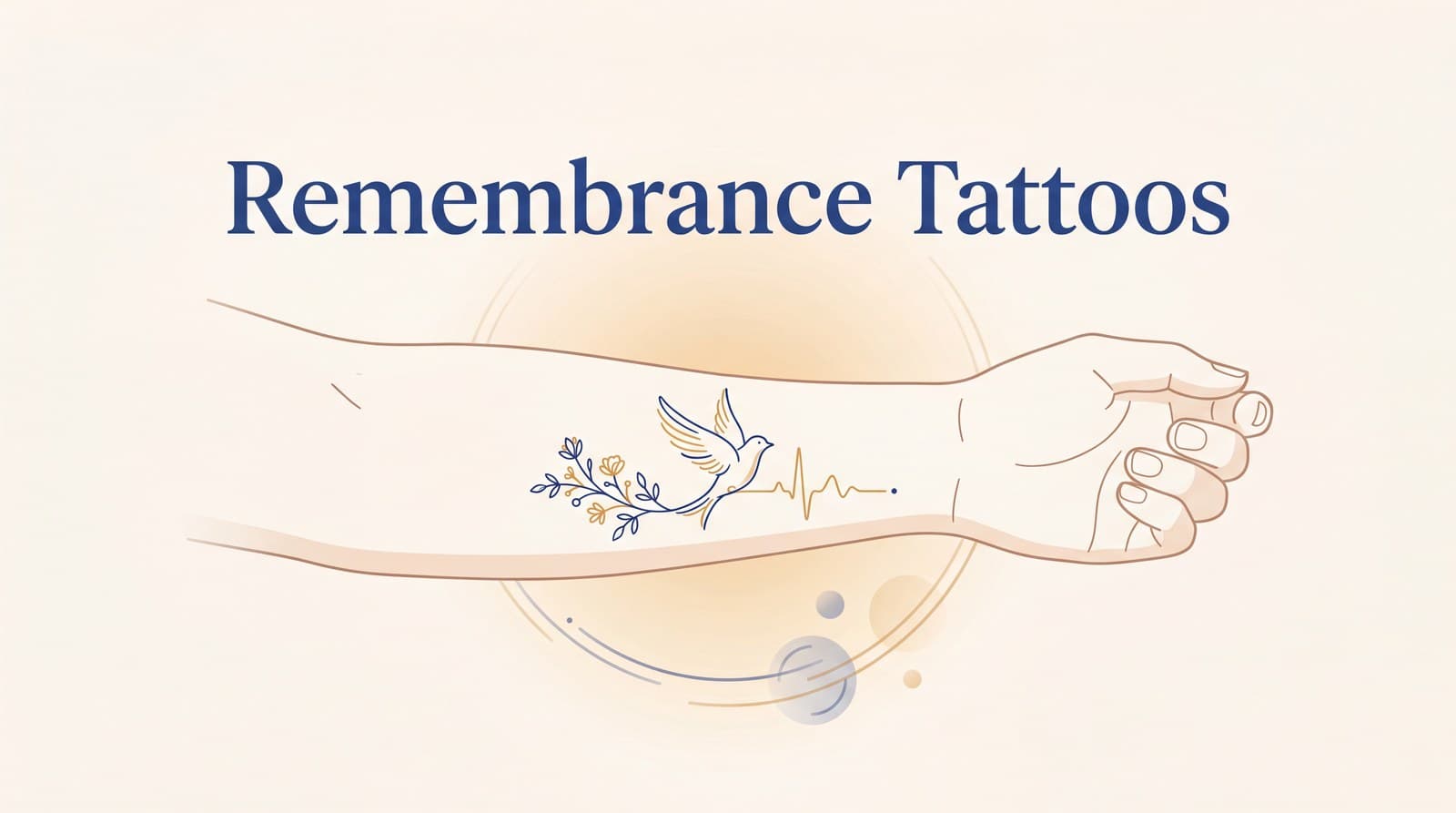
- Remembrance tattoos turn grief into something you carry with you — a permanent, personal tribute to a loved one who has passed.
- The most meaningful designs are personal: handwriting, portraits, dates, coordinates, birth flowers, and symbols that meant something to the person you lost.
- Popular styles include fine-line and minimalist, realism portraits, script lettering, and watercolor — each carries a different emotional tone.
- Cremation-ash (or “ritual”) tattoos blend a small, professionally processed amount of ashes into the ink, and are generally safe when handled by a specialist.
- A tattoo holds the feeling; a digital memorial holds the full story — photos, voice, and tributes that a QR code can link to the people you love.
Why People Choose Remembrance Tattoos
Grief doesn’t end at the funeral. It moves in long after the casseroles stop arriving, and for many people the urge to keep a loved one close becomes physical. That’s the quiet power of remembrance tattoos — they take something invisible, the ache of missing someone, and give it a permanent place on the body where you can see it, touch it, and carry it everywhere you go.
Tattoos are more mainstream than ever. Roughly a third of American adults now have at least one, and the number keeps climbing. Within that growth, memorial work has become one of the most requested categories in tattoo studios, because a remembrance tattoo does something a photo in a drawer can’t: it stays with you. It’s there on the anniversary, on the hard mornings, and on the ordinary Tuesday when a song on the radio brings everything rushing back.
If you’re still early in your grief and weighing different ways to honor someone, it’s worth seeing the full range of options first — our guide to meaningful ways to remember someone who has passed walks through tributes both big and small. A tattoo is one of the most personal of them all.
There’s no “right” time to get a remembrance tattoo. Some people get one within weeks; others wait years until they know exactly what they want. Both are valid. Grief has no schedule, and neither does honoring it.
Remembrance Tattoo Ideas by Meaning
The best remembrance tattoos aren’t pulled from a flash sheet — they’re built from the specific, irreplaceable details of one person’s life. Here are categories of designs to spark ideas, organized by what they symbolize.
1. Handwriting and Signatures
One of the most moving options is to tattoo a loved one’s actual handwriting — a signature, a note that ends in “love you,” a recipe card, or a single word in their own hand. A tattoo artist can trace it directly from a photo or scan so the lines are truly theirs. Nothing else captures a person’s presence quite like seeing their handwriting on your skin.
2. Portraits and Faces
Realism portraits are the boldest tribute — a likeness of your loved one rendered in fine detail. These are technically demanding and best left to artists who specialize in portrait work, but done well, they’re breathtaking. Some families choose a softened, illustrative version rather than a photorealistic one, which can feel gentler and ages better over time.
3. Dates, Names, and Coordinates
Sometimes the simplest design says the most. A birth date and a passing date, a name in elegant script, Roman numerals, or the GPS coordinates of a place that mattered — a childhood home, a wedding venue, a favorite shoreline. Coordinate tattoos are quietly personal: only you know exactly where they point.
4. Birth Flowers and Botanicals
Each month has a birth flower — January’s carnation, April’s daisy, October’s marigold — and a small botanical can honor someone without a single word. Flowers also carry their own symbolism in remembrance; forget-me-nots, lilies, and roses each tell a slightly different story. If you’re drawn to floral meaning, our guide to flowers that represent death and remembrance can help you choose one with intention.
5. Symbols and Shared Passions
A fishing lure for a dad who loved the water. A treble clef for a musician. A tiny airplane, a paw print, a sports emblem, a faith symbol. The most personal remembrance tattoos often skip names entirely and instead capture who the person was through the things they loved.
6. Quotes and Lyrics
A line they always said, a verse that comforted you, a lyric from the song played at their service. Script tattoos let the words themselves become the tribute. If you’re searching for the right phrasing, browse our collection of comforting grief quotes — many translate beautifully into a small, meaningful piece.
7. Heartbeats and Soundwaves
Soundwave tattoos convert a real audio clip — a voicemail saying “I love you,” a laugh, a few sung notes — into a visual waveform. A heartbeat (EKG) line can echo the same idea. These are deeply personal because the design is literally drawn from a sound only your family would recognize.
American adults now have at least one tattoo — and memorial work is among the most requested categories in studios today
Choosing a Style That Fits the Feeling
The style you choose shapes the emotional tone of a remembrance tattoo as much as the subject does. Here’s how the most popular approaches feel in practice.
| Style | Best For | Emotional Tone |
|---|---|---|
| Fine-line / minimalist | Dates, small symbols, single words, birth flowers | Subtle, quiet, understated |
| Realism portrait | Faces, photographic likenesses | Bold, powerful, present |
| Script / lettering | Names, quotes, handwriting, lyrics | Intimate, personal, timeless |
| Watercolor | Florals, birds, abstract color washes | Artistic, soft, hopeful |
| Traditional / neo-traditional | Roses, banners, symbolic icons | Classic, durable, statement-making |
If you’re honoring a parent specifically, the design language often shifts toward strength and gratitude — our deep dive on memorial tattoos for dad collects dozens of ideas that translate to grandfathers, fathers, and father figures alike.
Where to Place a Remembrance Tattoo
Placement is part of the meaning. Some people want their tribute where they’ll see it constantly; others prefer a private spot they reveal only when they choose to.
- Forearm or inner wrist: Highly visible to you throughout the day — a constant, comforting reminder.
- Chest, over the heart: The most symbolic placement, and a private one.
- Upper arm or shoulder: Room for larger portraits or detailed scenes.
- Behind the ear or back of the neck: Small, discreet, easily covered.
- Ribcage: Intimate and personal, often chosen for longer quotes.
A gentle note: Fine-line and small lettering can blur or fade over the years, especially on high-friction areas like the hands and feet. Ask your artist how a design will age before you commit — a slightly larger, simpler version often stays beautiful far longer.

A quick visual guide to remembrance tattoo ideas, styles, and placements.
Cremation-Ash Tattoos: A Deeper Tribute
For some families, the most profound option is to incorporate a small amount of a loved one’s cremated remains directly into the tattoo. Often called cremation-ash tattoos, “ritual” tattoos, or commemorative ash tattoos, these blend a carefully processed, fine portion of ashes into the ink before it’s applied.
Here’s how it works in practice. A specialist processes the ashes to a very fine, consistent particle size — reputable services filter to roughly 40 microns — so the material disperses smoothly into the ink rather than clumping. The artist then mixes that small amount into the pigment and tattoos as usual.
On safety: because cremation occurs at temperatures up to around 1,800°F, the resulting ashes carry essentially no risk of infection or disease on their own. The real safety factor is handling. The ashes must be processed and mixed in a clean, sterile environment, and the work should only be done by an artist who specializes in cremation tattoos. This is not the time to improvise at home or with an inexperienced studio.
Only a small amount of ashes is needed for a cremation tattoo, which means it can comfortably coexist with other tributes. Many families set aside a portion for ink and still keep ashes for scattering or keepsakes. If you’re deciding how to divide remains, our guide to what to do with cremation ashes covers seventeen meaningful options.
Ash tattoos sit alongside other “keep them close” tributes like memorial jewelry such as cremation rings, which hold a tiny amount of ashes in a wearable piece. The instinct behind both is the same — to keep a physical connection to someone you can no longer hold.
How to Plan a Remembrance Tattoo You’ll Love
A tattoo is permanent, and grief is fluid — which is exactly why a little planning makes the result feel right for years. Here’s a simple roadmap.
- Start with meaning, not aesthetics. Write down what you want to remember most about the person. The design should follow the feeling, not the other way around.
- Gather source material. Find the handwriting sample, the photo, the date, the lyric, or the audio clip you want to base it on. The more authentic the source, the more personal the result.
- Match the artist to the style. Portrait realism, fine-line script, and cremation-ash work are all specialties. Look at a portfolio of memorial pieces specifically, not just general tattoos.
- Consider how it will age. Ask about size, line weight, and placement so the piece stays legible and beautiful over decades.
- Give yourself permission to wait. If you’re not sure, a temporary or drawn-on version can help you live with the idea before it’s permanent.
Grief support and tribute planning go hand in hand. If the process stirs up more than you expected, that’s normal — understanding the stages of grief can help, and professional grief counseling is always a healthy step, not a last resort.
A Tattoo Holds the Feeling. A Digital Memorial Holds the Story.
Here’s something every grieving family eventually discovers: a tattoo is a powerful symbol, but a symbol can’t hold a whole life. It can’t store the voicemails, the hundreds of photos, the video of them laughing, or the stories that only get richer when the whole family adds to them. That’s where a remembrance tattoo and a digital memorial work beautifully together.
With Linkora, you can create a digital memorial page that gathers photos, videos, written tributes, and family history in one private, family-controlled place. Linkora has already helped more than 500 families preserve over 12,000 photos, with 98% caretaker satisfaction — and no app is required for anyone to visit.
The connection point is a QR code memorial: a small code that can be etched onto a headstone, plaque, or keepsake, so anyone who scans it is taken straight to the full living tribute. Your tattoo keeps your loved one close to your heart. The digital memorial keeps their whole story alive for the people who come after — privacy-first, and entirely in your family’s control.
Frequently Asked Questions About Remembrance Tattoos
What is a remembrance tattoo?
A remembrance tattoo is a tattoo created to honor and memorialize a loved one who has died. It can feature their name, dates, handwriting, portrait, a meaningful symbol, or even a small amount of their cremated ashes blended into the ink. The purpose is to keep their memory close in a permanent, personal way.
Are cremation-ash tattoos safe?
Generally, yes — when done by a specialist. Because cremation reaches temperatures around 1,800°F, the ashes themselves pose virtually no risk of infection. The key is proper handling: the ashes must be finely processed and mixed with ink in a clean, sterile environment by a tattoo artist experienced in cremation tattoos. Always choose a specialist rather than improvising.
How soon after a loss should I get a remembrance tattoo?
There’s no correct timeline. Some people get a tattoo within weeks as part of their grieving; others wait years until the right design becomes clear. Both are healthy. If you’re unsure, give yourself time — a meaningful tattoo is worth getting right rather than getting fast.
What are the most meaningful remembrance tattoo ideas?
The most meaningful designs are the most personal: a loved one’s actual handwriting or signature, their portrait, significant dates or GPS coordinates, their birth flower, a symbol of something they loved, a quote they always said, or a soundwave from a voicemail or laugh. Personal details almost always outlast generic designs in emotional value.
Can a remembrance tattoo be paired with a digital memorial?
Yes, and they complement each other well. A tattoo is a private, permanent symbol you carry; a digital memorial preserves the full story — photos, videos, voice, and tributes — that a symbol can’t hold. With a platform like Linkora, a QR code can connect a physical memorial to a living online tribute your whole family can add to over time.