
TL;DR
- Smart headstones use QR codes, NFC chips, augmented reality, and solar-powered displays to transform traditional gravestone markers into interactive digital memorials.
- QR code headstone adoption has increased 25% since 2020, and 70% of modern cemeteries now use some form of digital technology in their operations.
- Families can preserve photos, videos, stories, and tributes on smart headstones for graves, accessible to anyone with a smartphone – no app required.
- The cemetery software market is valued at $2.13 billion in 2024 and projected to reach $3.66 billion by 2034, signaling massive industry growth.
- This guide covers every type of smart headstone technology, costs vs. traditional headstone prices, and how to choose the right option for your family.
How Smart Headstones Are Changing Cemetery Memorialization
For centuries, headstones have served a single purpose: marking where someone rests and displaying a few lines of text. A name, two dates, and maybe a short verse. But what if those traditional gravestone markers could do so much more? What if they could share an entire life story with anyone who visits?
That is exactly what smart headstones are making possible. Across the United States, cemeteries are embracing technology that turns static monuments into living, breathing tributes. According to recent industry data, 70% of modern cemeteries now use digital mapping and GIS software, and QR code headstone adoption has increased 25% since 2020. The cemetery software market alone is valued at $2.13 billion and growing at a 5.6% compound annual growth rate.
Whether you are a family exploring options for headstones with QR codes, a monument dealer looking to expand your services, or a cemetery administrator curious about modernization, this guide covers everything you need to know about the future of headstones and cemetery memorialization.
What Are Smart Headstones?
Smart headstones are cemetery monuments enhanced with digital technology that connects physical gravestone markers to online content. Instead of limiting a memorial to what fits on a piece of granite, smart headstones link visitors to multimedia tribute pages featuring photos, videos, audio recordings, family trees, and written stories.
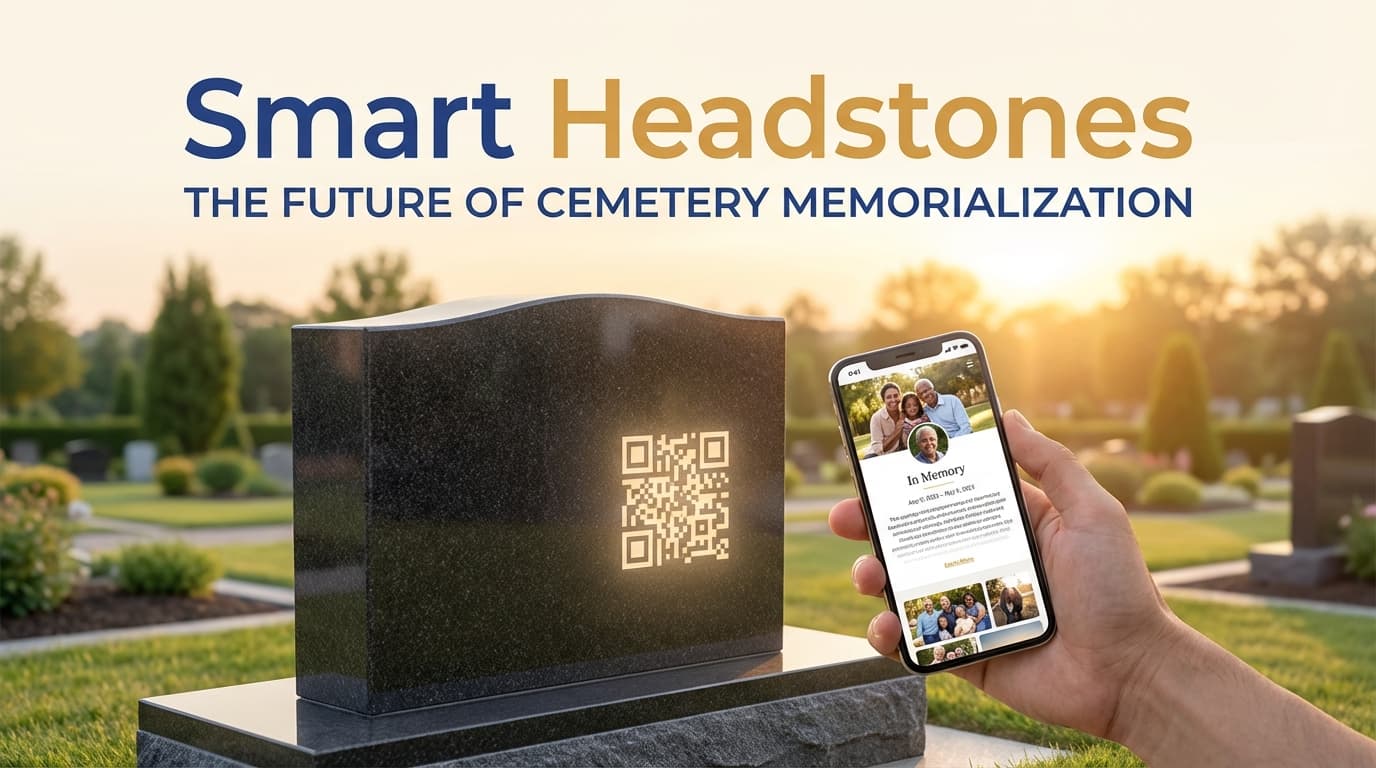
The concept is simple. A small piece of technology, whether a QR code, NFC chip, or AR-enabled marker, is embedded into or attached to the headstone. When a visitor interacts with it using their smartphone, they are taken to a digital memorial page that tells the full story of the person memorialized there.
Key Distinction: Smart headstones do not replace traditional monuments. They enhance them. A granite headstone with a QR code still looks like a classic memorial, but it offers visitors an entirely new way to connect with the person’s legacy.
There are four main types of smart headstone technology transforming cemeteries today:
QR Code Headstones: The Most Popular Smart Memorial Technology
QR codes are by far the most widely adopted technology for headstones. Small, weatherproof QR plaques, typically made from Grade 316 stainless steel with UV protective coating, are attached to or engraved into existing headstones for graves. When scanned with any smartphone camera, they link directly to an online memorial page.
The beauty of QR code headstones is their simplicity. There is no app to download. No special equipment needed. Almost everyone with a smartphone can scan the code and instantly access a rich, multimedia tribute. Families can include photos spanning decades, video messages from loved ones, written stories, and even a complete digital memorial with community features where friends and family contribute their own memories.
Companies like Linkora have made this technology accessible to any family. A QR memorial plaque can be added to an existing monument without any modifications to the original stone, making it one of the most affordable and practical smart headstone options available.
Increase in QR code headstone adoption since 2020, with growing demand from families seeking interactive memorials
NFC and Augmented Reality Memorials
Near Field Communication (NFC) chips take smart headstones a step further. Embedded directly into granite headstones or flat grave markers, NFC chips allow visitors to simply tap their phone against the monument to access digital content. No camera scanning required.
Augmented reality (AR) memorials represent the cutting edge of headstone technology. Using AR-enabled apps, visitors can point their smartphone at a monument and see digital content overlaid on the real world: biographical timelines appearing beside the headstone, video messages floating above the grave, or interactive 3D recreations of meaningful life moments. Companies like Digital Tombstone Solutions are launching AR-powered headstone experiences in 2026.
While AR headstones are still emerging, the technology is advancing fast. Imagine standing at a grandparent’s grave and watching their wedding video play right there beside their monument, or hearing their voice tell a favorite story through your phone’s speakers.
Solar-Powered Displays and Smart Materials
The newest frontier in smart headstones involves embedding actual digital displays into monument surfaces. Solar-powered lighting systems illuminate flat headstones and upright headstones at night, while weather-resistant screens can cycle through photos or display messages.
Smart materials are also entering the market. These include stones with integrated temperature sensors, self-cleaning coatings, and even materials that change appearance based on weather conditions. While these innovations are still in early stages, they point toward a future where headstones are truly intelligent objects, not just static stone.
3D printing is also reshaping how monuments are designed. Artisans can now create intricate, highly customized gravestone markers that reflect a person’s individuality in ways traditional carving never could. When combined with digital technology, 3D-printed monuments can incorporate hidden compartments for NFC chips, perfectly integrated QR code panels, and complex geometric designs that serve as AR markers.
Benefits of Smart Headstones for Families
The shift from traditional headstones to smart memorials is not about replacing what came before. It is about giving families more ways to remember and honor the people they love. Here is why families across the country are choosing smart headstones:
Unlimited storytelling. Traditional headstone prices buy you a limited amount of engraved text. Smart headstones remove that constraint entirely. Families can share hundreds of photos, hours of video, full written biographies, and contributions from everyone who knew the person. A digital memorial page connected to a smart headstone becomes a living archive that grows over time.
Multigenerational access. One of the most powerful aspects of smart headstones for graves is their ability to connect future generations to family history. Great-grandchildren who never met the person can scan a QR code and hear their voice, see their face, and learn their story. This kind of digital legacy preservation was simply not possible with traditional monuments.
Community engagement. Smart headstones create space for shared remembrance. Friends, former colleagues, distant relatives, and community members can all visit the digital memorial and leave their own messages, photos, and stories. This transforms a solitary cemetery visit into a communal experience of remembrance.
Privacy controls. Modern digital memorial platforms give families complete control over who can view and contribute to a memorial. Some families want their memorial open to anyone who scans the code. Others prefer password protection or invitation-only access. Smart headstone platforms like Linkora offer granular privacy settings that put the family in charge.
Trusted by Families: Linkora is trusted by 500+ families with 12,000+ photos preserved and 98% caretaker satisfaction. No app required. Visitors simply scan a QR code etched into the monument to access the full digital memorial.
How Monument Dealers and Cemeteries Are Adopting Smart Technology
The smart headstone movement is not just family-driven. Monument dealers, funeral homes, and cemetery administrators are recognizing the business opportunity and operational benefits of embracing digital technology.
About 45% of cemeteries in the United States now use some form of management software, and that number is climbing. Digital records reduce administrative search time by 40%, GPS-enabled cemetery maps help visitors find exact grave locations from their phones, and cloud-based platforms streamline everything from plot sales to maintenance scheduling.
For monument dealers looking to differentiate their offerings, smart headstones represent a significant revenue opportunity. Adding QR code memorials or NFC-enabled markers to their product lineup requires minimal investment but opens up an entirely new service category. Many dealers are now partnering with digital memorial platforms to offer technology-enhanced memorial packages that bundle traditional stonework with digital features.
The funeral and death care services market was valued at $82.61 billion in 2026 and is projected to reach $112.70 billion by 2035. Within that market, cemetery technology is one of the fastest-growing segments. Monument dealers who adopt smart headstone technology now are positioning themselves at the forefront of this transformation.
| Feature | Traditional Headstones | Smart Headstones |
|---|---|---|
| Content Capacity | Name, dates, short verse | Unlimited photos, videos, stories |
| Visitor Interaction | View only | Scan, contribute, share |
| Updateable | No (requires re-engraving) | Yes (update digital content anytime) |
| Accessibility | In-person only | Accessible from anywhere online |
| Family Tree | Not possible | GEDCOM import, interactive family trees |
| Privacy Controls | Public by default | Customizable (public, private, invitation-only) |
How to Choose the Right Smart Headstone
If you are considering a smart headstone for a loved one, here is a practical guide to making the right choice. The options can feel overwhelming, but the decision comes down to a few key factors.
Step 1: Decide on the technology. QR codes are the most affordable and widely compatible option. They work with any smartphone, require no special apps, and can be added to existing headstones. NFC chips offer a more seamless tap-to-access experience but require closer proximity. AR features are the most immersive but currently the most expensive and least widely supported.
Step 2: Consider material and durability. Whether you are looking at granite headstones, flat grave markers, or upright monuments, make sure the smart technology component is rated for outdoor use. Look for Grade 316 stainless steel QR plaques with UV protective coating. These are designed to withstand rain, heat, cold, and years of sun exposure without fading or becoming unreadable.
Step 3: Evaluate the digital platform. The technology on the headstone is only as good as the platform behind it. Ask about data longevity (will the memorial page still exist in 20 years?), storage capacity, privacy options, and ease of use for family members who are not tech-savvy. Platforms like Linkora are designed specifically for memorial pages with family-friendly interfaces and long-term digital preservation in mind.
Step 4: Check cemetery regulations. Before purchasing any smart headstone technology, confirm with the cemetery that it is permitted. Most cemeteries allow QR plaques and NFC chips since they do not alter the monument’s appearance significantly. Some cemeteries have specific guidelines about plaque size, placement, and attachment methods.
Step 5: Compare headstone prices with digital add-ons. Traditional headstone prices vary widely based on material, size, and design. Adding smart technology typically costs a fraction of the monument itself. A QR memorial plaque might add $50 to $200 to the overall cost, while a full NFC or AR setup could range from $200 to $1,000+ depending on the complexity.
Pro Tip: If you already have a traditional headstone in place, you do not need to replace it. QR memorial plaques from Linkora can be attached to any existing monument, bench, or urn, making it one of the most accessible and affordable ways to create a lasting tribute without major investment.

A visual comparison of smart headstone technologies: QR codes, NFC chips, and augmented reality memorials.
The Future of Cemetery Memorialization
Smart headstones are just the beginning. The convergence of memorial traditions and technology is accelerating, and several emerging trends point toward an even more connected future for cemetery memorialization.
Holographic memorials. Researchers are developing holographic display technology that could project life-sized images of the deceased at their gravesite. While still in early development, holographic memorialization using photogrammetry and 3D rendering is already being tested at select cemeteries.
AI-powered digital avatars. Some startups are exploring AI-driven memorial experiences where visitors can interact with a digital representation of the deceased. Using voice recordings, written correspondence, and family-provided context, these systems aim to create conversational avatars that can answer questions and share stories.
Green burials with integrated technology. As eco-conscious burial practices grow in popularity, smart technology is finding its way into natural burial settings. Biodegradable markers with embedded NFC chips and solar-powered memorial lights that leave no permanent environmental footprint represent the intersection of sustainability and digital remembrance.
Connected cemetery networks. Forward-thinking cemeteries are building digital infrastructure that connects every grave in their grounds. Visitors can use GPS-guided apps to navigate to specific plots, access historical records, and discover connections between people buried nearby. These “smart cemeteries” transform the entire grounds into a searchable, interactive archive of community history.
The global death care market is projected to reach $112.70 billion by 2035, and technology-driven memorial services are among the fastest-growing segments. For families, this means more options than ever for creating meaningful, lasting tributes that truly reflect a person’s life.