
TL;DR
- The most thoughtful sympathy gifts do one of two things well: ease an immediate burden, or give a family something meaningful to hold onto.
- Match the gift to your closeness with the family. Casual contacts send food, flowers, or a card. Close friends and family can send keepsakes, memorial jewelry, or a personalized tribute.
- Use the “Rule of Threes”: a gesture at three days, three weeks, and three months. Grief outlasts the casserole window by years.
- Practical gifts (meals, gift cards, errand help) almost never miss. Personalized keepsakes (photo books, engraved items, digital memorial pages) become anchors families revisit for decades.
- A growing alternative to flowers is a digital memorial page the whole family can contribute to, accessible by QR code or simple link — built once, treasured forever.
Why sympathy gifts matter more than people think
When someone you care about loses a loved one, the instinct is universal: I want to help, but I don’t know what to send. That hesitation often turns into nothing — no card, no meal, no acknowledgment — because the giver is afraid of saying the wrong thing or sending the wrong gift. The cost of that silence is real. Grieving families consistently say the hardest part of loss isn’t the first week, when the calls and casseroles arrive. It’s the months that follow, when the world moves on and they don’t.
A sympathy gift, done with care, is a small but durable signal that says: I see you. I haven’t forgotten. Your person mattered. It doesn’t have to be expensive. It doesn’t have to be elaborate. It just has to be sent. If you’re still working out what to put inside a card, our guide to meaningful sympathy and condolence messages pairs perfectly with anything you send. And if you’re frozen on what to even say first, start with what to say when you don’t have the words.
The two-lane rule. Every great sympathy gift falls into one of two lanes: comfort (making the next day, week, or month easier to survive) or remembrance (giving the family something that helps them carry the person forward). When in doubt, pick a lane, and pick the gift inside it that suits how close you are to the family.
How to pick the right sympathy gift
Before you scroll any list of ideas, answer two quick questions. The answers will narrow your choices in seconds and keep you from sending something well-meaning that lands wrong.
1. How close are you to the family?
Closeness should shape what you send. An overly personal gift from a distant acquaintance can feel intrusive. A generic basket from a close friend can feel hollow. Use this rough match:
2. Where is the family in their grief?
Think in seasons, not hours. In the first week, the kindest gifts are the simplest — meals, grocery delivery, childcare coverage, a ride to the funeral home. In the weeks after, what helps is steadier support: errands, a check-in, a small reminder that you haven’t forgotten. Months later, what families say they treasured most are the gestures that arrived after everyone else stopped reaching out.
Reach out at three days, three weeks, and three months. It’s the single most underused rule in sympathy giving.
The best sympathy gifts in 2026, organized by what they do
Here are the categories that consistently land well with grieving families, drawn from funeral-industry guidance and what bereaved families themselves say they remembered most. Within each, you’ll find a “best for” note so you can pick fast.
1. Meal and food gifts
Almost nothing is more universally welcome in the first two weeks after a loss. Grieving people forget to eat. Houses are full of relatives who also forget to eat. A meal that requires zero decisions is a small miracle.
- Meal delivery gift cards (DoorDash, Uber Eats, Grubhub) — $50–$150. Lets the family eat what they want, when they want, without coordinating with anyone.
- Prepared meal services (Spoonful of Comfort, Magic Spoon, local options) — soup, chicken pot pie, lasagna. Often arrives within 1–2 days.
- Grocery gift cards — $50–$200. Lower-pressure than a meal delivery, and useful for the household for weeks.
- A meal train — coordinate with mutual friends so the family isn’t getting seven lasagnas on Tuesday and nothing on Friday. MealTrain.com and TakeThemAMeal.com make this simple.
Best for: Anyone, any closeness level. Almost impossible to get wrong.
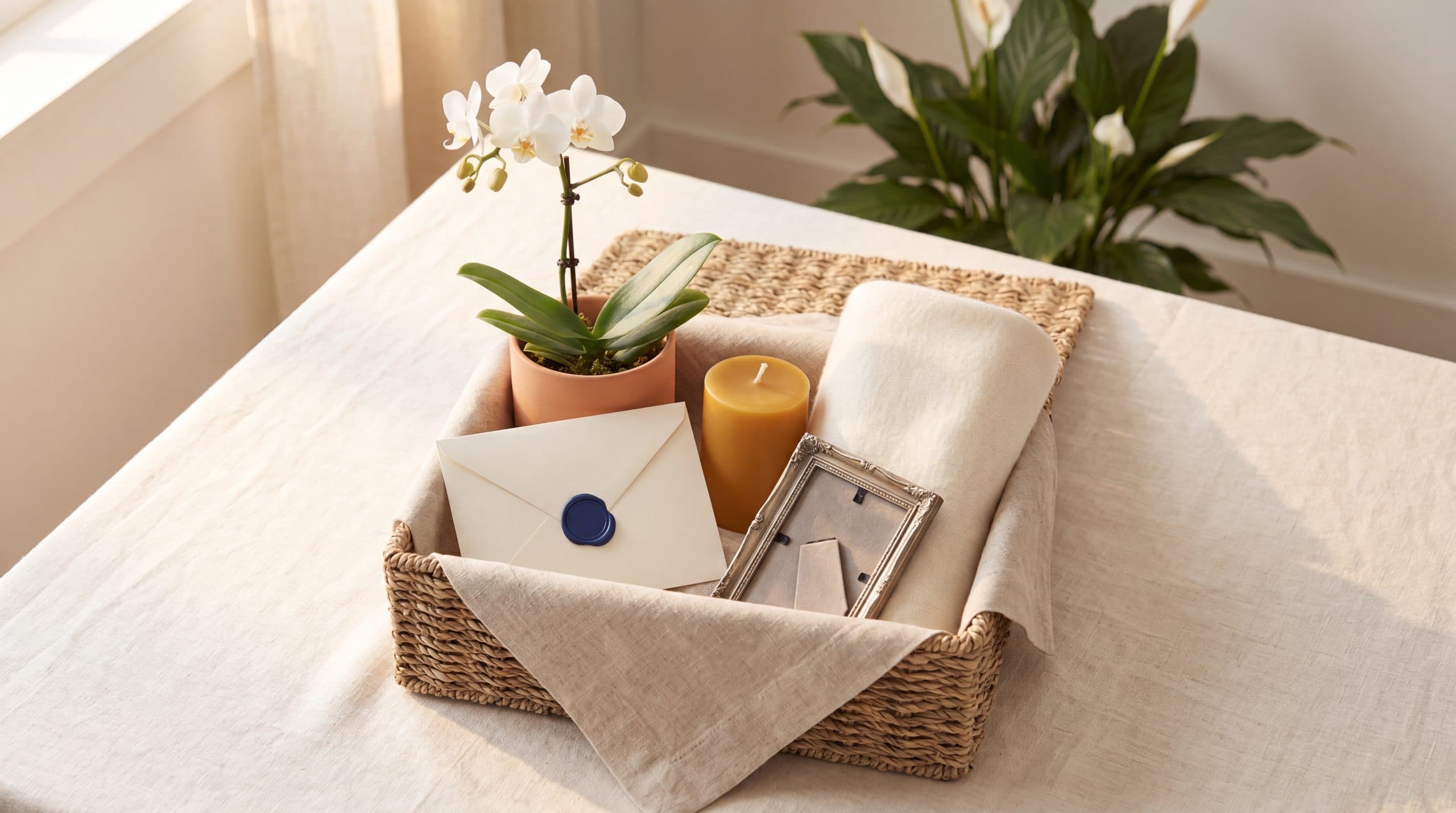
2. Care packages and comfort baskets
Care packages do double duty: they meet the body’s needs (warmth, tea, tissues) while signaling that someone is thinking of the person. Keep them practical, not performative.
- A soft throw blanket, cozy socks, or a sweatshirt in a neutral color
- Tea or coffee they actually drink (not a sampler — a real bag)
- A box of soft tissues, unscented lotion, a candle (unscented or very subtle)
- A journal, a fresh pen, and a short note saying it’s there if and when they want it
- A handwritten card — always. Pair it with our guide to sympathy cards if you’re unsure what to write.
Best for: Close friends, work groups pooling a gift, neighbors. Spend $40–$120 depending on contents.
3. Flowers, plants, and living memorials
Flowers are the default sympathy gift for a reason — they’re easy to send, universally recognized, and beautiful. The drawback is they don’t last. Living plants and trees solve that.
- White orchid — elegant, lasts months to years, low maintenance once you understand it
- Peace lily — the classic sympathy plant; thrives in low light
- Memorial tree — services like A Living Tribute plant a tree in a national forest in the person’s name
- Bonsai — a meaningful, sustained-care plant for a close family member
- Seasonal cut arrangement — still entirely appropriate. Avoid bright reds or overly cheerful palettes; whites, soft pinks, blues, and greens read as respectful.
Cultural note. Jewish mourning traditions generally don’t include flowers at the funeral or during the shiva period. If you’re unsure of the family’s customs, a meal delivery, a charitable donation in the person’s name, or a handwritten note is always a safe choice.
4. Personalized memorial keepsakes
This is the lane for closer relationships. Keepsakes are gifts the family will keep, look at, hold, and revisit. Done well, they become permanent fixtures in the home.
- Photo books — a curated collection of photos, ideally with one or two short captions per page. Services like Artifact Uprising, Shutterfly, and Mixbook handle the printing beautifully.
- Engraved keepsake box — for holding cards, photos, small mementos. Name, dates, sometimes a short phrase.
- Garden memorial stone — a stone with the person’s name placed in a garden bed
- Custom portrait or framed photograph — choose a photo the family already loves rather than commissioning something new
- Memorial wind chimes — often engraved, often paired with a verse. The sound becomes a gentle prompt of presence.
- Memorial jewelry — necklaces, bracelets, or memorial jewelry that holds their story, including pieces that incorporate a small amount of cremated remains or a lock of hair.
Best for: Close friends and family. Match the level of intimacy of the keepsake to the closeness of your relationship.
5. Digital memorial pages and QR memorials
This is the fastest-growing category of sympathy gift in 2026, and for good reason. Photos sit in albums. Stories live in people’s heads. A digital memorial page collects both in one place that the whole family can contribute to, accessible by QR code or a simple link.
Unlike a one-time gift, a digital memorial is something the family can keep adding to over years — a new photo on the anniversary, a story their child shares at 16, a video of the grandchildren. It’s also a unique alternative to flowers: a Linkora memorial page lets distant friends contribute a tribute even if they can’t make the service. If you’re new to the concept, our guide to what a digital memorial actually is walks you through the basics, and create a personal digital memorial page shows what setting one up actually looks like.
6. Charitable donations
A donation in the deceased’s name is one of the most respectful, no-misstep options when you don’t know the family well, when they’ve publicly asked “in lieu of flowers,” or when the person had a clear cause they cared about. A few guidelines:
- Always tell the family in writing that you donated — most charities will also send a notification card
- Don’t specify the dollar amount in the card
- Choose a cause that genuinely connects to the person, not just one you happen to support
- Hospice organizations, research foundations tied to the illness, animal shelters, faith communities, and the person’s alma mater are all common, well-received choices
7. Practical “errand” gifts
The most underrated category. Grief is administratively brutal — there’s paperwork, accounts to close, a house full of people, often kids to feed. Anything that absorbs even one task is a real gift.
- House cleaning service for a month
- Lawn care or snow removal for the season
- Gas station or rideshare credit (multiple trips to the funeral home, lawyer, family events)
- Childcare for a weekend, or paid summer-camp tuition for one week
- A “paperwork organizer” — a folder, stamps, pre-addressed envelopes, a roll of postage
- Dog walking or pet boarding
Best for: Close friends, family, and tight-knit groups. These take a small load off and never feel intrusive.
Sympathy gifts by relationship to the deceased
Some gift ideas only fully land when you’re thinking about which loss the family is grieving. Here are the relationships people most often want to support, with gifts that fit.
For someone who lost their mother
This is one of the hardest losses to give a gift for, because nothing replaces a mother. The goal is to gently signal her presence in the family’s life going forward. A framed handwriting print (a recipe in her writing, a note she signed), a piece of jewelry with her birthstone, or a custom photo book of mother-and-child moments tends to land well. Our deep guides on remembrance gifts for someone who lost their mother and condolence messages for the loss of a mother go further on this.
For someone who lost their father
Adult children grieving a father often appreciate gifts that honor a specific shared interest — a custom map of his hometown, a print of his favorite team’s stadium, a memorial tree in a park he loved, a framed photo from one of their best days together. For language to send alongside the gift, see sympathy messages for the loss of a father.
For a friend who lost a partner or spouse
Spousal loss is uniquely disorienting because it reshapes everyday life — meals, sleep, finances, the rhythm of evenings. Practical gifts (meal services, house cleaning, lawn care) carry the day for the first month. Beyond that, a sustained presence — weekly walks, regular calls, a standing dinner — is the gift no store can sell.
For a coworker
This is where group gifts shine. A pooled basket signed by the team, a group meal delivery, or a shared digital memorial page contribution all express collective care without anyone overstepping. If you’re sending individually, keep it modest — a handwritten card and a meal credit are usually exactly right.
For a family who lost a child
The hardest category. There are no “right” gifts here, only sustained presence. Memorial keepsakes — a star named for the child, a custom blanket with their name, a piece of jewelry that holds a fingerprint — are sometimes treasured. A simple “I’ll be at your door Saturday with dinner, no need to reply” is often more valuable than any object.
One rule above all: Say their name. In the card, on the gift, in the message. Grieving people fear the world is forgetting their person. Using the name is the gift.

Linkora sympathy-gift framework: pick a lane, match it to closeness and stage, send within two weeks, follow up at three months.
Sympathy gift etiquette: timing, delivery, and the things to avoid
When to send
If you can, send within two weeks of hearing about the loss. That said, sympathy gifts have no real expiration date — a late gift is far better than no gift, and many families say later gifts mean more because they arrive after everyone else has moved on. If you missed the funeral entirely, send something for the one-month, three-month, or first-anniversary marker. Our piece on meaningful ways to honor a death anniversary is full of ideas tailored to those later moments.
Where to send
The family’s home is almost always right. The funeral home is the right destination only for floral arrangements timed for the service. Avoid sending bulky baskets to a service unless the family has explicitly asked.
What to avoid
- Anything that implies a timeline for grief. “Hope you’re feeling better soon” lands harder than people realize. Use “thinking of you” instead.
- Strongly scented anything. Heavy perfumes in candles, soaps, or lotions can be overwhelming during a sensitive time.
- Religious gifts when you’re not sure of the family’s faith. A cross necklace is meaningful to some families and unwelcome to others. When unsure, choose a universal keepsake.
- “Cheering up” gifts. Funny mugs, balloon arrangements, and bright-color bouquets feel discordant in the first weeks.
- Saying nothing at all. The most common sympathy mistake by far. Even an imperfect note is far better than silence.
A simple 5-step plan for sending a sympathy gift well
- Decide your lane. Comfort (food, errands, care) or remembrance (keepsakes, photo books, a memorial page).
- Match the closeness. Use the relationship table above to pick a budget and a level of personalization that fits.
- Add a handwritten note. A specific memory or a sentence that names the person beats any printed card. Browse how to write a heartfelt tribute if you want a longer-form keepsake message.
- Time it to a season of grief. If you’ve missed the first wave, aim for the second — three weeks, three months, or the first anniversary.
- Follow up once. A single low-pressure check-in two to three months later — a text, a walk invite, a “thinking of you on Mother’s Day” — outweighs almost any object.
When you want the gift to last forever: a digital memorial page
Most sympathy gifts are designed for the first weeks. A digital memorial page is built for the next 30 years. It collects photos, videos, stories, and tributes in one place — and lets distant family contribute alongside the people who lived next door. Many families pair it with a small QR-coded memorial plaque or marker so visitors at a graveside, a garden bench, or a celebration of life can scan in and add a memory on the spot. If you’re planning a celebration of life, a digital memorial doubles as a digital guest book that lasts forever.
Linkora’s platform was built specifically for this — private by default, family-controlled, no app required for visitors, and designed so even non-technical relatives can contribute. A digital memorial page given as a sympathy gift is one of the few gestures that grows in value every year the family holds onto it.
For monument dealers, funeral homes, and florists offering sympathy products
If you run a funeral home, monument company, florist, or memorial-gift store, “sympathy gift” search demand keeps climbing year over year — and it’s one of the highest-converting keywords in deathcare. Families now expect alternatives to flowers, and the families who buy keepsakes and memorial jewelry from you are the same families looking for a digital memorial layer to pair with the physical product. Linkora’s partner program gives B2B buyers a turnkey way to add a branded digital memorial component — plaques, QR signs, or a co-branded memorial page — to existing product lines.
Frequently asked questions
How much should I spend on a sympathy gift?
Match the spend to your closeness. Distant relationships: $20–$75. Coworkers, often pooled: $30–$100. Close friends and family: $50–$200. Immediate family or lifelong friends: $100–$500+. The amount matters far less than the thought — a $15 handwritten card with a specific memory often outweighs a $200 basket with no note.
Is it too late to send a sympathy gift weeks after the funeral?
No — and many families say later gifts mean more. The first two weeks are flooded; weeks three through twelve are quieter. A meal, a check-in note, or a memorial keepsake delivered later is often the gift the family remembers most.
What’s a good sympathy gift that isn’t flowers?
A meal delivery gift card, a care package, a personalized photo book, a memorial wind chime, a charitable donation in the person’s name, or a digital memorial page the whole family can contribute to. Each lands with a different tone — pick the one that matches your closeness and how the family processes loss.
What should I write in the card?
Use the person’s name. Share one specific memory if you have one. Avoid timelines (“you’ll feel better soon”) and clichés (“they’re in a better place” unless you know the family shares that belief). “Thinking of you. [Name] mattered to me because…” is a strong universal opener. We have 75+ heartfelt condolence message examples if you want to start from a template.
Can a digital memorial page really replace a physical sympathy gift?
It doesn’t replace, it complements. A digital memorial works alongside a card, plant, or meal — but unlike most gifts, it keeps gaining value over decades as the family adds photos, stories, and milestones. For close relationships, it’s one of the few gifts that becomes more meaningful each year, not less.
Whatever you send, send something. The smallest gesture, the imperfect note, the late lasagna — every one of them carries the same quiet message: your person mattered, and I’m still here. That message, more than the gift it arrives with, is what grieving families remember. Browse more meaningful ways to remember someone and memorial service songs for more ways to make a gift truly personal. If you’re attending the service itself, our guide to what to expect at a funeral wake covers etiquette and tone.