
TL;DR
- “Natural causes” is not a cause of death. It is a manner of death, one of five boxes a certifier ticks. It tells you what did not happen more than what did.
- It means the death came from disease or the ordinary failure of the body, with no contribution from injury, poisoning, or violence. Not even a small contribution.
- The actual cause is written separately, as a chain of conditions in Part I of the certificate, read from the bottom up.
- “Old age” is never an acceptable entry. Certifiers are required to name a specific disease, even for someone who died at 99.
- If the certificate says “pending,” nothing is wrong. Toxicology and tissue work commonly take six to eight weeks, and complex cases four to six months.
What “natural causes” actually means
Someone hands you a piece of paper, or reads you a line over the phone, and the words on it are natural causes. It sounds like an explanation. For most families it is the opposite: it closes a door without telling you what was behind it.
Here is the plain version. Natural causes means the death came about through disease or the body’s own failure, and nothing external pushed it along. No injury. No poisoning. No drug. No fall, no crash, no act by another person. That is the whole of it. The phrase describes a category, not a diagnosis.
The confusion is understandable, because “natural causes” is the only manner of death that sounds like it might also be a cause. Accident, suicide and homicide all clearly describe circumstances. Natural sounds like it describes biology. It does not. Two people can both be recorded as having died of natural causes and have almost nothing else in common: one at 34 from an undiagnosed heart condition, one at 91 after nine years with dementia.
Vocabulary is part of what makes the aftermath of a death so disorienting. If other terms on the paperwork are unfamiliar too, our short explainers on what deceased means, what bereavement means and what interment means cover the words that turn up most often, and there is a fuller funeral glossary on the main site.
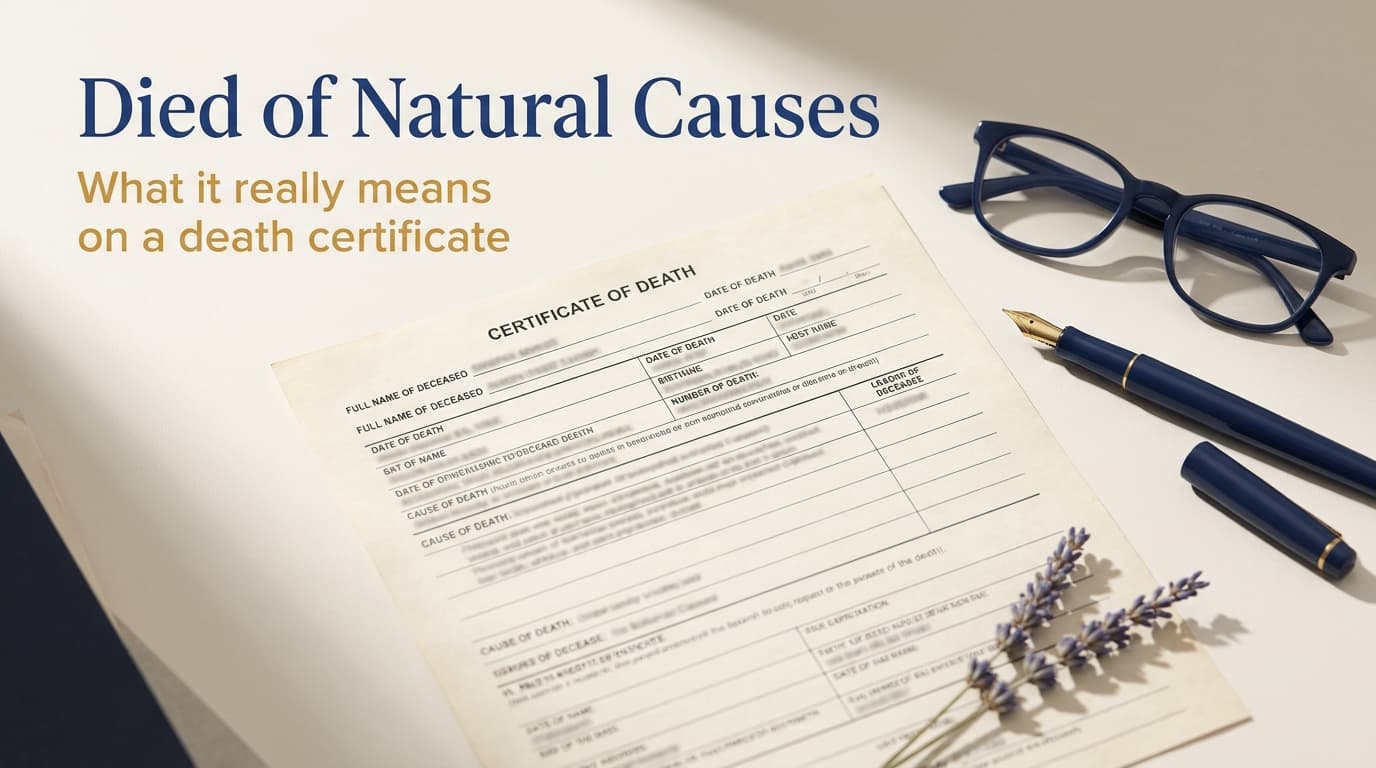
If you are holding a certificate right now and you want the actual cause, do not look at the manner box. Look at the block of lines a few inches above it, marked Part I. The lowest line that has writing on it is the condition that started everything. That is the answer you are looking for.
This guide walks through the whole document: what the manner box means, how to read the cause-of-death lines, who filled them in and why, what “pending” means, and the handful of situations where the exact wording turns out to matter practically. If you have not yet obtained the document itself, our guide on how to get a death certificate covers the ordering process and how many certified copies you are likely to need.
Natural causes is a manner of death, not a cause of death
Every death certificate in the United States asks two separate questions that sound like one question. What killed this person, and how did that come about. The first is the cause. The second is the manner. Natural causes answers only the second.
The five manners of death
In nearly every medicolegal jurisdiction in the country, the certifier picks from five options. There is no sixth.
| Manner | What it means | Extra detail required? |
|---|---|---|
| Natural | Death caused entirely by disease or the ageing body. No external factor contributed at all. | No |
| Accident | An unintentional injury or exposure, including most overdoses and falls. | Yes, a description of how the injury occurred |
| Suicide | Injury inflicted by the person with intent to end their own life. | Yes |
| Homicide | Death at the hands of another person. A medical finding, not a legal verdict. | Yes |
| Could not be determined | The evidence genuinely does not settle the question. Used sparingly. | Sometimes |
Two things about that table surprise most people. The first is that homicide on a death certificate is a medical classification, not an accusation. A forensic pathologist writing “homicide” is saying one person’s actions ended another’s life. Whether that was murder, manslaughter, self-defence or lawful is entirely for courts to decide, and the certifier has no role in it.
The second is how strict the natural category is. Guidance to certifiers is emphatic: if there is any contribution to the death from an external, unnatural factor, no matter how small, the manner should not be certified as natural. A woman of 92 with advanced heart disease who dies six weeks after breaking a hip in a fall has, in the language of the certificate, died of an accident. The fall started the chain. That classification often feels wrong to families, and it is worth knowing in advance that it is not a mistake or a slight.
Cause, mechanism and manner: three different questions
Forensic practice separates three ideas that everyday speech runs together. Getting them straight makes the whole document legible.
| Term | The question it answers | Example |
|---|---|---|
| Cause | What disease or injury brought this about? | Coronary artery disease |
| Mechanism | What physiological failure actually stopped life? | Cardiac arrhythmia |
| Manner | How did the cause come to happen? | Natural |
The mechanism almost never appears alone on a certificate, and that is deliberate. “Cardiac arrest” and “respiratory failure” are mechanisms. Every death involves one or the other, so writing them by themselves tells a public health statistician nothing. Certifiers are trained to push past the mechanism to the disease underneath. If you see “cardiac arrest” as the only entry on a certificate, that document was filled in poorly, and it is reasonable to ask for it to be revisited.
A single cause can sit under several different manners, which is exactly why the two fields exist. A gunshot wound is one cause of death. Whether it is an accident, a suicide or a homicide is a separate finding that depends entirely on circumstances the pathologist cannot see in the tissue.
How to read the cause-of-death section
The cause-of-death block on the US Standard Certificate of Death is the part families skip because it looks like a form. It is actually a short piece of writing, and it reads backwards.
Part I is a chain, read from the bottom up
Part I has four lines, labelled a through d. Line a holds the immediate cause, the final condition that directly produced death. Each line below it holds the condition that caused the line above. The lowest line with anything written on it is the underlying cause: the thing that started the whole sequence, and the entry that national mortality statistics are built from.
A real example, which reads oddly until you know the trick:
a. Aspiration pneumonia due to (or as a consequence of)
b. Dysphagia due to (or as a consequence of)
c. Alzheimer disease
Part II: Type 2 diabetes mellitus, chronic kidney disease
Read it upward and it becomes a story. Alzheimer disease led to difficulty swallowing, which led to food entering the lungs, which led to the pneumonia that ended her life. The manner box on this certificate says natural. The underlying cause, and the one that will appear in national statistics, is Alzheimer disease, not pneumonia.
Part II is everything else that mattered
Part II lists other significant conditions that contributed to the death but did not sit in the causal chain. Diabetes, hypertension, chronic kidney disease, COPD and obesity turn up here constantly. They made the person more fragile, or made treatment harder, without being the thing that started the sequence.
Families sometimes read Part II as an accusation, a list of everything that was wrong with someone. It is not. It is context, written for epidemiologists rather than for you.
Why “old age” will never appear
This is the single most common source of frustration with a certificate. Someone dies at 96 after a long, gentle decline, and the family expects the document to say so. It never will.
Federal guidance to certifiers is explicit that terms like senescence, infirmity, old age and advanced age have little value for public health or medical research, and that an elderly decedent should still have a clear, distinct causal sequence recorded wherever possible. Some state instructions put it even more bluntly and tell physicians not to report “old age,” “age 99” or “senile” at all. The reasoning is mundane rather than cold: age is already recorded elsewhere on the same form, so repeating it in the cause field adds nothing.
So when a doctor writes something specific for a very old person, they are not refusing to acknowledge that your mother simply grew old and tired. They are following a rule designed to make national mortality data usable. The certificate is a statistical instrument that happens to double as a legal record. It was never designed to describe a life.

Natural causes sits in the manner box. The actual cause is a chain of conditions read from the bottom up.
Who decides, and why some deaths go to the medical examiner
Two very different people can sign a death certificate, and which one signed yours explains a great deal about how much detail you got.
The attending physician
Most deaths in the United States are certified by the doctor who was already caring for the person. Someone with metastatic cancer under hospice care dies at home, and the physician who managed that care completes the cause-of-death section from what they already know. There is no investigation because none is needed. This is the ordinary path, and it is why the manner box on most certificates says natural. Non-medical-examiner physicians are only supposed to certify natural deaths in the first place.
If a death is expected and hospice is involved, the process is usually quiet and quick. Our guide to hospice care at home covers what happens in the hours immediately after, and the sounds and signs of the final days explains what many families witness but are never warned about.
The medical examiner or coroner
A separate set of deaths must be reported to a medicolegal authority regardless of what anyone thinks happened. The specific triggers vary by state, but the categories are consistent: any death by violence or injury, any sudden death of someone in apparent good health, any death without a physician in recent attendance, deaths involving drugs, deaths in custody, and anything that could pose a threat to public health.
Note the second category. A death can be entirely natural and still land in the medical examiner’s office simply because it was unexpected. A 54-year-old with no known heart condition who dies overnight will be investigated, and the finding may well be natural causes at the end of it. The investigation is not a suspicion of anything. A great many rulings of natural causes arrive at the end of a full medicolegal investigation rather than instead of one.
For families, the difference in experience is substantial. A referred death means a delay before the body is released, a delay before funeral planning can begin in earnest, and a period of not knowing that arrives on top of a sudden loss. Sudden deaths also carry a different weight of grief from expected ones, and what grief actually is and the stages people move through are worth reading if the shock has not yet settled.
Coroner and medical examiner are not the same office. A medical examiner is an appointed physician, usually a forensic pathologist. A coroner is often an elected official with no medical training who relies on contracted pathologists. Which system you get depends on your county, and it affects how much explanation a family receives.
What an autopsy does and does not settle
Fewer deaths are autopsied than most people assume. The share of US deaths autopsied fell from 19.3% in 1972 to 8.5% in 2007 and has kept sliding, reaching roughly 7.4% in 2020. Hospital autopsies, once performed on 40% to 60% of hospital deaths before 1970, are now rare. Those that do happen increasingly concentrate on deaths from external causes rather than disease, and the rate drops sharply with age: well under 5% for people who die in their seventies.
Share of US deaths autopsied in 2020, down from 19.3% in 1972
If a family wants an autopsy the medical examiner has declined, private services exist and generally cost several thousand dollars. That is occasionally the right call, but be clear-eyed about it: an autopsy answers what happened inside the body, not the question most families are really asking, which is whether anything could have been done differently.
What “pending” means, and how long it takes
A certificate that says the cause is pending is not a sign that something is wrong, that anyone suspects anything, or that a mistake has been made. It means the investigation is not finished, most often because laboratory results are outstanding.
Roughly 30% of medical examiner cases cannot be resolved immediately after examination, and the office orders microscopic, chemical or toxicological testing. Where drugs may have contributed, toxicology alone typically takes six to eight weeks. Amending the certificate afterwards commonly takes two to three months from the date of death, and genuinely complex cases can run four to six months.
Practically, this creates a real problem, because a great deal of the work after a death requires a certified copy. Most institutions will accept a pending certificate for the immediate steps: funeral arrangements, notifying Social Security, closing utility accounts. What often stalls is probate and insurance. If you are managing an estate, our guides to the executor’s role and to letters testamentary explain which steps can proceed without a final cause and which cannot.
One practical tip that saves families weeks of frustration: when the case is pending, ask the medical examiner’s office directly for the investigator’s name and case number, and ask what specifically is outstanding. Most offices will tell you. Waiting without knowing whether you are two weeks or four months out is far harder than waiting with a number.
What natural causes look like in practice
If natural causes means disease rather than injury, it is fair to ask which diseases. The answer is concentrated. In 2024, a total of 3,072,666 deaths were registered in the United States, 18,298 fewer than in 2023, and the age-adjusted death rate fell 3.8%. The three leading causes were heart disease with 683,037 deaths, cancer with 619,812, and unintentional injury with 196,488.
Heart disease and cancer alone account for roughly 42% of all deaths, and both are unambiguously natural. Unintentional injury, third on the list, is the largest category never certified as natural. COVID-19 left the top ten in 2024, and suicide entered it at tenth.
That distribution is why the natural box is ticked so often. Most Americans die of chronic disease, at the end of a decline that a physician was already watching, and that is exactly the pattern that produces a finding of natural causes with no investigation at all. For families in that situation, the certificate rarely holds surprises. The difficulty is usually not the medicine but the grief that arrives with it, and anticipatory grief after a long illness has its own particular shape, distinct from the shock that follows a sudden death.
When the exact wording matters
For most families the certificate is a formality. In a few situations the words on it carry real weight, and it is worth knowing which ones before you need to.
Life insurance and the contestability period
Almost every US life insurance policy has a contestability period, normally the first two years after the policy takes effect. If death occurs within that window, the insurer is entitled to investigate the application before paying, and it will read the death certificate closely.
A finding of natural causes helps, but it is not a guarantee. Denials during contestability usually come from material misrepresentation on the original application rather than from anything about the death itself. An insurer that finds an undisclosed condition on an old application can contest the claim even when the death was plainly natural. After two years, claims are rarely challenged, though named policy exclusions still apply. If a claim is denied and you believe the certificate was read wrongly, that is a moment for a lawyer rather than a phone call.
Getting a certificate corrected
Certificates do contain errors, and they can be amended. Factual errors such as a misspelled name or a wrong place of death are usually corrected through the state vital records office with supporting documentation. Changes to the medical portion, including cause and manner, can only be made by the certifier who signed it or by the medical examiner’s office with jurisdiction.
Amending the manner is possible but uncommon, and it requires new information rather than a difference of opinion: a late toxicology result, a witness account, a police finding. Start with the funeral director, who deals with vital records constantly. Our guide to working with a funeral director covers what they can and cannot do on your behalf.
What to write in the obituary
Whether to name the cause of death publicly is entirely the family’s decision, and there is no expectation either way. Many obituaries omit it. Many use “natural causes” precisely because it is vague enough to protect privacy while signalling clearly that nothing violent or sudden happened, which quietly heads off the questions people would otherwise ask. In an obituary, unlike on a certificate, natural causes is doing social work rather than medical work, and that is a perfectly legitimate use of the phrase.
Families most often withhold the cause when the death involved suicide, an overdose, violence or an open investigation, and that choice deserves respect without explanation. Others name it deliberately, particularly with illnesses they want understood rather than whispered about. Both are right.
What almost every family finds is that the obituary is far too small a container for a person. It exists to announce a death and give service details, and it is measured in column inches. If you are writing one now, our step-by-step guide to writing an obituary and the obituary templates will get you through the mechanics, and what to say when someone dies helps with the messages that follow.
A short checklist for the days ahead
If the certificate has just arrived and you are not sure what comes next, this is the order most families find workable.
- Order more certified copies than you think you need. Ten is a reasonable start. Banks, insurers, pension administrators and title companies each want an original, and reordering later costs time.
- Read Part I from the bottom line upward before you decide the document tells you nothing. The underlying cause is usually there.
- If it says pending, call the medical examiner’s office and get a case number, an investigator’s name, and a rough timeline.
- Notify the federal agencies early. Social Security, Medicare and the VA if applicable. Funeral directors often handle the Social Security notification, but confirm rather than assume.
- Deal with the estate in sequence, not all at once. The practical checklist for when a parent dies and the end-of-life planning checklist both lay out a workable order.
- Check whether a transfer-on-death designation exists on property or accounts before you assume everything must go through probate. A transfer-on-death deed bypasses it entirely.
- Give yourself permission to stop. Almost none of this is genuinely urgent in the first week. Bereavement leave exists for a reason, and grief does not schedule itself around paperwork.
If the phrase “natural causes” has left you feeling that you were told nothing, that reaction is worth taking seriously rather than arguing yourself out of. The document genuinely was not written to answer your question. Talking it through with the certifying physician, a hospice nurse, or a grief counsellor is not an overreaction. Unanswered questions about how someone died have a way of sitting in the middle of grief for years.
What the certificate cannot record
Every document in this process is designed for an institution. The death certificate is built for statisticians and courts. The obituary is built for a newspaper’s column width. Probate paperwork is built for a clerk. Each one is accurate, and not one of them holds anything a grandchild would want to know in thirty years.
That gap is the reason digital memorials exist. A digital memorial page has no word limit, no form fields, and no statistical purpose. It holds photographs, voice recordings, the stories that only came out at the wake, and the things people kept meaning to write down. Linkora connects that page to a QR code etched into the headstone or plaque, so anyone standing at the grave can scan it with a phone and reach the whole record. No app to download, and the family controls exactly who sees what.
More than 500 families now use Linkora, with over 12,000 photographs preserved and 98% caretaker satisfaction. If you are unsure what belongs on a memorial page, what to include on a memorial page and memorial page ideas are good starting points, and how QR codes on headstones work explains the physical side. Families planning further ahead often pair it with digital legacy planning.
Monument dealers, funeral homes and cemeteries can add digital memorial services through our partner program. Our guide to digital memorial services for monument dealers covers how it works commercially, and funeral technology trends for 2026 sets out where the industry is heading. Become a Partner.
Frequently asked questions
What are examples of natural causes of death?
Heart disease, cancer, stroke, chronic lower respiratory disease, Alzheimer disease, diabetes, kidney failure, liver disease and pneumonia are all natural causes. In 2024 heart disease accounted for 683,037 US deaths and cancer for 619,812, together more than 40% of all deaths. Anything involving injury, poisoning, drugs or another person’s actions is not classified as natural, however small the contribution.
Can someone die of old age?
Biologically, yes, in the sense that organ systems fail with age. Administratively, no. Federal and state guidance instructs certifiers not to record old age, senility or advanced age as a cause of death, because the person’s age is already recorded elsewhere on the certificate and the term carries no information for medical research. A specific disease is required even for someone who dies at 100.
How do I find out someone’s cause of death?
The certified death certificate is the primary record, and access is restricted in most states to immediate family, the executor and people with a documented legal interest. Order it through the state or county vital records office, or ask the funeral director to order copies on your behalf. If a medical examiner investigated, an autopsy report may also be available to next of kin, usually on separate request and sometimes for a fee.
Why does the death certificate say pending?
Because the investigation is unfinished, usually pending toxicology or microscopic tissue examination. About 30% of medical examiner cases cannot be resolved at the time of examination. Toxicology commonly takes six to eight weeks, and a full amendment two to three months, with complex cases running four to six months. A pending certificate is still a valid legal document for most immediate purposes, though probate and insurance often wait for the final version.
Does a natural causes ruling affect a life insurance payout?
It helps, but it does not decide the matter. Within the contestability period, normally the first two years of a policy, an insurer can investigate the original application regardless of how the person died, and most denials in that window come from misrepresentation on the application rather than from the cause of death. After two years, claims are rarely contested, although named policy exclusions still apply.