
TL;DR — Funeral Processions at a Glance
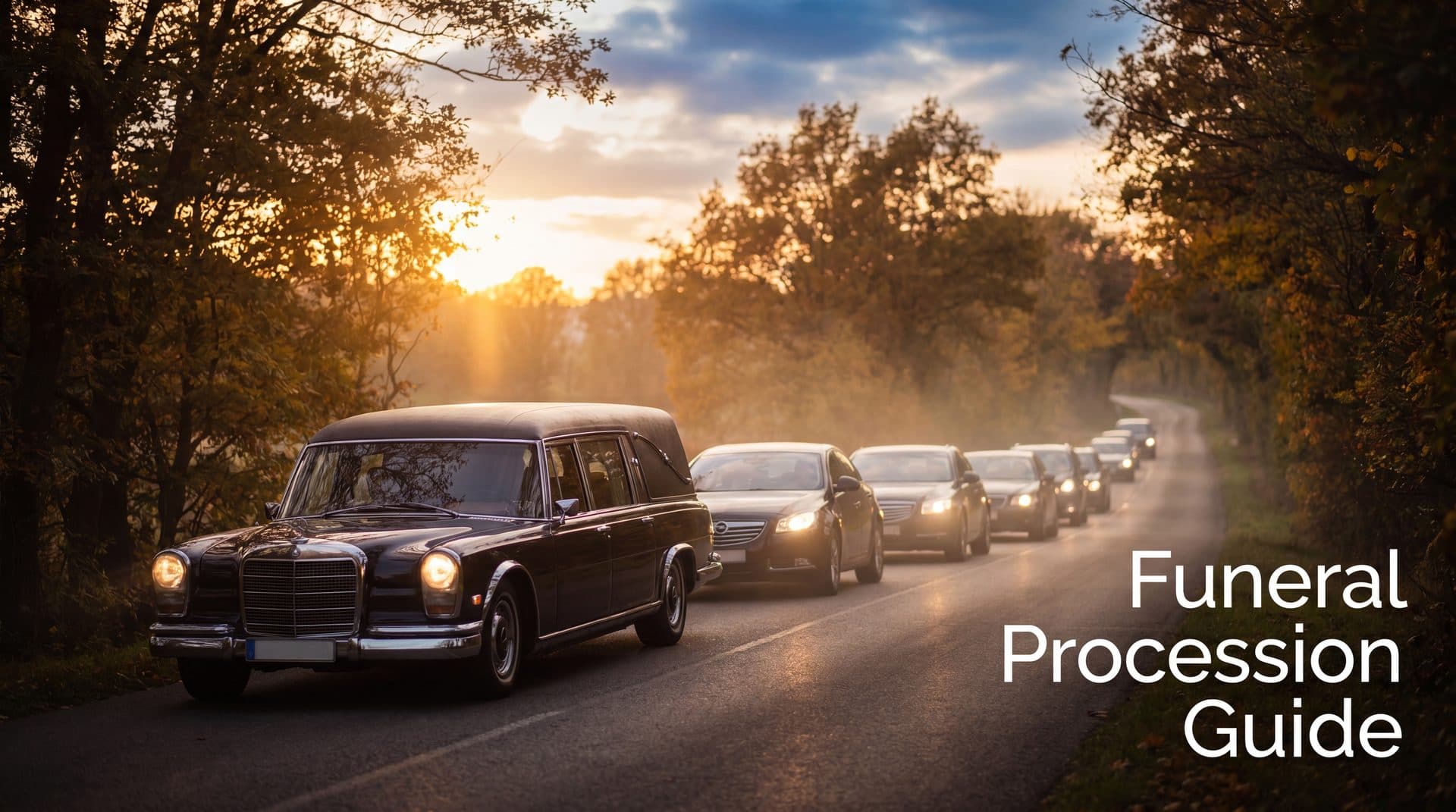
- A funeral procession (also called a cortege) is the organized line of vehicles or mourners that travels from the funeral service to the cemetery or crematory, led by the hearse carrying the deceased.
- The traditional order is: lead car, hearse, immediate family, then everyone else — arrive about 45 minutes early if you want to be near the front.
- Processions travel slowly — typically 20–30 mph on local roads and no more than about 50 mph on highways — with headlights and hazard lights on.
- Roughly two-thirds of U.S. states give processions right-of-way at intersections once the lead vehicle has lawfully entered; cutting into or breaking up a procession is illegal almost everywhere it’s addressed.
- Traditions range from New Orleans jazz funerals with a second line to military corteges with full honors — and modern processions increasingly end at a memorial that lives on digitally.
The Slow Drive That Says Everything
Few moments in a funeral are as quietly powerful as the funeral procession — the slow, deliberate line of cars with headlights on, moving together from the service to the place of rest. For the family, it’s a final journey taken alongside the person they loved. For everyone who pulls over to let it pass, it’s a brief, shared moment of respect for a stranger’s life. And yet most of us were never actually taught how a funeral procession works: who rides where, what the law says, or what to do when one appears in your rearview mirror.
This guide covers everything families and drivers need to know — the traditional order of vehicles, etiquette inside and outside the procession, how right-of-way laws differ by state, the history behind the tradition, and how to organize a meaningful procession today. If you’re in the middle of making arrangements, our step-by-step funeral planning checklist and our guide to what a funeral director does are good companions to this one.
What Is a Funeral Procession?
A funeral procession — formally called a cortege — is the organized movement of mourners accompanying a deceased person from one place to another, most often from the funeral home or church to the cemetery or crematory. The practice is ancient: long before automobiles, mourners walked behind the casket from the family home to the burial ground, often accompanied by music, prayer, or tolling bells. The procession physically enacted what the community felt — that no one should make their final journey alone.
Today’s version usually involves a line of vehicles rather than walking mourners, but the meaning is unchanged. The procession marks the transition between the wake or funeral service and the committal — the moment of final goodbye at the graveside. Many families say it is the part of the day they remember most vividly.
Good to know: A procession is not required. Families choosing direct cremation or a celebration of life weeks later often skip it entirely, or hold a symbolic walking procession at the memorial event instead.
The Order of Vehicles: Who Goes Where
Funeral directors organize processions in a consistent order, and understanding it helps the day run smoothly:
- Lead vehicle. A funeral home escort car or, in some communities, a police motorcycle escort. It sets the pace, runs flashing lights, and manages intersections.
- The hearse. Carries the casket or urn. Because the casket occupies the rear, only the driver and funeral director ride inside.
- Immediate family. Directly behind the hearse, often in limousines provided by the funeral home, though personal cars are common too. Pallbearers typically ride here as well.
- Flower or support vehicle. Some processions include a car for floral arrangements or extra equipment.
- Extended family and friends. Everyone else falls in behind, usually in the order they parked.
If you’re close family or a pallbearer driving your own car, funeral homes recommend arriving about 45 minutes before the service so staff can park you near the front of the line. Cars are usually staged in the lot in procession order, and the funeral attendant places a magnetic “Funeral” flag or windshield sticker on each participating vehicle.
Typical funeral procession speed on local roads — and no more than about 50 mph on highways
Etiquette When You’re Driving in the Procession
Driving in a procession for the first time can feel surprisingly stressful — you’re grieving, navigating unfamiliar rules, and trying not to lose the car ahead. These guidelines cover nearly every situation:
- Turn on your headlights and hazard lights. This identifies you as part of the procession and, in many states, is required to claim procession right-of-way at all.
- Stay close, but brake-safe. Keep a tight enough gap that other cars can’t merge into the line, while leaving room to stop safely.
- Follow the car ahead — not the traffic lights. In most states, once the lead vehicle lawfully enters an intersection, the entire procession may follow through, even if the signal changes. Proceed carefully and watch for cross traffic.
- Don’t leave the line. If you absolutely must exit, turn off your lights, leave the procession safely, and rejoin at the cemetery.
- Keep the mood respectful. No loud music, phone calls, texting, or horn use.
- At the cemetery, follow the attendants. Staff will direct parking so the casket and family reach the graveside first.
Wondering what to wear for the day itself? Our guide to appropriate funeral attire covers services, graveside committals, and celebrations of life.
Etiquette When You Encounter a Procession
For everyone else on the road, the rules are simpler — and they’re as much about decency as law:
- Never cut into or through the line. Driving between procession vehicles is illegal in nearly every state that addresses processions.
- Don’t pass. Avoid overtaking a procession, especially on two-lane roads — in many states it’s against the law.
- Yield at intersections. Even if your light is green, let the entire procession clear before proceeding.
- Don’t tag along. Switching on your headlights and joining the line to ride its right-of-way is explicitly banned in many jurisdictions.
- Consider pulling over. In many regions — especially small towns and the South — drivers pull to the shoulder until the procession passes. It’s rarely required by law, but it’s a gesture families never forget.
Funeral Procession Laws: What Varies by State
There is no federal funeral procession law — every state sets its own rules, and they differ more than most drivers realize. About two-thirds of states grant processions some form of right-of-way; the rest leave it to local ordinance or simple courtesy. Here’s how the most common questions break down:
Check before you drive: Your funeral director will know your state’s procession rules and whether a police escort is recommended for your route — one of many details covered in our complete guide to funeral directors.
Procession Traditions Worth Knowing
The New Orleans Jazz Funeral
The most famous funeral procession in America is the New Orleans jazz funeral — a tradition blending West African circle dances, French and Spanish colonial military bands, and the birth of jazz itself. A brass band leads mourners through the streets playing slow dirges and spirituals on the way to the cemetery. Then, after the body is “cut loose,” the music turns joyful, and the second line — friends, neighbors, and anyone moved to join — dances behind the band in celebration of the life lived. It’s grief and gratitude in a single parade.
Military Corteges
Military funeral processions follow centuries-old protocol — flag-draped caskets, uniformed escorts, and at national cemeteries, the playing of Taps and a flag presentation. Veterans’ families are often surprised to learn these honors are free; our guide to VA burial benefits and free cremation for veterans explains exactly what’s included and how to request it.
Walking Processions and Modern Variations
Walking corteges remain common worldwide — behind horse-drawn hearses in the UK and Ireland, in religious processions across Latin America and Asia, and in motorcycle club escorts honoring fallen riders here at home. Modern American processions are evolving too: GPS caravan apps help drivers stay together without breaking traffic laws, livestreams let distant relatives follow the journey, and smaller processions reflect the rise of cremation over traditional burial.
How to Organize a Funeral Procession: 7 Steps
- Decide whether you want one. Processions add about 30–60 minutes and real meaning to the day — but they’re optional, especially with cremation or a delayed memorial.
- Plan the route with your funeral director. Shorter and simpler is better; directors know which intersections and highways to avoid.
- Arrange escorts if needed. For long routes or large processions, a police or professional escort keeps everyone safe and legal.
- Assign the family cars. Decide who rides in the limousine and who drives, and have pallbearers positioned near the front. List the order in the funeral program so guests know what to expect.
- Brief your guests. A note in the program or a quick announcement covers headlights, staying in line, and the cemetery address for anyone who gets separated.
- Plan the graveside moment. Music carries powerfully outdoors — these memorial service songs work beautifully at the committal — and the headstone itself becomes the gathering point; see our guide to headstone inscriptions.
- Give the journey a destination that lasts. The procession ends at the monument — but the remembering doesn’t have to. A QR code memorial on the headstone lets every future visitor scan and step into the full story: photos, videos, voice recordings, and tributes.

Funeral procession order, etiquette, and right-of-way rules at a glance.
Where the Procession Ends, the Story Continues
A funeral procession is a community walking (or driving) someone home one last time. But after the cars disperse and the flowers fade, the monument stands quietly — and for most visitors, it can only say a name and two dates. That’s why a growing number of families pair the physical resting place with a digital memorial: a private, family-controlled page filled with the stories, photos, and voices that a stone can’t hold. Linkora has helped more than 500 families preserve over 12,000 photos this way — no app needed, just a simple scan of a QR code etched into the monument. If you’d like to see how it works, start with our walkthrough on creating a digital memorial page.
Frequently Asked Questions
Do funeral processions have the right of way?
In roughly two-thirds of U.S. states, yes — once the lead vehicle lawfully enters an intersection, the entire procession may follow through even if the light changes, provided vehicles have headlights on. In states without procession statutes, such as California and New York, processions must obey all signals unless a police escort is directing traffic.
Is it illegal to cut into a funeral procession?
In nearly every state that regulates processions, yes. Driving between procession vehicles, breaking up the line, or joining the procession to take advantage of its right-of-way are all prohibited and can carry fines.
How fast does a funeral procession drive?
Processions typically travel 20–30 mph on local roads and no more than about 50 mph on highways. The slow pace keeps the line intact, signals other drivers, and reflects the solemnity of the journey.
Do I have to pull over for a funeral procession?
Usually not by law — most states only require you to yield at intersections and never cut through the line. But pulling to the shoulder until the procession passes is a long-standing courtesy, especially in smaller communities, and it means a great deal to grieving families.
Who rides in which car in a funeral procession?
The lead escort car goes first, followed by the hearse (driver and funeral director only), then immediate family directly behind — often in limousines — followed by pallbearers, extended family, and friends. Arrive about 45 minutes early if you’re driving your own car and want to be near the front.
For monument dealers, funeral homes, and cemeteries: families increasingly ask how the graveside moment can live on after the procession ends. Linkora’s partner program makes adding QR code memorials to your offerings simple.