
TL;DR
- Grave markers come in six main styles: flat (flush), bevel, slant, upright, ledger, and bronze on granite. Most cemeteries accept granite and bronze; many restrict marble and softer stones.
- Families typically spend $1,000 to $3,000 on a marker including installation. Simple flat markers start around $300 to $500, while custom uprights can pass $6,000.
- Eligible veterans receive a government headstone or marker free of charge from the VA, delivered anywhere in the world.
- Always get your cemetery’s rules in writing before ordering. Size, material, and style requirements vary widely, and memorial parks often allow only flush markers.
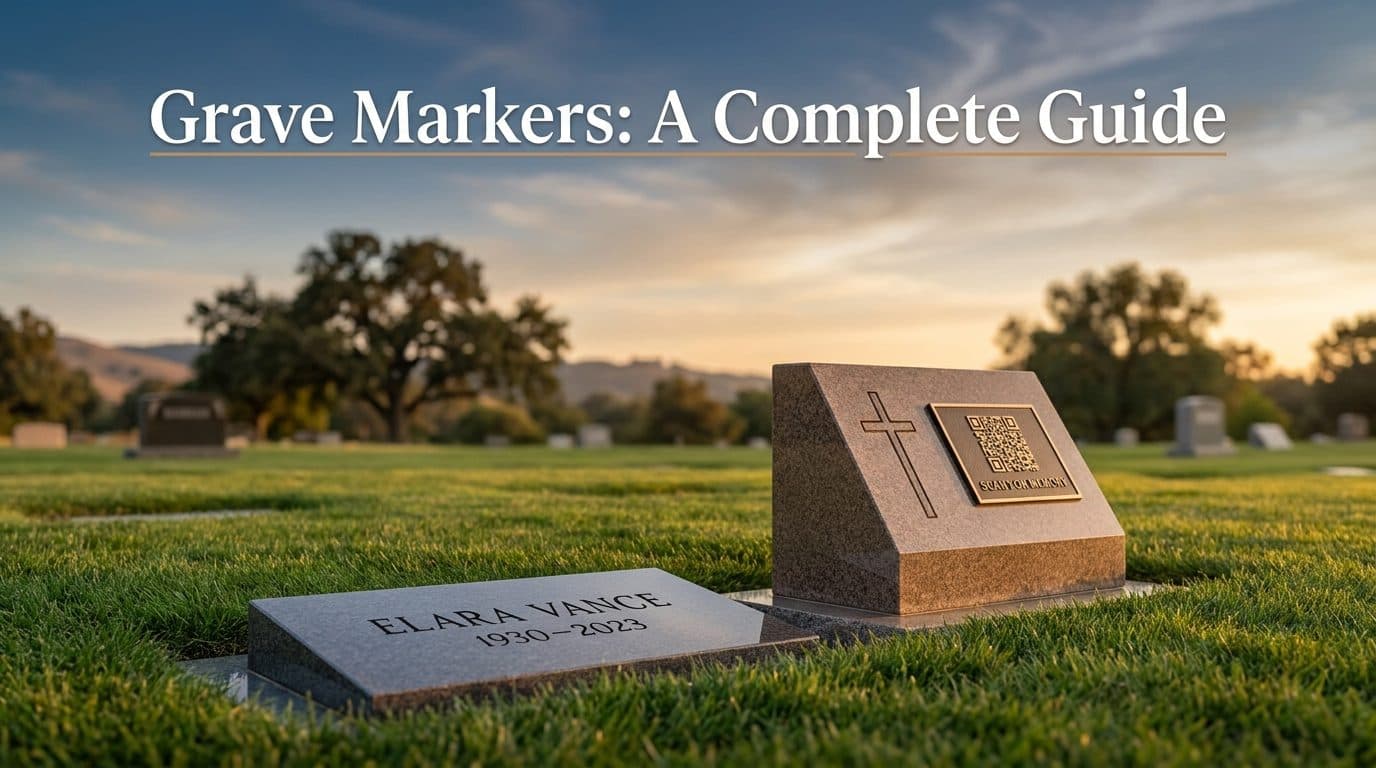
- A small QR code on the marker can connect the stone to a full digital memorial with photos, stories, and family history, so the marker tells more than a name and two dates.
What a grave marker is, and why the choice matters
A grave marker is any permanent memorial that identifies a burial place, from a modest flush granite plaque to a towering family monument. If you are shopping for one right now, you are likely discovering how many decisions hide inside this one purchase: style, material, size, inscription, cemetery approval, and a price range that stretches from a few hundred dollars to well over six thousand. The average family spends between $1,000 and $3,000 once installation is included, and most make this decision only once or twice in a lifetime, often while grieving.
This guide walks through every marker type, what each material costs, the cemetery rules that catch families off guard, the free options available to veterans, and how to choose a marker you will still feel good about in twenty years. If you are also weighing what the stone should say, our headstone inscriptions guide and our explainer on epitaph meaning and examples are good companion reads.
Grave marker vs. headstone vs. monument: what’s the difference?
The terms overlap, and monument dealers use them loosely, but there is a useful distinction. “Grave marker” is the umbrella term for any memorial that marks a grave. A “headstone” or “gravestone” usually refers to an upright stone placed at the head of the grave. A “monument” typically means a larger or more elaborate structure, sometimes marking a family plot rather than a single burial. In practice, a flat bronze plaque, a slant marker, and a six foot obelisk are all grave markers; only some of them are headstones.
Why it matters: cemeteries write their rules using these terms. A section that allows “markers” but not “monuments” is usually telling you that only flush or low profile memorials are permitted there. Confirm definitions with your cemetery office before you fall in love with a design.
The six main types of grave markers
1. Flat (flush) markers
Flat markers, also called flush or lawn level markers, sit even with the ground at the head of the grave. Standard single sizes are 24 x 12 inches or 28 x 16 inches, with companion versions around 36 x 18 or 44 x 14 inches for couples. They are the most affordable style, the easiest to maintain, and the only style permitted in many memorial parks. Their trade-off is visibility: they can be harder to find in a large lawn section, and grass creep needs occasional edging.
2. Bevel (pillow) markers
A bevel marker rises about 8 inches above the ground with a gently sloped face, like a pillow. The angle sheds water, keeps the inscription cleaner, and makes the marker easier to spot than a flush stone, while still keeping a low, tidy profile that many cemeteries accept in lawn sections.
3. Slant markers
Slant markers stand roughly 12 to 16 inches tall with a steeply angled face, usually on a granite base. They read almost like an upright headstone but cost less and satisfy height limits in many cemetery sections. The angled face is comfortable to read standing up, which matters for older visitors.
4. Upright headstones
The classic tablet on a base, typically 2 to 4 feet tall. Uprights offer the most room for inscriptions, carvings, portraits, and two sided engraving for companion plots. They require a concrete foundation, carry the highest material and installation costs, and are prohibited in flush only sections. For design inspiration, browse our headstone ideas and designs guide.
5. Ledger markers
A ledger is a thick horizontal slab that covers the entire grave. Common in historic cemeteries and some religious traditions, ledgers make a strong, permanent statement and effectively eliminate grass maintenance over the plot, at a price and weight closer to upright monuments. Ledgers are also frequently paired with mausoleum and crypt memorials.
6. Bronze on granite markers
A cast bronze plaque mounted on a granite base combines the warmth and fine detail of bronze lettering with granite’s stability. Many memorial parks require exactly this combination. Bronze develops a natural patina over decades and holds crisp detail beautifully; our bronze memorial plaques guide covers finishes, mounting, and care in depth.
Two smaller categories round out the family: temporary markers, the metal or plastic name plates a funeral home places at a new grave while the permanent marker is made (usually a 3 to 6 month wait), and niche markers, the compact plaques used on columbarium niches for cremated remains. With cremation now chosen in most American deaths, compact markers for urn gardens and niches are one of the fastest growing corners of memorialization. If you are still deciding between burial and cremation, our cremation vs. burial guide lays out the full comparison.
Grave marker materials: what grave markers are made of
Most grave markers today are cut from granite or cast in bronze, and the reasons are practical. Granite is the default choice for good reason. It resists weathering, holds detailed engraving, comes in dozens of colors, and a well cut granite marker stays legible for a century or more. Bronze is equally accepted nearly everywhere, highly resistant to corrosion, and ages into a dignified patina. Marble is beautiful, with soft veining and a long tradition, but it is noticeably softer; acid rain and freeze-thaw cycles blur marble inscriptions over decades, which is why many cemeteries now restrict it along with sandstone and limestone. Fieldstone, slate, and even glass appear in some cemeteries, but always check the rules first.
How much does a grave marker cost in 2026?
Prices vary by region, material, size, and how much custom work you order, but current industry pricing for grave markers clusters around these ranges:
| Marker type | Typical price range | Notes |
|---|---|---|
| Flat granite marker | $300 – $1,500 | Simple designs start near $300; engraving adds cost |
| Companion flat marker | $800 – $2,000 | Covers two names on one stone |
| Bevel or slant marker | $700 – $2,500 | Base usually included; more visible than flush |
| Upright headstone | $1,500 – $4,000+ | Custom carving can exceed $6,000 |
| Bronze on granite | $2,000 – $5,000 | Larger plaques run higher |
| Installation and setting fees | $300 – $800 | Charged by the cemetery; uprights need foundations |
The least expensive way to mark a grave permanently is a small flush granite marker with a simple inscription, often possible for under $500 plus the cemetery’s setting fee. Budget honestly for the extras: foundation pours, delivery, portrait etching, and vases each add real money, the same way casket costs ride on top of base funeral pricing.
Cemetery rules: get approval before you order
The single most expensive mistake families make is ordering a marker the cemetery will not accept. Every cemetery publishes marker regulations covering permitted styles, maximum dimensions, approved materials, base requirements, and who may perform installation. Memorial parks, designed for an unbroken lawn appearance, nearly always require flush markers and often specify bronze on granite only. Traditional cemeteries may allow uprights in some sections and restrict others. Religious cemeteries can add rules about symbols and wording. The difference between a cemetery and a graveyard often shows up precisely in these rules.
Practical tip: request the marker regulations in writing, share them with your monument dealer before design work begins, and get the cemetery’s written approval of the final drawing. Reputable dealers handle this step for you as a matter of course.
Free grave markers for veterans from the VA
The Department of Veterans Affairs furnishes a government headstone, marker, or medallion at no cost for eligible veterans, delivered anywhere in the world. Options include upright headstones in granite or marble, flat markers in granite, marble, or bronze (the standard flat marker measures 24 x 12 inches), and bronze niche markers for columbaria. Eligibility generally covers veterans discharged under conditions other than dishonorable and service members who die on active duty; spouses and dependent children qualify for government markers only in national or state veterans cemeteries. One caveat: in a private cemetery, the marker itself is free but setting fees remain the family’s responsibility. Veterans’ families should also read our guide to free cremation and burial benefits for veterans.
Personalizing the marker: inscriptions, portraits, and QR codes
Once style and material are settled, the marker becomes a canvas. Families choose names and dates, an epitaph, religious or military emblems, laser etched portraits, and carved flowers or scenes. The constraint is always space: even a generous upright gives you a handful of lines to summarize an entire life.
That constraint is exactly why QR code memorials have moved from novelty to mainstream. A small, weatherproof QR plaque etched or mounted on the marker links visitors to a full digital memorial: photo galleries, video tributes, a written life story, a family tree, and a guest book where visitors leave memories of their own. No app is needed; a phone camera scan opens the page. Our guides to how QR codes on headstones work and choosing a QR memorial plaque cover materials and durability, and our look at smart headstones shows where the technology is heading.
trust Linkora QR memorials, with 12,000+ photos preserved and 98% caretaker satisfaction
Linkora’s platform is privacy first: the family controls exactly what appears on the memorial page and who can see it, and the page can grow over the years as new generations add memories. The stone carries the name; the QR code carries the story.

The six main grave marker types at a glance, with typical price ranges including installation.
How to choose the right grave marker: a 7 step roadmap
Step 1: Get the cemetery’s marker regulations first. They narrow your choices instantly and prevent costly re-orders.
Step 2: Set a total budget. Include the marker, engraving, delivery, foundation, and the cemetery’s setting fee, not just the sticker price.
Step 3: Choose the style. Flush for simplicity and lowest cost, bevel or slant for visibility on a budget, upright or ledger for presence and inscription space.
Step 4: Choose granite or bronze unless tradition says otherwise. They are accepted nearly everywhere and last the longest.
Step 5: Draft the inscription without rushing. Check spelling, dates, and name order twice; engraving corrections are difficult and sometimes impossible.
Step 6: Decide how the marker will share the fuller story. If a few carved lines feel too small for the life you are honoring, plan for a QR memorial plaque now so it integrates cleanly with the design.
Step 7: Order through a reputable monument dealer and confirm the timeline. Three to six months from order to installation is normal; the funeral home’s temporary marker holds the place meanwhile.
Monument dealers, funeral homes, and cemeteries: Linkora’s partner program lets you add digital memorial services to every marker you sell, with no technical work on your side. It is a natural upsell that families genuinely thank you for.
Frequently asked questions
What is the average cost of a grave marker?
Most families spend between $1,000 and $3,000 including installation. Simple flat granite markers start around $300 to $500, upright headstones typically run $1,500 to $4,000, and bronze on granite markers range from $2,000 to $5,000. Cemetery setting fees add $300 to $800.
What is the difference between a grave marker and a headstone?
“Grave marker” is the umbrella term for any permanent memorial identifying a grave, including flat, bevel, slant, and bronze markers. A headstone specifically refers to an upright stone standing at the head of the grave. Every headstone is a grave marker, but not every grave marker is a headstone.
What is the least expensive way to mark a grave?
A small flush granite marker with a simple engraved inscription is the most affordable permanent option, often under $500 plus the cemetery’s setting fee. Eligible veterans can receive a government furnished headstone or marker from the VA at no cost for the marker itself.
What does a penny left on a grave marker mean?
Coins on a grave are a tradition of respect, most often at veterans’ graves. A penny means someone visited, a nickel traditionally means the visitor trained with the deceased, a dime means they served together, and a quarter signals the visitor was present when the person died.
Can I add a QR code to an existing grave marker?
Yes. Weatherproof QR plaques in anodized aluminum, stainless steel, or laser etched granite can be adhered or mounted to almost any existing marker, usually without cemetery objections since they do not alter the stone. The code links to a digital memorial page the family controls and can update over time.
A marker for the name, a memorial for the story
A good grave marker does its quiet work for a century: it says someone rests here, and someone cared enough to mark it well. Choose the style the cemetery allows, the material that lasts, and an inscription checked twice. Then consider giving visitors a way to meet the whole person, not just the name and dates. A Linkora QR memorial turns any marker, new or decades old, into a doorway to photos, voices, and stories that a stone alone could never hold.