
TL;DR
- Cremated remains are not ash at all. They are finely processed bone fragments, mostly calcium phosphate, the same mineral family that gives bone its strength.
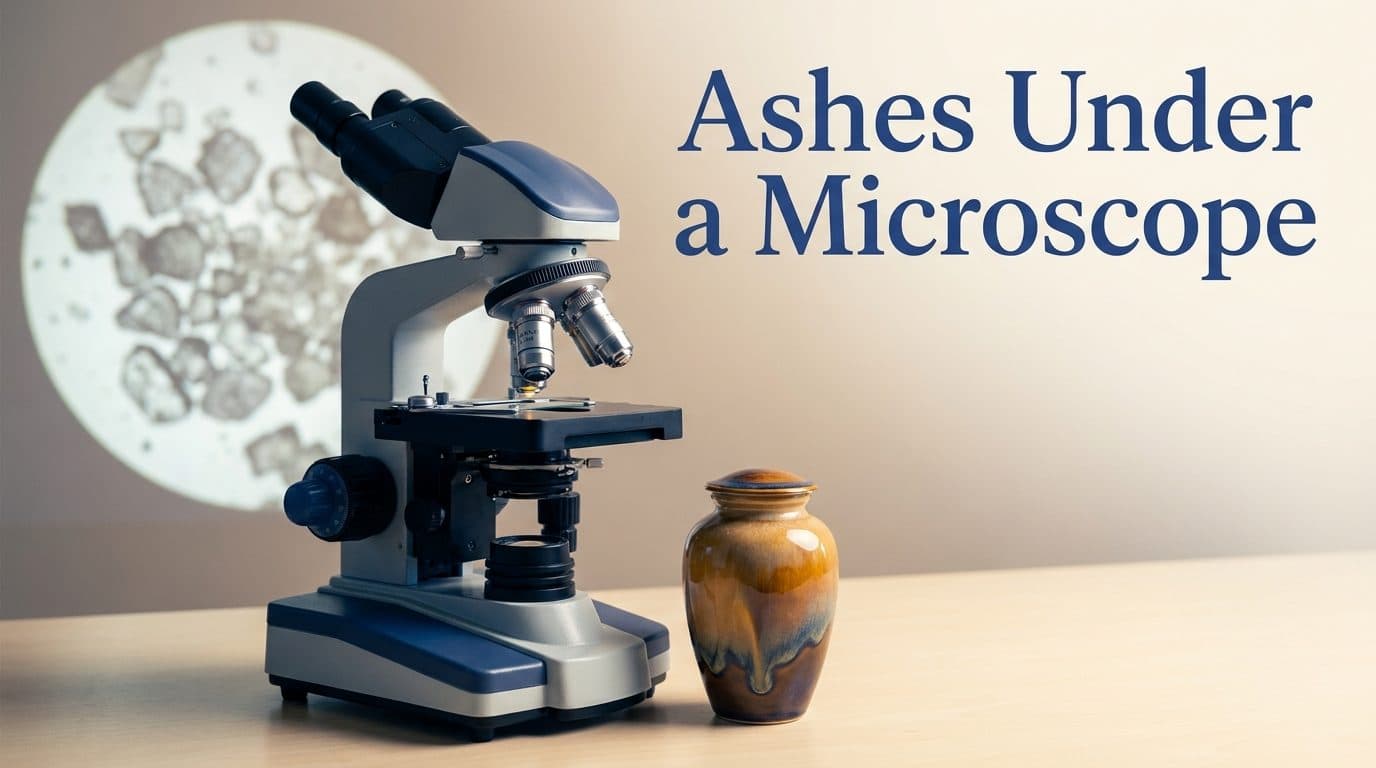
- Under an ordinary microscope, human ashes look like gray, white, and off-white crystalline mineral fragments, similar to coarse sand or crushed shell.
- The viral “galaxy” images are real photographs, but they were made with a specialized epifluorescence technique patented by an artist, not a standard lab microscope.
- An adult cremation leaves roughly four to nine pounds of remains, about 3.5% of the body’s original mass, after exposure to 1,400 to 1,800 degrees Fahrenheit.
- Cremated remains are sterile and safe to hold, and a Linkora QR memorial can keep the person’s full story alive wherever the ashes finally rest.
Why millions of people are looking at ashes under a microscope
If you have recently lost someone and found yourself searching for what human ashes look like under a microscope, you are in remarkable company. A set of luminous images swept across social media claiming to show cremated remains magnified into swirling fields of color, like nebulae and galaxies. For anyone holding an urn at home, the idea lands with real force: could the person I love literally look like the night sky?
The honest answer is layered, and it is worth telling carefully, because the truth is quieter than the viral version but no less moving. This guide walks through what cremated remains actually are, what they genuinely look like up close, where those galaxy images come from, and how families turn this curiosity into something lasting. If you are earlier in the process and still weighing options, our cremation vs. burial guide and our plain-language guide to simple cremation are good companion reads.
What cremation ashes actually are
The first surprise for most families is that “ashes” is not really the right word. During cremation, the body is exposed to temperatures between 1,400 and 1,800 degrees Fahrenheit for two to three hours. Soft tissue is consumed entirely, and carbon leaves as gas. What endures is the skeleton: the mineral scaffolding of bone. The Cremation Association of North America describes the final step plainly, the recovered bone fragments are processed into fine particles, most no larger than an eighth of an inch.
cremation temperature; what remains afterward is bone mineral, not ash
Chemically, cremated remains are dominated by calcium phosphates, the mineral family behind hydroxyapatite, which makes up as much as 70% of bone by weight. Published breakdowns of cremated remains show roughly this profile:
| Component | Approximate share | What it is |
|---|---|---|
| Phosphate | ~47.5% | The backbone of bone mineral |
| Calcium | ~25.3% | Paired with phosphate in hydroxyapatite |
| Sulfate | ~11% | Residual mineral salts |
| Potassium and sodium | ~4.8% combined | Trace body electrolytes |
| Carbonate and trace elements | ~1–4% | The small fraction of carbon that survives, plus silica, magnesium, and others |
An adult cremation typically yields four to nine pounds of remains, roughly 3.5% of the body’s original mass. The amount tracks skeletal size rather than body weight, which is why a tall, small-framed person can leave more remains than a heavier, shorter one. If cost questions are also on your mind right now, our cremation cost guide breaks down what families actually pay.
What human ashes look like to the naked eye
Before any magnification, cremated remains resemble coarse sand or finely crushed shell, with a texture closer to fine gravel than to fireplace ash. The color usually sits in a spectrum from white and off-white through pale gray, sometimes with hints of tan. Two urns from the same crematory can look slightly different, and that is normal. Retort temperature, the mineral makeup of the person’s bones, age, medications, and the fineness of the final processing all nudge the shade lighter or darker. Even lighting plays tricks: warm lamplight makes remains look beige, cool daylight makes them look gray.
If your loved one’s ashes look different from what you expected, or different from another family member’s, it almost never signals a problem. Color and texture vary naturally from person to person and cremation to cremation. Reputable crematories also include a stainless steel ID disc or tag that follows the remains through the entire process.
Human ashes under a real microscope
Place a pinch of cremated remains under a standard light microscope and you will see something austere and quietly beautiful: irregular crystalline fragments in white, gray, and charcoal, some porous like tiny pieces of coral, others sharp-edged like broken quartz. The porous pieces are recognizable bone microstructure, the honeycomb architecture that once made the skeleton both light and strong. What you will not see is color. Bone mineral does not glow pink and violet on its own; under ordinary magnification the palette is black, white, and gray.
That is not a disappointment so much as a fact with its own weight. You are looking at hydroxyapatite crystals that a living body built over decades, the physical remainder of every step taken and every embrace given. Plenty of families find that the plain scientific truth, that we carry a mineral framework assembled across a lifetime, is meaningful enough without any enhancement.
So what about the viral galaxy images?
The images that sparked this entire search trend trace back to Gabriela Reyes Fuchs, an artist who photographs human and animal ashes using a patented method built on epifluorescence microscopy. The technique excites the sample with light and records the light it emits in return, and Fuchs composes the results into prints with an unmistakably cosmic feel, sold through her company Innerstela. A widely shared Medium essay titled “We Are Made of Stars” brought the images to millions more readers.
When fact-checkers at Snopes examined the claim in early 2026, they noted something telling: when Fuchs first asked a university lab to view ashes under a conventional microscope, she was told the result would only be black, white, and gray. The galaxy look comes from her specialized process and artistic composition, not from what any family would see through a standard eyepiece. Snopes ultimately left the claim unrated, since the photographs are real but the presentation is art.
The galaxy images are best understood as memorial art, not microscopy. And that is a legitimate form of remembrance. Grief has always reached for beauty, whether in stained glass, headstone carvings, or fluorescent photographs of bone mineral. The science and the art can both be true to their own purpose.

What cremated remains really are, at a glance.
A note on pet ashes
Many people arrive at this question after losing a dog or cat, and the science is essentially identical. Pet cremains are the same calcium phosphate bone mineral, in smaller quantities, and they show the same gray-white crystalline structure under magnification. Our pet cremation guide covers the process, costs, and keepsake options for animal companions.
What families can do with this understanding
Learning what remains truly are tends to change how families think about honoring them. A few practical directions this knowledge often leads:
- Choose a resting place with intention. Scattering, burial, columbarium niches, home display, and divided keepsakes are all covered in our guide to what to do with cremation ashes.
- Select an urn suited to that choice. Material, size, and sealing matter differently for display, burial, or scattering. Our cremation urn guide walks through the options.
- Consider a wearable keepsake. Because remains are stable mineral, a small portion can be sealed in cremation rings and memorial jewelry, keeping a physical trace close.
- Ask your crematory questions freely. How identity is tracked, whether witnessing is available, and how remains are processed are all fair questions, and good providers answer them openly.
- Preserve the story, not just the substance. Minerals hold no memories. Photos, voices, and stories need their own home, which is where a digital memorial comes in.
The part of a person no microscope can show
Here is the gentle truth underneath this whole question: whether ashes look like gray sand or a painted galaxy, the person you love is not in the minerals. Their laugh, their recipes, the way they told a story, those live in memory, and memory needs a place to gather. That is exactly what a digital memorial provides: a private, family-controlled page for photos, videos, tributes, and even a family tree, reachable by anyone who scans a small QR code on an urn, keepsake box, columbarium niche, or headstone. No app required.
Families using Linkora have already preserved more than 12,000 photos across 500+ memorials, and because the family keeps complete control over visibility, the page can be as private or as open as feels right. If you would like to see how one looks in practice, start with our guide on creating a digital memorial page or explore the Linkora features page.
Frequently asked questions
Do human ashes really look like galaxies under a microscope?
Not under a standard microscope. Ordinary magnification shows gray, white, and black crystalline bone mineral fragments. The viral galaxy images were created by artist Gabriela Reyes Fuchs using a patented epifluorescence technique and artistic composition, which fact-checkers at Snopes classified as art rather than typical microscopy.
What are cremation ashes made of?
Cremated remains are processed bone fragments composed mostly of calcium phosphates, about 47.5% phosphate and 25.3% calcium, with smaller amounts of sulfate, potassium, sodium, and 1 to 4% residual carbonate. They are not ash in the fireplace sense, since soft tissue and most carbon leave as gas during cremation.
How much ash does a human cremation produce?
An adult cremation typically produces four to nine pounds of remains, roughly 3.5% of original body mass. The amount depends on skeletal size rather than body weight, so height is a better predictor than heaviness.
Are cremation ashes safe to touch?
Yes. The extreme heat of cremation sterilizes the remains, and the resulting mineral is chemically stable and non-hazardous. Many families handle ashes directly when scattering or filling keepsakes, though the fine particles are best kept away from eyes and lungs on windy days.
Why are my loved one’s ashes a different color than expected?
Cremated remains range naturally from white to gray to tan. Retort temperature, bone mineral density, age, medications, and the final processing all influence the shade, and lighting changes how the color reads. Variation between two people’s remains is completely normal and not a cause for concern.
Give their story a permanent home
The minerals in an urn are the body’s quiet remainder. The life itself deserves more room than that. Linkora turns any urn, niche, or monument into a doorway to a living memorial page where photos, videos, and family stories stay safe for generations, with privacy fully in your family’s hands.
Are you a funeral home, crematory, or monument dealer? Linkora’s partner program adds digital memorial services to your offerings. Become a Partner.