
The Short Version
- A memorial bench turns a quiet seat into a living tribute, letting families, friends, and even strangers pause and remember a loved one in a place that mattered.
- Expect to pay $400–$700 for recycled plastic, $800–$2,200 for hardwood, and $1,500–$6,000+ for granite, before engraving, plaques, and installation.
- Placing a bench in a public park or cemetery almost always requires permission, an approved design, and a dedication fee; private gardens give you complete creative control.
- The most powerful inscriptions are short, specific, and personal — a name, a date, and one line that captures who the person was.
- Adding a small QR code plaque links the bench to a multimedia digital memorial — photos, videos, stories, and tributes — so the bench becomes a doorway into a life, not just a marker.
Why a Memorial Bench Has Become One of the Most Loved Modern Tributes
Walk through any city park, university campus, botanical garden, or cemetery and you will start to notice them: simple benches with small bronze, granite, or composite plaques. Some hold a name and a date. Some carry a single sentence that stops you mid-step. Each one is a memorial bench — a quiet, public form of remembrance that has grown steadily in popularity over the last decade as families look for ways to honor a loved one that feel personal, useful, and lasting.
Unlike a headstone, a bench invites people in. A passerby sits down, reads the plaque, glances at the view, and for a moment becomes part of the story. That is a powerful thing. It is also why the meaning of “memorial” has evolved — modern families want tributes that are participatory, shareable, and woven into everyday life, not just visited once a year.
This guide walks through everything families, monument dealers, and grief professionals need to know in 2026: the real costs, the materials that hold up to decades of weather, how to handle permits for parks and cemeteries, inscription ideas that work, and how a small QR code can turn a bench into a doorway to a full digital memorial.
What Exactly Is a Memorial Bench?
A memorial bench is any outdoor seating — usually wood, metal, granite, or composite — dedicated to honoring a deceased person, a couple, a group, or sometimes a pet. It is identified by an attached plaque or engraved inscription that names the person being remembered, often with their birth and death dates and a short tribute line.
Families choose memorial benches for three reasons that headstones, urns, and tattoos cannot fully cover:
- They are useful. A bench gives something back to a community — a place to rest, watch children play, eat lunch, or pray. The gift outlives the giver.
- They sit in places that mattered. A favorite walking trail, a college campus, a beach overlook, a backyard garden, a parish church — the location itself becomes part of the tribute.
- They invite return visits. Cemeteries can feel formal. Benches in everyday spaces become destinations for birthdays, anniversaries, quiet walks, and ordinary Tuesday afternoons.
A memorial bench is not a substitute for a grave marker or a digital memorial page — it is a companion to them. Many of the most meaningful ways families remember a loved one layer two or three small gestures rather than depending on one big monument.
How Much Does a Memorial Bench Cost in 2026?
Cost is almost always the first question, and the honest answer is: it depends on three things — material, size, and where the bench will live. A simple recycled-plastic bench dedicated in a small town park can be under $800 all-in. A custom granite cremation bench that doubles as an urn vault can cross $10,000 once engraving, base, and installation are added.
Here is what families typically pay in 2026, based on industry pricing from monument dealers, park bench programs, and memorial bench suppliers across the United States.
On top of the bench itself, plan for three additional line items that catch first-time buyers off guard:
- Engraving or plaque: $75 for a small laser-engraved aluminum plate, up to $400–$800 for hand-cut granite lettering or bronze plaques.
- Installation: Public parks usually require their crews to install, with fees ranging from $250 to over $1,200 depending on the city. Concrete footings for granite benches add cost.
- Dedication or sponsorship fee: Many park conservancies and college campuses bundle the bench, plaque, installation, and a 10–25 year placement guarantee into a flat sponsorship fee of $2,500–$7,500.
Expected lifespan of a properly installed granite memorial bench
A Quick Note on Granite Cremation Benches
Granite cremation benches deserve their own mention. These are solid granite benches with a hollow base or sealed compartment designed to inter cremated remains — a single bench can be both a tribute and a final resting place. They are increasingly chosen by families who want a permanent memorial outside a traditional cemetery plot, or who are pairing burial with cremation across two parents. If your family is still weighing options, our cremation vs. burial guide walks through the considerations, and our complete guide to cremation urns covers the alternatives.
Choosing the Right Material
The “right” material depends on three honest questions: How much weather will the bench face? How long do you want it to last? And what does it need to feel like when someone sits down?
Granite — The Forever Bench
Granite is the gold standard for cemeteries and family memorials. It does not rust, rot, fade, or crack under freeze-thaw cycles. Inscriptions sandblasted into granite stay readable for a century. The trade-off is weight (a single granite bench can exceed 600 pounds) and price. Granite also feels cold to sit on in winter and very warm in direct summer sun — something to factor into the location.
Hardwood — The Garden Bench
Teak, cedar, white oak, and ipe make beautiful private-garden benches. Teak in particular weathers to a silvery patina that many families love. Hardwood needs occasional sealing or oiling to last decades; left untreated in heavy weather, even teak will eventually crack and split. Engraving directly into wood is possible but a separate brass or stainless plaque holds up better long term.
Recycled Plastic — The Park Workhorse
Recycled high-density polyethylene (HDPE) benches are increasingly the default for municipal parks. They look like wood from a few feet away, do not splinter, never need sealing, and shrug off rain, salt, and graffiti. Many park conservancies standardize on them precisely because they survive heavy public use. Plaques are usually attached separately.
Cast Aluminum or Steel — The Civic Bench
You see these in city plazas, train stations, and older parks. Powder-coated cast aluminum and steel offer ornate Victorian-style detailing at reasonable prices and can be paired with wood slats. They handle weather well with periodic recoating but can chip if struck. Most accept screwed-on bronze plaques cleanly.
Where Can You Put a Memorial Bench? Location, Rules, and Permits
This is where many families get tripped up. The bench is the easy part. Getting permission to install it in the place that matters is often the longest part of the project.
Private Property (The Most Flexible Option)
A bench in your own backyard, patio, family farm, or private memorial garden gives you total control: pick any style, any material, any inscription, any number of plaques, and add landscaping or lighting around it. This is the simplest path and often the most meaningful for families who want a quiet space they can visit daily.
Public Parks — The Sponsorship Path
Most municipal parks, university campuses, botanical gardens, and zoos run formal memorial bench programs — sometimes called “Adopt-a-Bench” or “Sponsor-a-Bench” programs. These typically include:
- A standardized bench style the institution chooses (you cannot bring your own)
- A small plaque (often 2×6 or 3×10 inches) with strict character limits, usually 60–120 characters across 3–5 lines
- Inscription text the institution must approve in writing — political, religious, or commercial language is usually disallowed
- Installation by park staff at a location either you choose from approved spots or the park assigns
- A guaranteed placement period (commonly 10, 15, or 20 years) after which the family is offered renewal
Sponsorship fees vary widely by city — from around $1,500 in smaller towns to $10,000+ for high-demand benches in places like Central Park, Golden Gate Park, or Boston Common. Apply early; waitlists at popular parks can run two to five years.
Cemeteries
Cemeteries handle benches through their groundskeeper or family services office, not the city. Rules are usually strict about size, base type (most require a concrete footing), material, and whether the bench can serve as a cremation interment. Benches typically count as part of your plot allowance, so confirm whether yours has room. If you’re modernizing other parts of the plot too, see our piece on how cemeteries are embracing QR code technology.
Churches, Schools, and Nonprofits
Many churches, alumni associations, scout camps, hospitals, and nature preserves accept memorial benches through their development or facilities office. These often require a charitable gift on top of bench costs (a memorial gift to the institution) but the dedication process is usually faster and more personal than a city park program.
A common surprise: public benches almost never come with named perpetual rights. After the placement period ends (often 10–20 years), the bench, plaque, or location can be reassigned. Families who want a truly permanent tribute often pair a public bench with a private memorial — a headstone, an urn, or a digital memorial page that outlives any single object.
Inscription and Plaque Wording: Less Is Almost Always More
The best memorial bench inscriptions stop a stranger mid-step. Long quotations get skipped. Generic phrases blur together. The inscriptions that work are short, specific, and unmistakably about one person.
A reliable structure for almost any bench plaque has just three elements:
- The name (full name, or the name they were known by — “Bobby” not “Robert” if that is who he was)
- The dates (year of birth and year of death, or full dates if there is room)
- One short line that captures something true — a place they loved, a phrase they used, a habit, a sentiment
Classic Inscription Templates
- In Loving Memory of [Name], [Years] — Forever in Our Hearts
- In Memory of [Name], Who Loved This Place
- For [Name], [Years] — Sit a While and Remember
- [Name], [Years]. A Life Well Lived. A Love Well Shared.
- Dedicated to [Name] by a Family That Loved Him
- In Honor of [Name]’s Lifelong Love of [Park / Place / Activity]
Inscriptions That Get Quoted in Strangers’ Photos
These are the bench plaques that show up on social media every year. They work because they speak directly to the person sitting down:
- “Sit here a while and watch the world go by — she always did.”
- “He never passed a bench without stopping. Neither should you.”
- “Rest. Breathe. Remember someone you love.”
- “For [Name] — who would have told you the joke first.”
- “She loved this view. We hope you do too.”
Faith-Based Inscriptions
- Until We Meet Again
- Safe in the Arms of the Lord
- “The Lord Is My Shepherd” — Psalm 23
- Forever in God’s Garden
If you want a fuller library of inscription wording to draw from, our complete guide to headstone inscriptions includes hundreds of examples that translate cleanly to bench plaques. Faith families often pair an inscription with a comforting verse — our roundup of Bible verses for the death of a loved one is a good place to start.
Sizing reality check: Most small bench plates handle 2–3 lines of text comfortably. Full dedication plaques can fit 4–6 lines. Always confirm the exact character limit, font, and line count with your engraver or park program before finalizing the wording — what looks great in a Google Doc may not fit on a 3-inch plate.
Adding a QR Code Plaque: The Bench That Tells a Whole Life Story
Here is where memorial benches are quietly changing. A bench, no matter how beautifully engraved, can only hold a name, a date, and one short line. But a small QR code etched onto the plaque can carry an entire life behind it — photos, video tributes, a written biography, the eulogy, a family tree, and messages from anyone who knew them.
The mechanics are simple. A weatherproof QR plaque is fixed to the bench — either as a standalone tag or built into the main inscription plate. A visitor scans the code with any phone camera. Within seconds they are reading the person’s story, watching a clip of them telling their favorite joke, or leaving a note for the family. No app, no account, no friction. This is exactly how QR codes on headstones work, and the same approach translates directly to memorial benches.
For families, the appeal is the depth that engraving alone cannot offer. For monument dealers and park sponsors, the appeal is product differentiation — a $1,200 plaque becomes a $1,500 plaque with a story behind it, and the digital memorial generates ongoing engagement instead of a one-time sale.
How Linkora pairs with memorial benches. Each Linkora memorial includes a unique QR plaque designed to be etched into stone, screwed onto wood, or attached to bronze. The plaque links to a private, family-controlled digital memorial with unlimited photos, videos, family tree, and tributes. No app required. Scan, sit, remember.
What Goes on the Digital Side of a QR Bench
The best digital memorials behind a bench follow the same principle as the inscription: real and specific. Families who get the most out of pairing a bench with a digital tribute usually include:
- A short biography — one to three paragraphs in the voice of someone who knew them
- 20–100 family photos across the person’s life
- One or two short video clips — the person speaking, laughing, telling a story
- The eulogy and any readings from the service
- An open guestbook where visitors can leave a message or memory
- A family tree or GEDCOM import so descendants can place themselves in the story
Our guides on how to create a digital memorial page that truly honors a life and what to put on a memorial web page walk through this step by step. If you want inspiration, these beautiful memorial page ideas show what a well-built tribute can feel like.
For Monument Dealers and Funeral Homes
The QR memorial bench is one of the cleanest upsell paths in the deathcare industry today. The family is already paying $1,500–$5,000 for a bench. Adding a $300–$600 lifetime digital memorial plaque is a fraction of the order total and dramatically increases the perceived value. It also creates a recurring touchpoint with the family long after the sale. Our guide for monument dealers adding digital memorial services covers how to fold this into existing product lines.

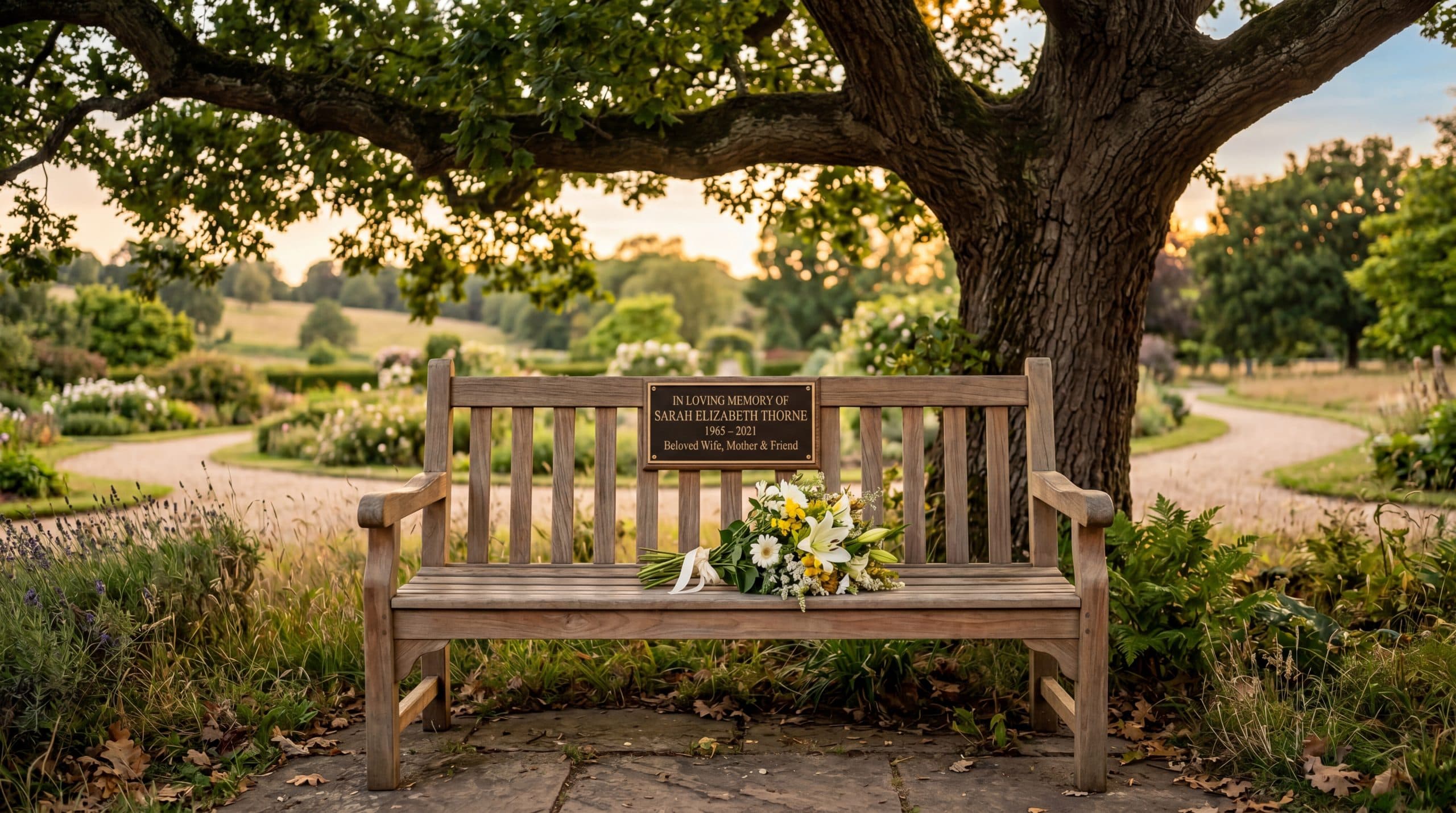
Memorial bench planning at a glance: materials, costs, location rules, and inscription tips.
A Practical 7-Step Plan for Choosing and Dedicating a Memorial Bench
Step 1: Pick the Location First, Not the Bench
Decide where the bench should live before you spec the bench. The location dictates material, size, plaque format, and rules. A private garden lets you choose anything. A city park dictates almost everything.
Step 2: Contact the Land Manager
For public locations, call the parks department, conservancy, cemetery office, or institution. Ask for: their bench program guidelines, the waitlist, the sponsorship cost, the plaque format and character limit, the placement guarantee period, and what happens after it expires.
Step 3: Match Material to Climate
Granite for permanence. HDPE recycled plastic for heavy public weather. Hardwood for sheltered gardens. Cast aluminum or steel for civic spaces. If freeze-thaw or salt air is a concern, lean toward granite or HDPE.
Step 4: Draft the Inscription
Use the three-part structure — name, dates, one specific line. Write three versions. Show them to two people who knew the person well. The version that makes them smile or tear up is the right one. Then count characters.
Step 5: Decide on a QR Plaque
If a digital memorial would help your family share the person’s full story — especially with relatives who live far away or with future generations — add a QR code plaque before the bench is installed. Retrofitting later is possible but more expensive.
Step 6: Plan the Dedication
A small dedication ceremony — even just family and a few close friends — gives the bench a sense of occasion. Some families read a short tribute, place flowers, scatter ashes nearby (where allowed), and share a meal afterward. Anyone planning a celebration of life can extend it into a bench dedication.
Step 7: Document and Share
Photograph the finished bench from several angles. Add the photos and location to the digital memorial. Share the dedication with family who could not attend. The bench is now a fixed point on the family map — somewhere to return on birthdays, anniversaries, and ordinary days when you want to sit and remember.
Frequently Asked Questions About Memorial Benches
How much does a memorial bench typically cost?
A complete memorial bench — bench, plaque, engraving, and installation — usually runs $1,200 to $5,000 in 2026. Recycled plastic park benches can come in under $1,000; custom granite cremation benches with detailed engraving can exceed $10,000. Public park sponsorship programs typically bundle everything into a flat fee of $2,500–$7,500.
Can I put a memorial bench anywhere I want?
Only on private property you own. Any public space — a city park, university, botanical garden, church, school, or cemetery — requires written permission from the land manager and typically follows their program rules for bench style, plaque format, and inscription content.
What material lasts the longest?
Granite is the most durable option, with a 100+ year lifespan and weatherproof engraving. Recycled HDPE plastic also lasts 50+ years with no maintenance. Hardwood and metal benches typically last 30–75 years with periodic sealing or recoating.
How long can the inscription be?
Small plaques typically allow 2–3 lines of about 30 characters each. Full-size dedication plaques fit 4–6 lines. The most memorable bench inscriptions stay short on purpose — a name, dates, and one specific line that captures the person.
How does a QR code on a memorial bench work?
A small QR code is laser-etched onto the bench plaque or a separate weatherproof tag. Visitors scan it with any phone camera — no app required — and are taken to a private digital memorial page containing photos, videos, biography, tributes, and a guestbook. The family controls who can view and contribute.