
TL;DR — Cemetery vs Graveyard, Quickly
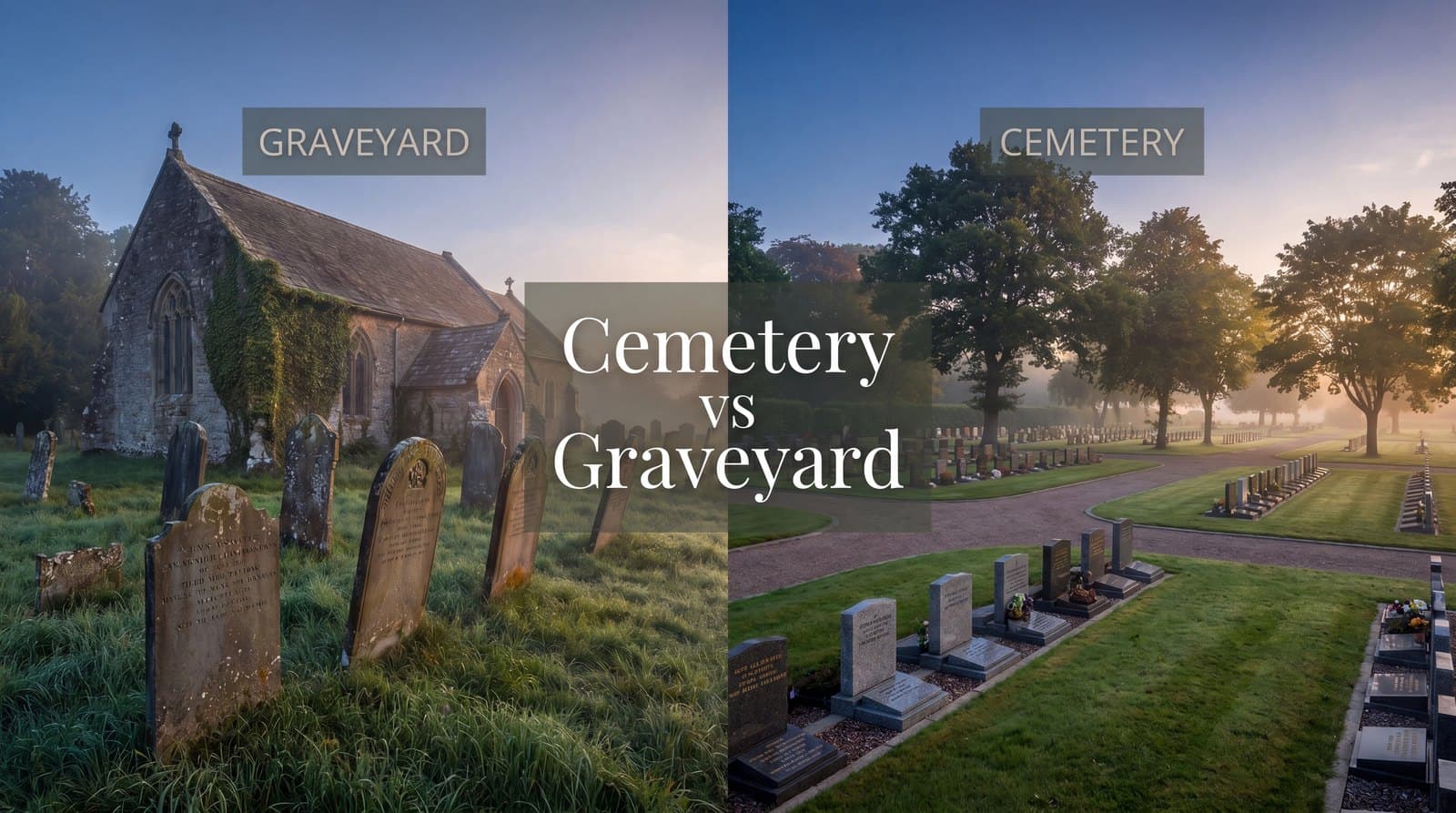
- Both words mean a place where the dead are buried, but a graveyard sits on the grounds of a church, while a cemetery is a separate, usually larger burial ground not attached to any church.
- The word graveyard comes from the old root for “to dig,” while cemetery comes from the Greek koimeterion, meaning “sleeping place” — a gentler image that arrived with a gentler era of burial.
- Graveyards often have stricter rules: many only accept members of the same church and limit headstones to conservative stone or granite designs. Cemeteries are typically open to all faiths and allow far more variety.
- Cemeteries appeared in the early 1800s when crowded churchyards ran out of room, giving rise to the spacious “garden” or rural cemeteries we still visit today.
- In everyday speech the two terms are used interchangeably — the surest way to tell them apart is to ask who manages the land: a church, a town, a nonprofit, or a private association.
Two Words for One Quiet Place
Walk past an old stone church and you’ll often see a cluster of weathered headstones leaning in the grass beside it. Drive to the edge of town and you’ll find something different: acres of manicured lawn, winding paths, and rows of markers stretching toward the tree line. Most of us would call both a “cemetery” — or both a “graveyard” — without a second thought. Yet there is a real distinction between the two, one rooted in centuries of history, religion, and a very practical problem: where do you put everyone when the churchyard fills up?
This guide untangles the difference between a cemetery vs graveyard, where each word comes from, how the rules differ, and why the two have largely merged in modern speech. Whether you’re researching family history, planning a burial, or simply curious about the language we use for our final resting places, understanding the distinction adds a little depth to every quiet plot you pass. And if you’re weighing burial options for a loved one, our step-by-step funeral planning checklist is a steady companion to keep alongside this one.
The Short Answer: What’s the Difference?
The core distinction is location. A graveyard is a burial ground that sits on the grounds of a church — which is why it is also called a churchyard. A cemetery is a dedicated burial ground that stands on its own, not attached to any house of worship, and is usually managed by a municipality, a nonprofit, or a private cemetery association.
That single difference ripples outward into nearly everything else. Because a graveyard is bound to a particular church, it tends to be smaller, older, more religiously restricted, and more conservative in what it allows on a headstone. A cemetery, freed from those walls, is usually larger, more open to people of every faith, and far more flexible about the markers and memorials families can choose. In casual conversation, though, the words have become near-perfect synonyms — and that’s perfectly fine.
Quick test: If the burial ground is on the grounds of a church, it’s a graveyard (a churchyard). If it stands alone — run by a town, a company, or a nonprofit — it’s a cemetery. When in doubt, ask who owns and manages the land.
Where the Words Come From
The two terms carry very different histories in their roots, and those roots hint at how attitudes toward death have shifted over time.
Graveyard: the digging place
“Graveyard” is a plain, descriptive compound. Grave traces back to the old Germanic root graban, meaning “to dig,” joined with yard, an enclosed piece of land. Put together, it is simply “the enclosed place where graves are dug” — honest, earthy, and unadorned, much like the era that produced it.
Cemetery: the sleeping place
“Cemetery” is softer and more poetic. It descends from the Greek koimeterion, which means “sleeping place” or “dormitory.” Early Christians adopted the word to frame death not as an ending but as a rest — a sleep from which the faithful would one day wake. That gentler vision of remembrance still shapes how we speak about those we’ve lost, and it echoes in the language families reach for today, from headstone inscriptions to eulogies.
The year “graveyard” first appears in English as a synonym for churchyard — long before “cemetery” took on its modern, standalone meaning
A Short History: How Churchyards Became Cemeteries
For most of European history, there was no meaningful difference between a graveyard and a churchyard. In deeply religious societies, the church controlled burial almost entirely, so the dead were laid to rest on consecrated ground beside the parish church. Through the Middle Ages, “graveyard” and “churchyard” were effectively the same word for the same place.
The problem was space. As towns grew and centuries of burials accumulated, churchyards became dangerously overcrowded — there was simply nowhere left to keep squeezing people in. By the early 1800s, cities faced a genuine public-health and dignity crisis. The solution was the cemetery: a large, planned burial ground built away from the church, on the edges of town, where land was plentiful.
These new spaces launched what became known as the garden or rural cemetery movement. Paris opened Père Lachaise in 1804, a sprawling landscaped park of monuments and shade trees, and the idea spread quickly. In the United States, Mount Auburn Cemetery near Boston opened in 1831 and set the template: cemeteries as serene, parklike grounds meant for the living to stroll as much as for the dead to rest. The distinction we draw today — graveyard by the church, cemetery on its own — was born largely out of that practical need for room.
Cemetery vs Graveyard: The Key Differences
Here is how the two compare across the things families actually care about when choosing or visiting a burial place.
Who is allowed to be buried there
Because a graveyard belongs to a specific church, it usually comes with religious requirements. In many cases only members of that faith — and sometimes only that particular congregation — may be buried there. A cemetery has no such ties. It welcomes people of every religion and of no religion at all, which is one reason cemeteries became so popular as towns grew more diverse.
What you can put on the headstone
Headstone rules tend to be stricter in a graveyard. Markers may be limited to traditional stone or granite, and any wording usually has to align with the church’s values. Cemeteries are far more permissive, allowing varied shapes, materials, photographs, and increasingly modern features. If you’re exploring options, our guides to modern headstone ideas and designs and to smart headstones show just how much that freedom has expanded.

A side-by-side look at how cemeteries and graveyards differ — and where they overlap.
What About Burial Grounds, Memorial Parks, and Mausoleums?
“Cemetery” and “graveyard” aren’t the only words in this family, and the extra terms can blur the picture. A quick tour helps.
Burial ground
“Burial ground” is the broadest, most neutral term of all — an umbrella that covers cemeteries, graveyards, and historic or indigenous sites alike. If you want a word that carries no assumption about church ownership or size, this is it.
Memorial park
A memorial park is a modern style of cemetery that favors flat, ground-level markers instead of upright headstones, creating sweeping open lawns. The look is deliberately gentle and parklike — a direct descendant of that 19th-century garden cemetery ideal.
Mausoleum and columbarium
A mausoleum is an above-ground building that houses caskets in sealed crypts, while a columbarium holds urns of cremated remains. Both are often found within a larger cemetery rather than standing alone. If your family is still weighing the choice between burial and cremation in the first place, our guide to cremation vs burial lays out the considerations, and our burial vault guide explains what goes into the ground around a traditional casket.
Genealogy tip: If you’re tracing ancestors, the distinction matters. A relative buried in a small rural graveyard was likely tied to a specific church, so parish records are your best lead. Someone in a large municipal cemetery will more often appear in town or association records instead.
Does the Difference Still Matter Today?
In everyday conversation, not much. Dictionaries and language experts agree that “cemetery” and “graveyard” are now used interchangeably, and no one will misunderstand you whichever word you choose. The historical distinction is real, but it has softened into a matter of nuance rather than rule.
Where it still matters is in the practical details of planning a burial. The kind of ground you choose shapes who may be buried there, what the headstone can look like, how the plot is managed, and what it costs. If you’re making arrangements, the most useful question isn’t “is this a cemetery or a graveyard?” but “who runs it, and what are their rules?” That single answer tells you everything the old vocabulary was trying to capture.
Honoring a Life Beyond the Stone
However you name the place, a burial ground has always done two jobs at once: it marks where someone rests, and it tells visitors who they were. For most of history, a headstone could only manage the first — a name, two dates, and a short line of stone. The story of an entire life had to fit in a few carved words.
That’s changing. Families today are pairing the traditional marker with a QR code memorial — a small code etched on or beside the headstone that any visitor can scan with a phone, no app required, to open a full digital memorial of photos, videos, and stories. It works in a centuries-old churchyard and a brand-new memorial park alike, which is exactly why cemeteries are increasingly embracing the technology.
With a platform like Linkora, you can create a digital memorial page that turns a quiet plot into a living tribute. You control who can view and contribute, the memories stay private and protected, and the same code can sit on a headstone, a plaque, or a memorial card. If you’re deciding what belongs on that page, our guide to what to put on a memorial web page is full of ideas.
Cemeteries, funeral homes, and monument dealers can offer QR code memorials to every family they serve. If that’s you, our partner program for funeral homes and cemeteries makes it simple to add as a service — get in touch to learn more.
Frequently Asked Questions About Cemeteries and Graveyards
What is the main difference between a cemetery and a graveyard?
A graveyard is a burial ground located on the grounds of a church, which is why it’s also called a churchyard. A cemetery is a standalone burial ground not attached to a church, usually managed by a town, nonprofit, or private association. Graveyards tend to be smaller and more religiously restricted, while cemeteries are larger and open to all faiths.
Are cemetery and graveyard the same thing?
In modern everyday speech, yes — the two words are used interchangeably and no one will misunderstand you. Historically, though, they differed: a graveyard was always attached to a church, while a cemetery was a separate burial ground. The simplest way to tell which is which is to check who owns and manages the land.
Why are cemeteries not attached to churches?
Cemeteries arose in the early 1800s because church graveyards had become overcrowded and there was no room left to bury more people on church grounds. Towns and private associations created large burial grounds on the edges of cities, launching the garden or rural cemetery movement — places like Père Lachaise in Paris (1804) and Mount Auburn near Boston (1831).
Can anyone be buried in a graveyard?
Often not. Because a graveyard belongs to a specific church, many only allow members of that faith or congregation to be buried there, and headstones may have to follow conservative, church-approved designs. Cemeteries, by contrast, are typically open to people of all religions and offer far more flexibility in marker style.
What is the difference between a burial ground and a cemetery?
“Burial ground” is the broadest, most neutral term — an umbrella that covers cemeteries, graveyards, and historic sites without implying who owns them. A cemetery is one specific type of burial ground: a dedicated, standalone site not attached to a church, usually managed by a municipality, nonprofit, or private cemetery association.