
TL;DR – Epitaph Meaning, at a Glance
- An epitaph is a short inscription written in memory of a person who has died, most often the few lines carved on a headstone or grave marker beneath the name and dates.
- The word comes from the Greek epitaphios, meaning “on or over a tomb,” from epi (upon) and taphos (tomb). Some of the earliest examples survive on ancient Egyptian coffins.
- An epitaph is not the same as a eulogy or an elegy. An epitaph is a brief inscription on stone; a eulogy is a spoken tribute at a funeral; an elegy is a mournful poem.
- Most headstones hold only about 15 to 40 words comfortably, and engravers often charge per character, so the best epitaphs say a great deal in very little space.
- A QR code memorial lets you keep the short epitaph on the stone while linking to the whole story, so the few carved words open into a lifetime of photos, voices, and memories.
What Does the Word Epitaph Actually Mean?
An epitaph is a short piece of writing in memory of someone who has died, usually the brief inscription placed on their headstone or grave marker. If you have ever stood in a cemetery and read the handful of words carved beneath a name and two dates, you have read an epitaph. It is the smallest and most enduring of all the tributes we leave, meant to last as long as the stone itself, and often the only words about a person that strangers will ever see.
People most often look up the epitaph meaning because they have met the word at a graveside, in a poem, or while helping to plan a memorial, and they want to know exactly what it asks of them. The short answer is that an epitaph remembers a life in miniature. Where a whole biography would fill a book, an epitaph must fit on a slab of granite, so it distills a person down to a phrase: who they were, who loved them, or the single truth their family most wants to outlast them. Understanding the word clearly is the first step to choosing one well, and it sits close to other words families wrestle with after a loss, which is why it helps to also be clear on what the word memorial really means before you decide how to remember someone.
Where the Word Epitaph Comes From
The word traces back through Medieval Latin epitaphium, a funeral oration, to the Greek epitaphios, which literally means “on or over a tomb.” It is built from two smaller pieces: epi, meaning upon or over, and taphos, meaning tomb or burial. Put them together and the word tells you exactly what it is: writing set upon a grave.
The practice is far older than the English word. Some of the earliest surviving epitaphs appear on ancient Egyptian sarcophagi and coffins, where inscriptions named the dead and asked the gods to grant them safe passage into the afterlife. In other words, the very first epitaphs were not written for other mourners at all. They were written for eternity, a message meant to be read long after everyone who knew the person was gone. That original impulse, to speak past your own lifetime, is still the heart of what an epitaph does today.
A quick note on the word “epitaph”: It is sometimes used loosely to mean any final statement about a person or thing, as in “a fitting epitaph for his career.” That figurative sense grew directly out of the literal one. Whether carved in stone or written in a sentence, an epitaph is the last word, the line meant to sum something up once it has ended.
Epitaph vs Eulogy vs Elegy vs Inscription
Few words are confused as often as epitaph, eulogy, and elegy. They sound related, they all gather around funerals, and they all honor someone who has died. But they are different tools, and knowing which is which saves real confusion when you are planning a service or a stone.
An epitaph is the shortest of the three: a brief inscription, often only a few words, meant to be carved on a headstone and to endure. A eulogy is much longer and is usually spoken aloud at the funeral, a prose tribute that looks back over the person’s life, character, and accomplishments. If you are the one preparing to speak at the service, our guide to writing a eulogy with real examples walks through that spoken tribute in detail. An elegy, meanwhile, is a poem of mourning, longer and more literary than an epitaph, and it can be written long after the loss; you can read more about what an elegy is and how it differs from a eulogy in our companion guide.
One more term is worth untangling. People often use “inscription” and “epitaph” as if they mean the same thing, but there is a subtle difference. An inscription is everything engraved on the stone, including the name, the birth and death dates, and any symbols. The epitaph is specifically the message, the phrase or verse chosen to say something about the person beyond the plain facts. Every epitaph is part of the inscription, but not every inscription contains an epitaph.
The easiest way to keep them straight: an epitaph is written in stone and read for centuries; a eulogy is spoken once, on the day.
A Short History of Epitaphs
Epitaphs have changed shape across cultures and centuries, and their history is really a history of how people have chosen to face death. Ancient Greek epitaphs were often deeply emotional and literary, written in elegiac verse and unafraid of grief. Roman epitaphs, by contrast, tended to be plain factual records, listing a name, a role, and the years lived, closer to a public ledger than a poem.
By the Elizabethan era, epitaphs had become far more common in English, and many of the best known were witty literary creations that were never meant to sit on an actual tomb. Poets composed mock epitaphs for the living and the famous, treating the form as a kind of compressed portrait. That playful tradition has never entirely died out, which is why so many famous epitaphs are funny rather than solemn. Across all these eras, the through line holds: an epitaph is a culture’s attempt to fix a person in a few permanent words, whether those words weep, boast, joke, or simply state the facts.

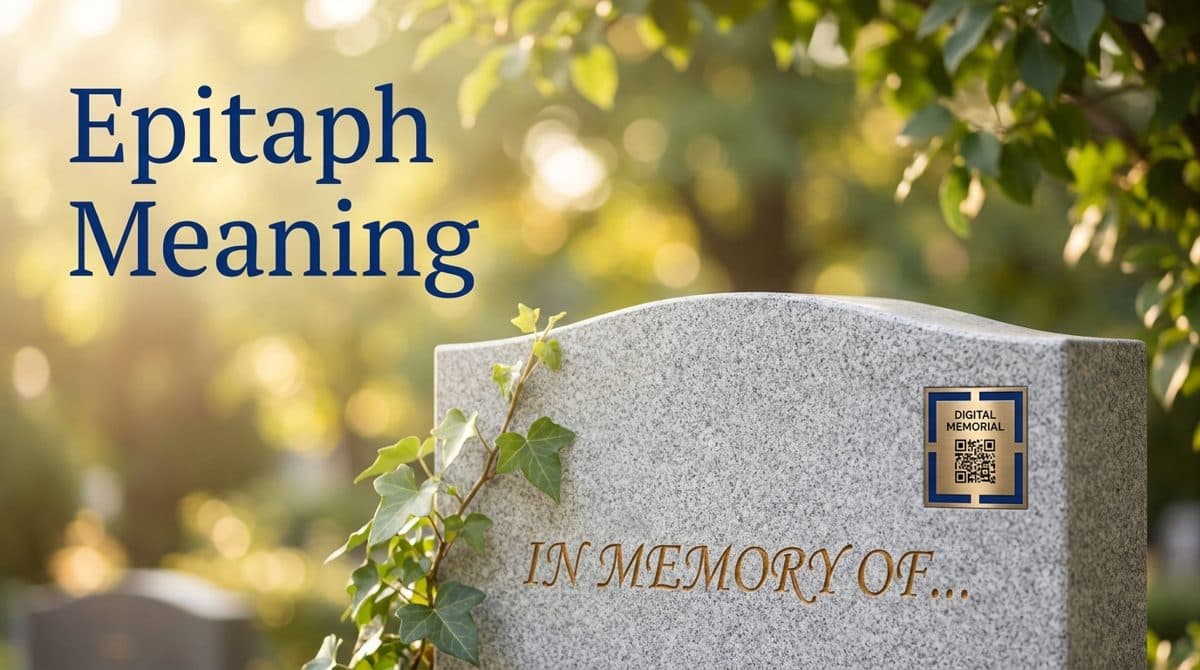
The epitaph at a glance: its meaning, its close cousins, and what to know before you carve one in stone.
Famous Epitaphs Worth Knowing
The clearest way to understand what an epitaph can do is to meet a few memorable ones. They show the full range of the form, from the solemn to the mischievous. Benjamin Franklin, a printer to the end, wrote his own epitaph as if he were a book, hoping he would “appear once more in a new and more beautiful edition, corrected and amended by the Author.” It is faith and wit in a single breath.
Some epitaphs distill a whole public life. Martin Luther King Jr.’s reads, “Free at last, Free at last, Thank God Almighty I’m Free at last,” borrowing the words that defined his mission. Joe DiMaggio’s is quieter, “Grace, Dignity and Elegance Personified,” honoring the man more than the ballplayer. Others refuse to take death too seriously at all: the writer Dorothy Parker suggested “Excuse my dust” and “If you can read this, you’re standing too close,” proving that humor can be its own kind of tenderness. Set side by side, these examples make the point that there is no single right tone for an epitaph. The best one is simply the one that sounds like the person it remembers.
What Fits on a Headstone: Space, Cost, and Rules
Before you fall in love with a long, beautiful sentence, it helps to know the practical limits of stone. This is the part families are most often surprised by, and it shapes almost every epitaph ever written. Most headstones hold only about 15 to 40 words comfortably beyond the name and dates, and flat or smaller markers hold far less. Upright monuments give you more room, but even there, brevity reads better; a stone crowded with text is hard to read and loses its dignity.
Cost is the other quiet constraint. Many engravers include a base number of characters and then charge for each one after that, often somewhere between roughly $10 and $30 per character depending on the font, the letter size, and your region. A short epitaph of a dozen words can add a few hundred dollars to a monument; a long one can add far more. There is also a timing lesson worth heeding: adding an inscription later, after the stone is already set, usually costs significantly more than engraving it all at once, so it pays to decide on the epitaph up front.
| Question families ask | What to expect |
|---|---|
| How many words fit? | About 15 to 40 comfortably on most stones; fewer on flat or bronze markers. Under 15 is often the sweet spot. |
| How much does the epitaph add? | Roughly $10 to $30 per character beyond the included base, so a short epitaph may add a few hundred dollars. |
| Can I add it later? | Yes, but retrofit engraving usually costs noticeably more than doing it when the stone is first cut. |
| Do I need approval? | Almost always. Cemeteries have rules on wording, symbols, and size, so confirm in writing before engraving. |
Because the physical space is so tight, many families now think of the stone as the doorway rather than the whole house. The epitaph names the person; a scannable memorial holds everything else. If you are weighing the design of the marker itself, our guide to headstone inscriptions and wording and our roundup of modern headstone ideas and designs walk through the choices in detail.
How to Write an Epitaph for Someone You Love
You do not need to be a writer to compose a good epitaph. What the form asks for is not eloquence but truth, said briefly. Here is a gentle way to approach it.
Start with the person, not the phrase. Before you reach for a quotation, sit with who they actually were. What did they do, not just what were they like? “She grew roses for the whole street” says more than “she was kind.” An epitaph built from one specific, true detail will always outlast a general virtue. Then cut it down hard. Write the long version first, everything you wish you could say, and then keep trimming until only the essential words remain. Brevity is not a limitation on a headstone; it is the source of its power.
Borrow when your own words will not come. There is no shame in choosing a line of scripture, a lyric, or a favorite saying. Our collections of comforting grief quotes can offer language when grief has stolen yours. Read it aloud, and then wait. Say the words out loud, imagine them carved in stone, and then sleep on it. The line you love late at night can feel different in the morning, and a stone is meant to last a century, so one more day of thought is always worth it. Finally, get the cemetery’s written approval before anything is engraved, because corrections after the fact are costly and heartbreaking.
Worth remembering: An epitaph does not have to capture everything. It cannot. Its job is not to hold the whole person but to point to them, to make a passing stranger pause and a grandchild feel found. Say one true thing well, and let a fuller memorial carry the rest.
Epitaph Examples by Type
Sometimes the fastest way to find your own words is to see a range of others. These short examples are meant as starting points, not scripts. For a mother or father, families often reach for the quiet and universal: “Beloved Mother,” “Always Our Guide,” “Home in Our Hearts,” “Loved Beyond Measure,” or “A Life of Giving.” For a religious epitaph, common choices include “Safe in God’s Hands,” “Forever with the Lord,” “In God’s Care,” or “At Peace in Christ.” For a secular tone, families choose lines like “A Life Well Lived,” “Forever Remembered,” “Love Lives On,” or simply “At Peace.”
Notice how short each of these is. None try to explain a life; each simply honors one. When you find the few words that feel right, they will likely be plainer than you expect, and that plainness is exactly what makes them last.
Beyond the Stone: The Modern Epitaph
For all its power, the traditional epitaph carries a quiet sorrow of its own. A whole person, every story and laugh and photograph, must be compressed into a name, two dates, and a handful of words. The rest, the parts that made them unmistakably themselves, has historically had nowhere to go once the people who remembered them were gone too.
That is part of why families are turning to digital memorials. A QR code memorial is a small code placed on a headstone, plaque, or memorial card that anyone can scan with a phone, no app required, to open a full digital memorial. The carved epitaph stays exactly as it should be, short and dignified, while the code beside it opens into everything the stone could never hold: photo galleries, video, a recording of the person’s own voice, their life story, and messages from everyone who loved them. If you are curious how the technology works in practice, our guide to how QR codes on headstones work explains it step by step.
With a platform like Linkora, you can create a digital memorial page that keeps the epitaph and the whole life together in one place. You decide who can view and contribute, the content stays private and in your family’s control, and relatives near and far can add the stories the stone had no room for. The epitaph becomes not the end of what can be said about someone but the invitation to discover it.
Monument dealers, funeral homes, and cemeteries can offer QR code memorials to every family they serve, helping people preserve not just a name and an epitaph but the whole story behind them. If that is you, our partner program makes it simple to add digital memorials as a service.
A Last Word on Epitaphs
If you take only one idea from this guide, let it be this: an epitaph is a life reduced not to less, but to essence. The word may come from ancient tombs, and the great examples may be centuries old, but the task is the same one every grieving family still faces. We lose someone, and we are asked to choose the few words that will speak for them long after we cannot. Choose them with care, say one true thing, and then keep the rest of the story somewhere lasting, so the next person who loved them, or who never got the chance to, can find it too.
Frequently Asked Questions About Epitaphs
What is the meaning of an epitaph?
An epitaph is a short piece of writing in memory of a person who has died, most commonly the brief inscription carved on their headstone or grave marker. The word comes from the Greek epitaphios, meaning “on or over a tomb.” In everyday use, an epitaph is the message chosen to remember someone in a few lasting words.
What is the difference between an epitaph and a eulogy?
An epitaph is a very short inscription carved on a headstone and meant to endure for generations. A eulogy is a longer tribute, usually spoken aloud at the funeral, that looks back over the person’s life and character. In short: an epitaph is written in stone and read for centuries, while a eulogy is spoken once, on the day of the service.
How long should an epitaph be?
Shorter is almost always better. Most headstones hold about 15 to 40 words comfortably beyond the name and dates, and many of the most powerful epitaphs are under 15 words. Because engravers often charge per character and stone crowded with text is hard to read, brevity serves both your budget and the dignity of the marker.
What is a good epitaph for a mother or father?
Families often choose quiet, universal lines such as “Beloved Mother,” “Always Our Guide,” “Home in Our Hearts,” “Loved Beyond Measure,” or “A Life of Giving.” Religious options include “Safe in God’s Hands” or “Forever with the Lord.” The best choice is the one that sounds like the person, so a single true detail about who they were is often more moving than a general phrase.
Can a headstone have a QR code as well as an epitaph?
Yes. Many families now keep a short carved epitaph on the stone and add a small QR code beside it. Visitors scan the code with a phone, no app required, to open a full digital memorial with photos, videos, and stories. The epitaph stays brief and dignified while the QR code preserves everything the stone has no room to hold.