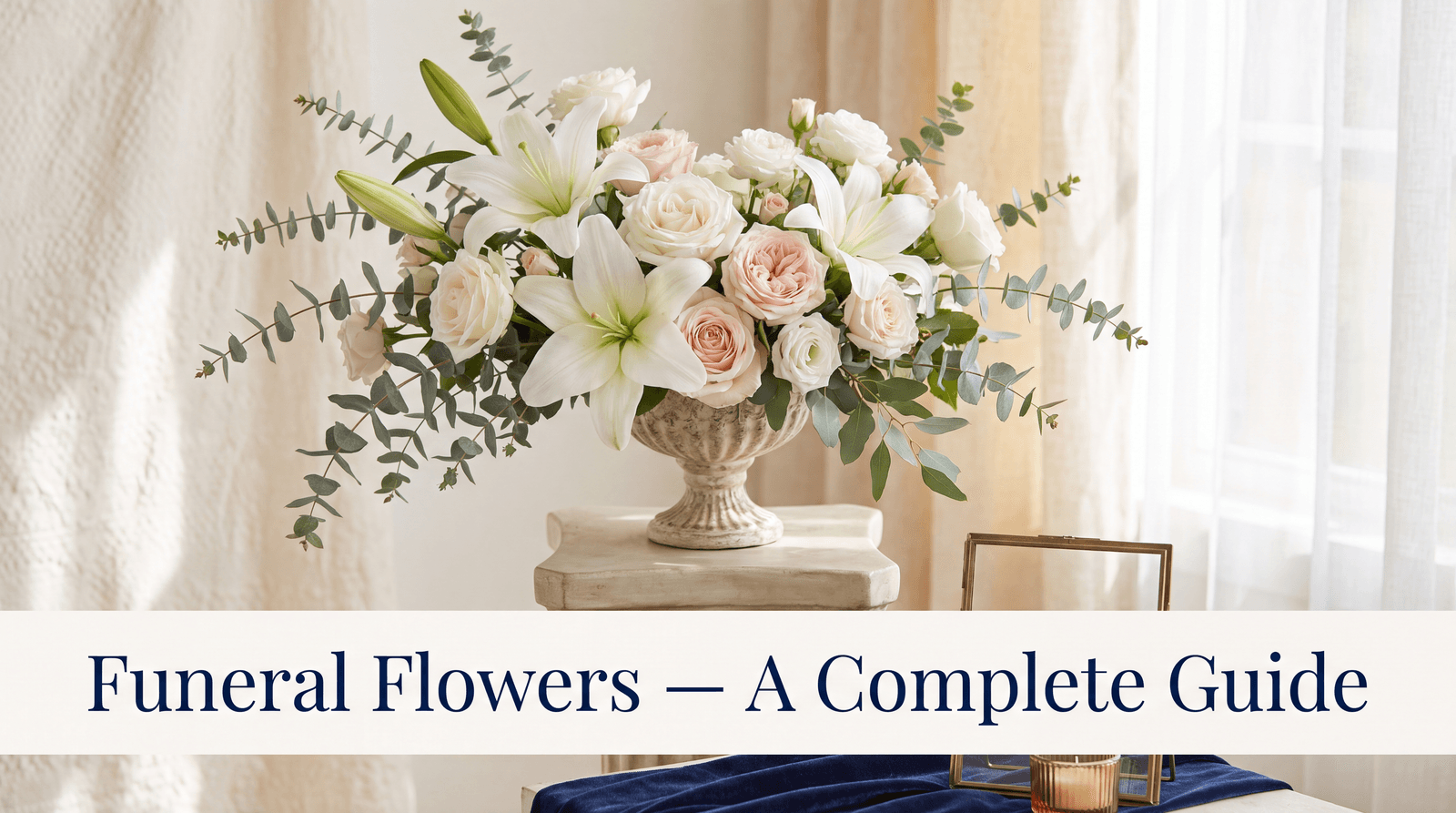

The Short Version
- Funeral flowers fall into a few main forms: casket sprays, standing sprays, wreaths, baskets, and hand-tied bouquets, each suited to a different sender and setting.
- Most arrangements cost between $100 and $300, while casket sprays bought by the immediate family typically run $200 to $500.
- Different blooms carry different meanings: lilies for restored innocence, white roses for reverence, carnations for remembrance, and chrysanthemums for grief.
- Always honor the family’s wishes first. If the notice says “in lieu of flowers,” a donation or a lasting tribute is the kinder choice.
- A short, sincere card message matters more than a clever one. “Always in our hearts” is enough.
Why We Send Funeral Flowers in the First Place
Few gestures are as universally understood as flowers at a funeral. They say what words often cannot: I am thinking of you, and this loss matters. The tradition reaches back thousands of years, and it endures because it gives grieving people something gentle to look at in a room heavy with sorrow. So if you are wondering what funeral flowers actually are and how to choose them, you are asking a question families have navigated for generations.
At their simplest, funeral flowers are floral arrangements displayed at a wake, funeral service, or graveside, or sent to a grieving family’s home as an expression of sympathy. But the choices behind them, what type to send, which blooms to pick, how much to spend, and what to write, carry quiet meaning. This guide walks through all of it, with the same care you would want to bring to the moment itself. If you are early in arranging a service, our funeral planning checklist pairs naturally with everything below.
A note before you order: The single most important rule of funeral flowers is to follow what the family has requested. If the obituary or service notice asks for donations instead of flowers, take that at face value. Honoring a stated wish is never the wrong choice.
The Main Types of Funeral Flower Arrangements
Not every funeral flower is meant for the same place or the same person. Understanding the common arrangement types makes it far easier to choose something appropriate to your relationship with the deceased.
Casket Sprays
A casket spray rests directly on top of the casket and is usually the centerpiece of the service. Because of its prominence, it is almost always chosen and paid for by the immediate family. A half-couch spray covers the lower half of the casket lid (common with open-casket services), while a full-couch spray drapes the entire lid.
Standing Sprays
A standing spray is a large, one-sided arrangement displayed on an easel so it is visible from across the room. These are a popular choice for close friends, extended family, coworkers, and organizations who want their tribute to be seen during the service.
Wreaths
The circular shape of a wreath has long symbolized eternal life and the unbroken circle of love. Wreaths are a traditional, dignified option and work well from groups, clubs, or workplaces.
Baskets and Bouquets
Smaller basket arrangements and hand-tied bouquets are gentler, more personal gestures. They are ideal for sending to the family’s home before or after the service, where a large standing piece would feel out of place. If you are choosing between flowers and another gesture, our guide to thoughtful sympathy gifts offers lasting alternatives.
Typical cost of a standard funeral flower arrangement in 2026
What Different Funeral Flowers Mean
Part of what makes funeral flowers so meaningful is that the blooms themselves carry symbolism. You do not need to memorize a florist’s encyclopedia, but knowing a few traditional meanings helps you choose something that feels intentional.
- Lilies are the most classic funeral flower, symbolizing the restored innocence of the departed soul. The white lily, in particular, represents purity and renewal.
- Roses shift meaning by color: white for reverence and humility, red for love and respect, pink for gratitude and admiration, and yellow for friendship.
- Carnations are fragrant and long-lasting, which makes them a practical, popular choice for multi-day services. They speak to remembrance and enduring affection.
- Chrysanthemums carry strong cultural weight. Across much of Europe they are reserved almost exclusively for mourning, while in the United States white “mums” represent truth and honor.
- Orchids convey everlasting love and sympathy, and a potted orchid can live on long after the service as a quiet keepsake.
If you would like to go deeper on the symbolism behind specific blooms, our companion piece on flowers that represent death and remembrance explores the history and meaning of each in detail.

A quick reference to funeral flower types, costs, and meanings.
Funeral Flower Costs: What to Expect in 2026
Cost is one of the most common questions, and the honest answer is that it depends on the arrangement, the flowers, and your location. As a general guide:
| Arrangement | Typical Price Range | Usually Sent By |
|---|---|---|
| Casket spray | $200 – $500 | Immediate family |
| Standing spray | $150 – $350 | Close friends, coworkers, groups |
| Wreath | $100 – $350 | Organizations, clubs, workplaces |
| Basket or bouquet | $60 – $150 | Friends, neighbors, distant relatives |
Families ordering several pieces often spend $500 to $700 in total. Premium blooms such as roses, lilies, and orchids cost more per stem than carnations or chrysanthemums, and delivery fees typically add $7 to $30. There is no “correct” amount to spend, a modest, heartfelt arrangement is every bit as meaningful as an elaborate one.
Funeral Flower Etiquette: Who Sends What, and When
Etiquette around funeral flowers is really just a series of small kindnesses. A few guidelines cover most situations:
- Match your tribute to your relationship. Immediate family handles the casket spray; friends, colleagues, and groups typically send standing sprays, wreaths, or baskets.
- Send to the right place. Larger pieces (sprays, wreaths) go to the funeral home in time for the service. Smaller baskets and bouquets are better sent to the family’s home.
- Time it thoughtfully. Aim for delivery before the service begins. If you have missed the funeral, flowers sent to the home in the days or weeks afterward are a comforting reminder the family has not been forgotten.
- Respect “in lieu of flowers.” When a family requests donations or asks for no flowers, follow that wish. A gift to the named charity is the gracious response.
Faith matters too. Customs vary widely. Flowers are warmly welcomed at most Christian and Buddhist services (white blooms are traditional for Buddhist mourning), but are generally not part of Jewish or Hindu funerals, where a donation or another gesture is more appropriate. When in doubt, a quick, respectful question to the family or funeral director is always welcome.
What to Write on a Funeral Flower Card
The card can feel like the hardest part, but it should not. You are not expected to be profound. Showing up, in any form, is what the family will remember. Keep it short and sincere. A few examples:
- “With heartfelt sympathy. You are in our thoughts.”
- “Always in our hearts. Forever remembered.”
- “Thinking of your family during this difficult time.”
- “A beautiful life that will never be forgotten.”
- “With love and deepest condolences, from the Patel family.”
If you want help finding the right words, our collections of heartfelt condolence messages and sympathy card wording offer dozens of examples for every relationship. And remember the broader rhythms of the day, from arrival to attire, are covered in our overview of funeral etiquette and what to wear.
How to Choose the Right Funeral Flowers: A Simple Step-by-Step
If you are standing in front of a florist’s website feeling unsure, this short roadmap takes the guesswork out of it. Work through it in order and you will land on something appropriate every time.
- Read the notice first. Before anything else, check the obituary or service announcement for instructions. “In lieu of flowers,” a named charity, or a request for a specific color all change your next step. Honoring that request is rule number one.
- Define your relationship. Are you immediate family, a close friend, a coworker, or a more distant acquaintance? This decides the scale of your tribute. Family handles the casket spray; friends and colleagues send standing sprays, wreaths, or baskets; acquaintances send a modest bouquet to the home.
- Choose the form. Match the arrangement to where it will be seen. For the service itself, a standing spray or wreath makes sense. For the family directly, a basket or potted plant they can keep is gentler.
- Pick the blooms and color. Soft whites, pinks, and lavenders are universally appropriate. If you know the person loved a particular flower or color, that personal touch is always welcome and often more meaningful than tradition.
- Set a comfortable budget. Spend what feels right for your relationship, not what you think is expected. A $75 arrangement chosen with care says everything a $400 one does.
- Confirm delivery details. Give the florist the funeral home name, service date and time, or the family’s home address, and aim to have flowers arrive before the service begins.
- Write a short, sincere card. A single warm line is plenty. Sign it clearly so the family knows who to thank later.
One more consideration that families increasingly weigh: what happens after the petals fall. Flowers are a beautiful gesture in the moment, but they ask nothing of the future. Many people now pair a traditional floral tribute with something permanent, a place where memories can keep growing long after the service ends.
When Flowers Fade: Creating a Tribute That Lasts
Here is the quiet truth about funeral flowers: their beauty is part of the point, but it is fleeting. Within a week or two, the arrangements are gone. For many families, that impermanence is exactly why they look for a way to honor a loved one that lasts beyond the service.
That is the gap Linkora was built to fill. A QR code memorial turns a headstone, plaque, or keepsake into a living tribute: visitors simply scan the code to reach a private memorial page filled with photos, videos, stories, and tributes from everyone who loved them. Where flowers honor a life for a week, a digital memorial preserves it for generations, no app required. You can explore the idea further in our guide to planning a celebration of life, which many families now pair with a permanent online tribute.
Frequently Asked Questions
What are the most traditional funeral flowers?
Lilies are the most traditional, symbolizing restored innocence and renewal. White roses, carnations, and chrysanthemums are also classic choices, each carrying its own meaning of reverence, remembrance, or honor.
How much should I spend on funeral flowers?
Most arrangements range from $100 to $300, with casket sprays running $200 to $500. There is no required amount. A modest, sincere arrangement is just as meaningful as an expensive one, so spend what feels comfortable for your relationship to the family.
What does “in lieu of flowers” mean?
It means the family would prefer you make a charitable donation or another gesture instead of sending flowers. Always honor this request, it is a clear statement of the family’s wishes, and a donation to the named cause is the most respectful response.
Where should funeral flowers be delivered?
Large arrangements like standing sprays and wreaths should be sent to the funeral home before the service. Smaller baskets and bouquets are better delivered to the family’s home, either before the service or in the days afterward.
Are flowers appropriate for every funeral?
Not always. Flowers are welcomed at most Christian and Buddhist services but are generally not customary at Jewish or Hindu funerals. When you are unsure, ask the family or funeral director, or consider a lasting tribute such as a digital memorial instead.
Are you a funeral home, florist, or monument dealer? Families increasingly want tributes that outlast the service. Linkora’s partner program helps you offer QR code memorials alongside your existing services. Become a partner and add a lasting digital option for the families you serve.