
TL;DR
- A columbarium is a structure of small niches that hold urns of cremated remains. It gives ashes a permanent, visitable home, the way a grave does for a casket, and it can stand indoors or outdoors, in a cemetery, a memorial park, or a church.
- A single niche usually costs $500 to $2,800. Price depends on indoor versus outdoor placement, single versus companion size, and eye-level position, and buying at the time of death typically adds 20 to 25 percent.
- Niches come in three main styles: bronze-front, granite-front, and glass-front. The first two seal the urn behind an engraved plate, while glass-front niches sit indoors and display the urn and small keepsakes.
- A columbarium is not the same as a mausoleum. A columbarium holds cremated remains in compact niches, while a mausoleum entombs full caskets in larger crypts, though one building can contain both.
- A niche plaque has room for a name and dates and little else. A growing number of families now add a QR code memorial so a scan opens the person’s full story in photos, video, and voice, no matter how small the niche.
What a Columbarium Actually Is
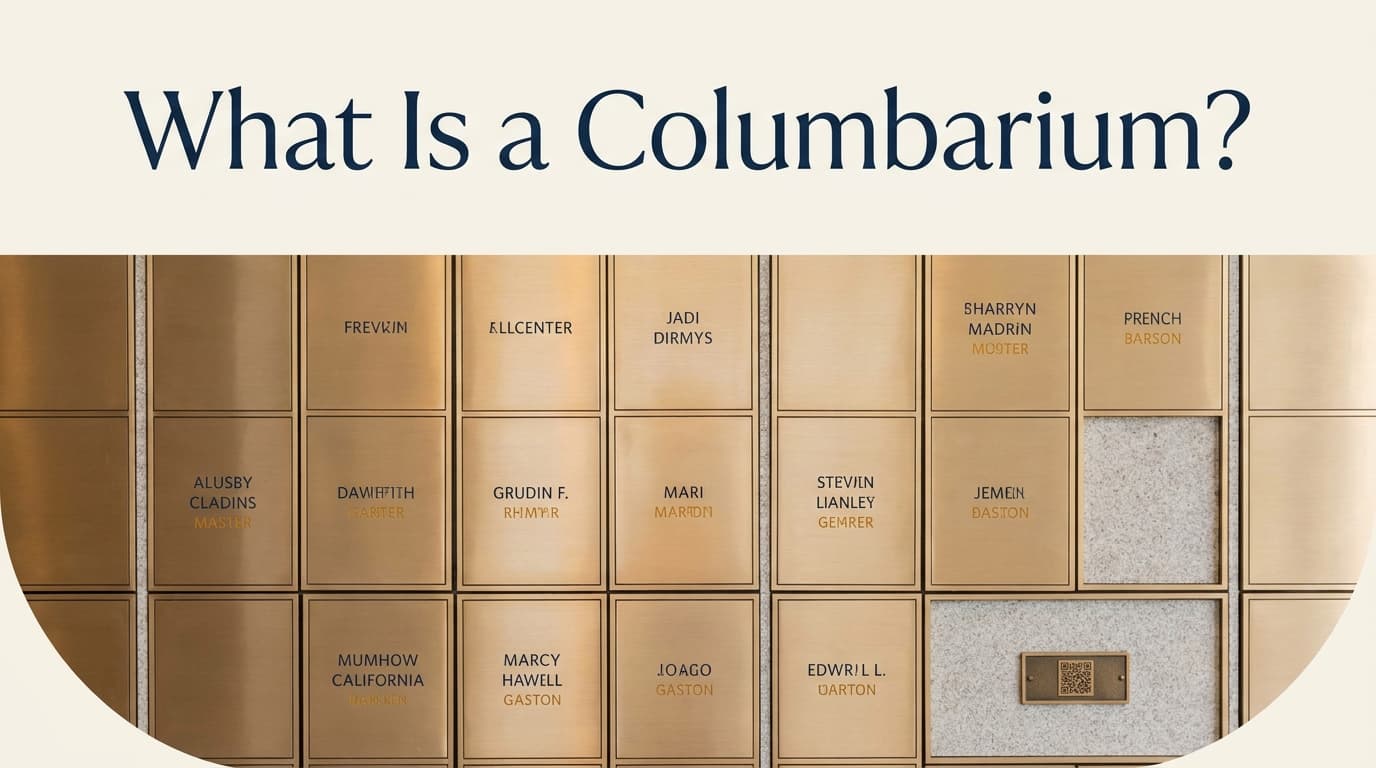
A columbarium is a structure built to hold cremated remains. Instead of a plot of ground, it offers rows of small compartments, called niches, each sized to hold one or more urns. A niche is sealed with an engraved front, usually bearing a name and two dates, and the wall of niches together forms a quiet, dignified place that families can visit the way they would a graveside. As cremation has become the choice of most American families, the columbarium has moved from a niche option, in every sense, to one of the most common destinations for ashes.
The appeal is easy to understand. Keeping an urn at home works for some families and unsettles others, and scattering ashes, while beautiful, leaves no fixed place to return to. A columbarium niche solves both problems at once. It gives cremated remains a permanent address, a spot with a name on it where grandchildren can stand years from now, without requiring the land, the vault, or the cost of a full burial. If you are still weighing the larger decision, our guide to cremation versus burial lays out the trade-offs, and our overview of what to do with cremation ashes covers every option side by side.
Columbaria stand in many settings. You will find them inside mausoleums and cemetery chapels, along garden walls in memorial parks, as free-standing outdoor structures, and, increasingly, in churches that maintain a “garden of remembrance” for their congregation. Placing cremated remains in a niche is a form of interment known as inurnment, and it carries the same sense of a final, cared-for resting place.
Where the Word Comes From
The word carries a surprisingly gentle image. “Columbarium” comes from the Latin columba, meaning dove, and originally described a Roman dovecote, a structure lined with small recessed compartments where doves nested. Ancient Romans, who widely practiced cremation, borrowed both the design and the name for their underground vaults of niches that held funerary urns. The resemblance was exact: rows of tidy compartments, each holding something precious, set into a wall.
That two-thousand-year-old picture still fits. A modern columbarium is a wall of small honored spaces, and the dove, long a symbol of peace and the soul at rest, turns out to be a fitting root for a place built to hold remembrance. The concept faded in the West during centuries when burial dominated, then returned in step with the modern rise of cremation, which our simple cremation guide traces in more detail.
Columbarium vs Mausoleum vs Ground Burial
These three terms get used interchangeably, but they describe different things. The simplest way to keep them straight is to ask what is being placed and where.
| Option | What It Holds | Typical Setting |
|---|---|---|
| Columbarium | Urns of cremated remains, in small niches | Cemetery walls, memorial parks, chapels, churches |
| Mausoleum | Full caskets, in larger crypts (may also hold niches) | Above-ground buildings and family tombs |
| Ground Burial | A casket, or an urn buried in a plot | In-ground cemetery plots, often with a vault |
The key distinction is cremation. A columbarium is built for ashes, which is why its niches are compact, while a mausoleum is built for full-body entombment in crypt-sized spaces. Confusingly, the two often live together: many mausoleums dedicate a wall or a room to columbarium niches, so a single building can serve both cremation and casket families. If your decision involves a traditional plot instead, our guide to the burial vault explains what an in-ground interment requires.
The Three Types of Columbarium Niches
Not all niches look alike. The front of the niche, the part that faces visitors and carries the memorial, comes in three main styles. A columbarium may offer one, two, or all three, and any of them can be sized for a single urn or for a companion niche that holds two.
Bronze-front niches
Sealed with a cast-bronze plate, this is the most traditional look. The bronze front is engraved with the name, dates, and often a short line of scripture, a motto, or a symbol. Bronze weathers well, which is why bronze-front niches appear both indoors and outdoors. Families who like the material often carry it through the rest of the memorial, as our guide to bronze memorial plaques explores.
Granite-front niches
Here the niche is closed with a panel of granite, laser-etched with details or fitted with a small bronze plaque. Granite gives a look that matches nearby headstones and monuments, and like bronze it holds up indoors or out. The wording follows the same tight discipline as any grave marker, and our guide to headstone inscriptions applies almost word for word to a niche front.
Glass-front niches
Always located indoors, a glass-front niche is essentially a small shadow box. Behind the glass sits the urn itself, often alongside a photograph, a folded flag, or a few meaningful keepsakes. It is the most personal of the three, letting a life show through rather than sealing it away, though the protection of an indoor, climate-controlled setting is what makes it possible. Choosing the right vessel matters more with a glass front, and our complete guide to cremation urns walks through sizes, materials, and styles.
Indoor vs Outdoor Columbariums
One of the first choices a family makes is whether the niche sits inside a building or out in the open air, and the difference affects comfort, cost, and the feel of every future visit.
Indoor niches sit inside mausoleums, chapels, or churches. They stay climate-controlled and sheltered, so visits are comfortable in any season and the memorial front is protected from weather. Glass-front niches live here. Indoor placement usually costs more and can be limited in availability.
Outdoor niches line garden walls, courtyards, and free-standing towers in memorial parks. They offer a natural, open setting many families prefer, tend to be more widely available, and often cost less, though the memorial front is exposed to sun, rain, and temperature swings over the years.
How Much a Columbarium Niche Costs
Cost is usually the deciding factor, and the good news is that a niche is one of the more affordable forms of permanent memorialization. A single columbarium niche commonly runs from about $500 to $2,000, though a standard niche bought ahead of time can range from roughly $750 to $2,800 depending on the details.
Typical cost of a single columbarium niche
Several factors move the price within that range. Region matters, as does indoor versus outdoor placement and single versus companion (double) occupancy. Position within the structure matters too: eye-level niches, the easiest to see and touch, command a premium, while niches near the floor or high overhead cost less. And timing has a real effect on the bill.
Buying a niche pre-need, meaning in advance rather than at the time of death, typically saves 20 to 25 percent over buying it at-need. Planning ahead locks in today’s price and spares the family a rushed decision during grief.

What the Price Includes, and What Costs Extra
A niche quote often bundles more than the space itself, so it helps to know what a fair price should cover before you compare providers. Typically the cost includes the niche property, an endowment or perpetual-care fee for maintaining the structure, one inurnment with the labor to place and seal the urn, the official recording of the placement, and basic engraving of the name and dates on the front.
Watch for add-ons. Some facilities charge separately for the plaque or lettering, for the act of opening and closing the niche, or for keeping records, and a few of these can be recurring fees billed monthly, quarterly, or annually rather than once. Ask for an itemized list, and compare it against the broader picture in our complete guide to cremation costs so you know where a niche fits in the total.
Columbarium Rules and Visiting Etiquette
Because a columbarium is a shared wall of memorials, most facilities enforce rules that keep it clean, uniform, and fair to every family. These policies surprise some visitors, so it is worth knowing them before you decorate a niche or plan a visit.
Many columbaria prohibit affixing anything to the niche front, since tape, glue, hooks, or wire can stain or damage the stone. Loose paper items such as cards and photos are often removed because they blow away, and decorations that extend past the niche edge, block a neighbor’s niche, or sit on the ground are usually cleared as well. Flower policies vary widely: some sites allow cut flowers only during the inurnment ceremony, others permit an approved vase or a short display for a week, and many require that nothing exceed the niche front. These rules are not about restricting grief; they protect the surfaces and ensure that no one memorial crowds another. The same spirit governs a cemetery’s grounds, as our guide to cemetery decoration rules explains in depth.
As for visiting, observe posted hours, keep the space tidy, and be mindful that others may be grieving nearby. A columbarium tends to be quieter and more contained than an open cemetery, which many families find comforting.
Columbaria in Churches and Faith Communities
Beyond cemeteries and memorial parks, a growing number of churches maintain their own columbaria, often set in a memorial garden or a quiet chapel alcove and given names like the “Garden of Remembrance.” For many congregations, a church columbarium lets members rest within the community they worshipped in, frequently at a lower cost than commercial cemetery property. These spaces usually carry their own rules and may be reserved for members and their families, so it is worth asking the parish office about eligibility, pricing, and any faith-specific customs around inurnment. Attitudes toward cremation differ across traditions, a topic our guide to what major faiths teach about cremation addresses directly.
The One Thing a Niche Front Cannot Hold
Here is the quiet limitation built into every columbarium. A niche front is small, often just a few inches of bronze or granite. It has room for a name, two dates, and if you are lucky a single short line. It cannot hold the voice, the photographs, the stories, or the ordinary details that made the person who they were. The wall keeps the ashes safe and gives you a place to stand, but the life itself asks for more room than any niche can offer.
This is where a small QR code, added to the niche plaque or a nearby keepsake, changes everything. A visitor scans it with a phone, no app required, and the few engraved words open into the whole life behind them: photos, video, voice recordings, a family tree, and stories from everyone who loved them, with space for new visitors to add their own. The engraved front honors the moment. The digital memorial page honors the person, and it keeps growing over the years.
The timing is no accident. As cremation rises, more remembrance is moving onto compact niches and plaques with little room to say much, and families are reaching for technology to fill the gap. The market for QR-linked memorials, valued at roughly $450 million in 2024, is forecast to pass $1.2 billion by 2033, and QR scanning is now second nature to over a hundred million Americans. To see how it fits the wider picture, read our overview of QR code memorials and our look at funeral technology trends for 2026. A weatherproof QR memorial plaque is built to sit outdoors for years, and setting one up is simpler than most families expect, as our guide to creating a digital memorial page shows.
How to Choose a Columbarium Niche
If you are comparing options, this short sequence keeps the decision manageable and helps you ask the right questions.
- Decide on setting. Cemetery, memorial park, or your own faith community, and indoor or outdoor. This narrows everything else.
- Choose the niche type and size. Bronze, granite, or glass front, and single or companion occupancy if a spouse may join later.
- Ask for an itemized price. Confirm what the quote includes, whether inurnment and engraving are covered, and whether any fees recur.
- Consider buying pre-need. Planning ahead saves money and removes a hard decision from an already hard day.
- Give the niche room to grow. Add a QR code so the few engraved words open into the person’s full story, which our real memorial examples and features overview bring to life.
Run a cemetery, funeral home, or monument business? Families increasingly ask for digital options alongside a niche, and adding QR memorials is a simple way to meet that demand. Linkora’s partner program helps cemeteries, monument dealers, and funeral homes offer digital memorial services with no technical lift. Become a partner to learn more.
Frequently Asked Questions About Columbariums
What is a columbarium?
A columbarium is a structure built to hold cremated remains in small compartments called niches. Each niche holds one or more urns and is sealed with an engraved front bearing a name and dates. Columbaria can stand indoors or outdoors and are found in cemeteries, memorial parks, chapels, and churches. Placing ashes in a niche is called inurnment, and it gives cremated remains a permanent, visitable resting place.
How much does a columbarium niche cost?
A single columbarium niche typically costs between $500 and $2,800. The price depends on region, indoor versus outdoor placement, single versus companion size, and position within the structure, since eye-level niches cost more than those near the floor or ceiling. Buying a niche in advance (pre-need) usually saves 20 to 25 percent compared with buying at the time of death. Most quotes include the niche, perpetual care, one inurnment, and basic engraving, though plaques and record-keeping can carry extra fees.
What is the difference between a columbarium and a mausoleum?
A columbarium holds cremated remains in small niches, while a mausoleum entombs full caskets in larger, crypt-sized spaces. Because ashes take far less room than a body, columbarium niches are compact and often more affordable. The two are related and sometimes combined: many mausoleums include a wall or room of columbarium niches, so a single building can serve both cremation and casket families.
Can you put photos or flowers on a columbarium niche?
It depends on the facility’s rules, which are often stricter than at a graveside. Many columbaria prohibit affixing anything to the niche front and remove loose photos, cards, or decorations that extend beyond the niche edge. Flower policies vary: some allow cut flowers only during the inurnment ceremony, while others permit an approved vase or a brief display. Always check the specific columbarium’s regulations before decorating a niche.
Can a columbarium niche have a QR code memorial?
Yes, and it is a natural fit. A niche front has room for only a name and dates, so a growing number of families add a small QR code to the plaque or a nearby keepsake. A visitor scans it with a phone, with no app required, and reaches a full digital memorial page holding photos, video, voice recordings, and stories. It lets a compact niche carry the person’s whole life rather than a single engraved line. Check with the columbarium first, as some cemeteries have policies on plaque design.
A Small Space, a Whole Life
A columbarium answers a very human need: to give someone we loved a place, even after cremation. It is affordable, permanent, and dignified, a quiet wall where a name endures and a family can return. The only thing a niche cannot do is tell the whole story, and that is exactly the part technology now makes possible. Choose the niche for the place, and add a digital memorial for the person, so the few words carved in stone open into everything they were.