
TL;DR
- A memorial garden is any planted space set aside to remember someone. It can be a full backyard bed, a single tree, or three pots on a balcony. Size has almost nothing to do with whether it works.
- Gardening genuinely helps. In one UK survey of bereaved people, 40% credited gardening with helping them through their grief, and time spent in a garden measurably lowers cortisol and blood pressure.
- Do not pour cremated ashes straight onto plants. Cremains have a pH near 12 and a very high salt content, which will kill most plants. Mix at least three parts compost to one part ashes, or use a biodegradable planting urn.
- On your own property you generally do not need a permit to scatter ashes, but check city and county rules, and get written permission before scattering anywhere you do not own.
- Gardens are alive, which is their beauty and their weakness. Plants die, and anything rooted in the ground legally stays with the house when you sell. Pair the garden with something that travels.
Why so many families reach for a shovel after a funeral
In the weeks after a death there is a strange, restless energy that has nowhere to go. The casseroles stop arriving. The paperwork thins out. And you are left with an urge to do something for a person you can no longer do anything for. For a surprising number of families, that urge ends up pointed at a patch of dirt in the backyard.
It turns out to be a good instinct. In a survey of bereaved people in the UK, 40% said gardening had helped save them from their grief, and roughly three quarters agreed that time in nature helped them heal. The mechanism is not mysterious. Working outdoors with your hands lowers cortisol and blood pressure, and it gives grief something slow and physical to attach itself to. Bereavement counselors have a name for it now: grief gardening.
There is a second thing happening too. A memorial garden gives you somewhere to go. If your person was cremated and the urn is on a shelf, or the cemetery is a four hour drive away, the absence of a place to visit is its own quiet problem. A garden solves that. It is why memorial gardens sit alongside other meaningful ways to remember someone who passed away as one of the most common things families do in the first year.
One note on terminology, because it trips people up in search results. Many cemeteries in the United States are named “Memorial Gardens.” Those are commercial burial grounds. This guide is about the other kind: the private, personal garden a family plants at home.
Start with the space you actually have
The single most common reason a memorial garden never gets built is that the first version imagined is too ambitious. A grieving family sketches a stone path, a water feature, and a pergola, then looks at the cost and the labor and quietly shelves it. Nothing gets planted at all.
Scale down. The garden’s job is to be a place you return to, not a landscaping achievement. Any of these count:
A single tree
The most durable option and the least work per year. A maple for fall color, a dogwood or weeping cherry for spring bloom, or an oak if you want something your grandchildren will sit under. Check the mature size before you dig, because the sweet little sapling in the pot is frequently a forty foot tree in thirty years.
A defined bed
Six by eight feet is plenty. Edge it with stone so it reads as intentional rather than as an unweeded corner. This is the most flexible option because you can add to it every year on a birthday or anniversary.
Containers
For renters, apartment dwellers, and anyone who expects to move, containers are not a compromise. They are the smarter choice. Three large pots on a balcony with rosemary, lavender, and something that flowers will do the same emotional work as a quarter acre, and they come with you.
A corner of an existing garden
You do not need new ground. Claiming one established bed, adding a marker, and planting one new thing in it is a complete memorial garden.
of bereaved people surveyed said gardening helped save them from their grief
Choosing plants that mean something
There are two ways to pick plants, and the best gardens use both.
The first is personal. What did they grow? What did they cut and bring inside? If your mother had a lilac by the back door for thirty years, plant a lilac and stop researching. A plant that smells like a specific person’s house beats any symbolism in a book.
The second is traditional. The language of flowers has been assigning meaning to plants for centuries, and leaning on it gives a garden a layer that visitors can read. Our guide to flowers that represent death and remembrance goes deeper, but here are the ones that come up most often in memorial planting.
| Plant | Meaning | Practical note |
|---|---|---|
| Rosemary | Remembrance. Planted at Roman tombs, and the source of Ophelia’s line in Hamlet. | Evergreen in warm zones, needs a pot indoors north of zone 7. Brush it and you get the scent. |
| Forget-me-not | Enduring memory. Less about mourning, more about refusing to let someone fade. | Self-seeds readily, which many families find fitting. Can spread further than you intend. |
| Lily | Peace and the restored innocence of the soul. The classic funeral flower. | Toxic to cats. Choose something else if neighborhood cats visit your beds. |
| Lavender | Devotion and calm. | Wants sharp drainage and full sun. It dies in wet clay, not in cold. |
| Oak | Strength and endurance. | A multi-generational choice. Give it 40 feet of clearance from the house. |
| Weeping cherry | The brevity and beauty of a life. | Spectacular for two weeks a year. Shorter lived than an oak, roughly 20 to 30 years. |
| Poppy | Eternal sleep and remembrance, especially for veterans. | Direct sow in fall or very early spring. Resents transplanting. |
| Peony | Honor and a long, prosperous life. | Can outlive the person who planted it. Peonies at 80 years old are common. |
One design rule worth following: choose at least one plant for each season. A garden that is glorious in May and bare from September through April will let you down in exactly the months when grief tends to get heavier.
The ashes question, which most guides get wrong
If cremation was the choice, the obvious next thought is to work the ashes into the garden. Please read this part before you do.
Cremated remains are not like wood ash or fertilizer. They come out of the retort with a pH of roughly 12 on a 14 point scale. Healthy garden soil sits between 6 and 7. That gap is not a small adjustment, it is orders of magnitude, and cremains also carry a very high sodium load. High alkalinity locks up nutrients so roots cannot absorb them, and the salt pulls water back out of plant tissue. Poured directly around a memorial tree, ashes will very often kill it, which is a heartbreak nobody needs to discover a season later.
Before you scatter: mix at least three parts compost to one part cremains, or use a commercial soil-neutralizing amendment and let the mixture rest 90 to 120 days before it goes near roots. If you want to plant immediately, a two-chamber biodegradable urn keeps the seedling and the remains separated until the tree is established.
The three workable approaches:
- Dilute and rest. Three parts compost to one part ashes, mixed thoroughly, left to sit for three to four months. Then incorporate into the bed rather than concentrating it in one spot.
- Use a planting urn. Systems like the two-chamber bio urn run about $129 to $159 including a young tree, and they are engineered around exactly this problem. The roots grow in protected medium and only reach the remains once they are strong enough to handle it. Our complete guide to cremation urns covers the biodegradable options in more detail.
- Keep the ashes out of it. Entirely legitimate. The garden can be a memorial without being a burial. Many families keep the urn indoors and treat the garden as the place they go to sit. If you are still weighing options, our guide on what to do with cremation ashes lays out the full range.
Full tree pod burials, where the whole system is installed by a provider, typically run $500 to $4,000, and $2,000 to $5,000 once cremation and planting are included. If the ecological angle is what draws you, the same thinking runs through green burial.

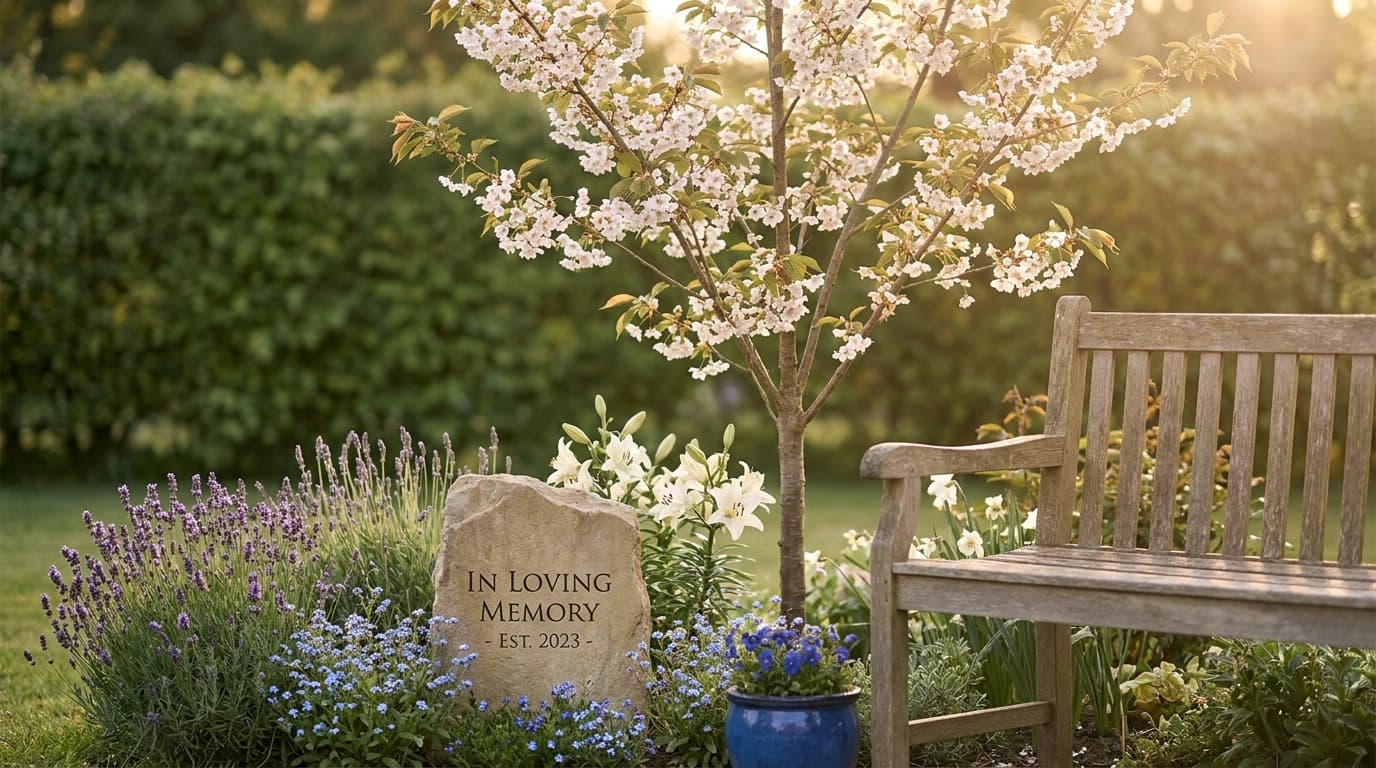
A memorial garden at a glance: choosing the space, the plants, and how to handle ashes safely.
The objects that turn a garden into a memorial
Plants alone read as landscaping. What makes a space legible as a memorial is usually one deliberate object, and one is enough.
A marker or plaque. The most direct choice. A name, two dates, and a line that sounds like them. Bronze memorial plaques mounted on a boulder or set flush in the bed weather beautifully and last for decades. Engraved garden stones are the budget version and start under $50.
A bench. If you want people to actually spend time in the garden rather than glance at it, put somewhere to sit in it. A memorial bench with an engraved backrest does double duty as marker and invitation.
Seasonal objects. Wind chimes, a birdbath, solar lanterns, or the memorial ornaments families hang on the tree each December. Small acts of tending are often the point.
Something from their life. Their garden tools hung on the fence. The birdhouse from their old porch. A rose divided from their own yard before the house sold. These land harder than anything bought new.
If the garden is for a pet, the same logic applies at a smaller scale, and our pet memorial ideas guide has options built for that. And if you are also caring for a plot at a cemetery, the rules there are stricter than at home, which our guide to cemetery decorations covers.
What the law actually says
The legal picture is simpler than most families fear, with one caveat.
No US state prohibits scattering cremated remains on private property with the owner’s permission, and on land you own yourself you generally need no permit at all. That is the whole rule for most backyard memorial gardens.
The caveat is local. Counties and municipalities can add their own requirements, and homeowners associations can restrict what you plant, how tall it grows, and whether you may install a permanent marker. Two phone calls, one to the county and one to the HOA, take ten minutes and prevent an expensive misunderstanding.
If the garden is on someone else’s land, including a relative’s, get written permission. Verbal agreements between family members have a way of not surviving a change of ownership. Scattering without permission can be treated as trespass.
The part nobody plans for: gardens do not move
Here is the difficulty at the center of every memorial garden, and it is worth facing before you plant rather than after.
The garden is alive, and living things are conditional. Droughts happen. Trees fail. A late frost takes the peony. And there is a legal wrinkle that catches families off guard every year: anything rooted in the ground is considered part of the real property. When you sell the house, the memorial tree stays. You cannot dig it up on the way out unless you wrote it into the sales agreement, and even then transplanting a mature tree is rarely survivable for the tree.
Families move for jobs, for a partner, for care needs, for the simple reason that the house got too big. Roughly one in ten Americans moves in any given year. Which means the odds that a garden planted today is still yours to visit in twenty years are considerably worse than most families assume when they are standing there with a shovel and good intentions.
None of this is a reason to skip the garden. It is a reason to pair it with something portable. The garden is where you go. A digital memorial is where the person is kept: the photographs, the recordings of their voice, the stories cousins add at Thanksgiving, the timeline of a whole life rather than two dates on a stone. One is rooted in a specific address. The other is not.
Linkora connects a QR code, etched into a plaque or marker, to a private memorial page the family controls. Set a small marker in the garden and anyone sitting on the bench can scan it and see photos, videos, tributes, and an imported family tree instead of a name and a pair of dates. No app is needed. Families decide exactly who can view and who can contribute. More than 500 families have preserved over 12,000 photos this way, and when they move, the page moves with them. You can see how it works or browse real memorial examples.
A weekend plan, start to finish
If you want to stop reading and start digging, this is the shortest honest path.
- Pick the spot on a Saturday morning. Watch where the sun lands at 9am, noon, and 4pm. Full sun means six hours or more. Most memorial favorites, including lavender, rosemary, and peonies, want it.
- Choose three plants, not twelve. One anchor (a tree or shrub), one that carries meaning, one that flowers in a different season than the other two. You can add every year.
- Handle the ashes decision before you plant, not after. Dilute and rest, use a planting urn, or leave them out. All three are fine. Reversing course later is not easy.
- Buy the marker at the same time as the plants. Gardens that get a marker in the first month get finished. Gardens that wait for the “right” plaque tend to stay unmarked for years.
- Make the first visit deliberate. Plant it with the people who would want to be there. Read something. This is often the moment families describe as the real goodbye, more than the funeral was. Our celebration of life guide has readings that work outdoors.
- Give it a date. A birthday, the death anniversary, the first warm weekend. Something you tend on a schedule stays alive. Our guide to marking a death anniversary has ideas for what to do when the day comes.
Expect the garden to change you as much as you change it. Many families find that the maintenance is the point: the weeding and watering become a standing appointment with someone they miss. If writing helps you process alongside the physical work, a grief journal pairs unusually well with a garden, because both reward showing up in small doses over a long time.
Frequently asked questions
What is a memorial garden?
A memorial garden is a planted space set aside to remember a specific person or pet. It can be a full garden bed, a single memorial tree, or a few containers on a balcony. What distinguishes it from ordinary landscaping is usually one deliberate element: a plaque, an engraved stone, a bench, or plants chosen for their connection to the person. Note that many US cemeteries also use “Memorial Gardens” in their business name, which is a different thing entirely.
Can you put cremated ashes directly in a memorial garden?
Not without preparing them first. Cremated remains have a pH around 12 and a very high sodium content, compared with healthy garden soil at pH 6 to 7. Poured directly around plants, ashes commonly kill them. Mix at least three parts compost to one part ashes and let the mixture rest 90 to 120 days, use a commercial soil-neutralizing amendment, or plant with a two-chamber biodegradable urn that keeps the seedling separated from the remains until its roots are established.
Is it legal to scatter ashes in my own garden?
In the United States, generally yes. No state prohibits scattering cremated remains on private property with the owner’s permission, and no permit is typically required on land you own. Check for local county or city rules and any homeowners association restrictions on permanent markers or plantings. If the land belongs to someone else, including a family member, get written permission first, because scattering without it can be treated as trespass.
What plants are best for a memorial garden?
Start with anything the person actually grew or loved, which will always outperform symbolism from a list. Then add from the traditional palette: rosemary for remembrance, forget-me-nots for enduring memory, lilies for peace, lavender for devotion, poppies for eternal rest, and oak or weeping cherry as an anchor tree. Choose at least one plant for each season so the garden is not bare during the winter months, when grief often feels heaviest.
What happens to a memorial garden if we move house?
Anything rooted in the ground is legally part of the property and stays with the house unless you specifically negotiate otherwise in the sales agreement, and mature trees rarely survive transplanting anyway. If a move is likely, plant in large containers, choose a memorial tree through a program that plants in a public forest, or pair the garden with a portable memorial. A QR-linked digital memorial page holds the photos, videos, and stories regardless of what address you live at.