
TL;DR
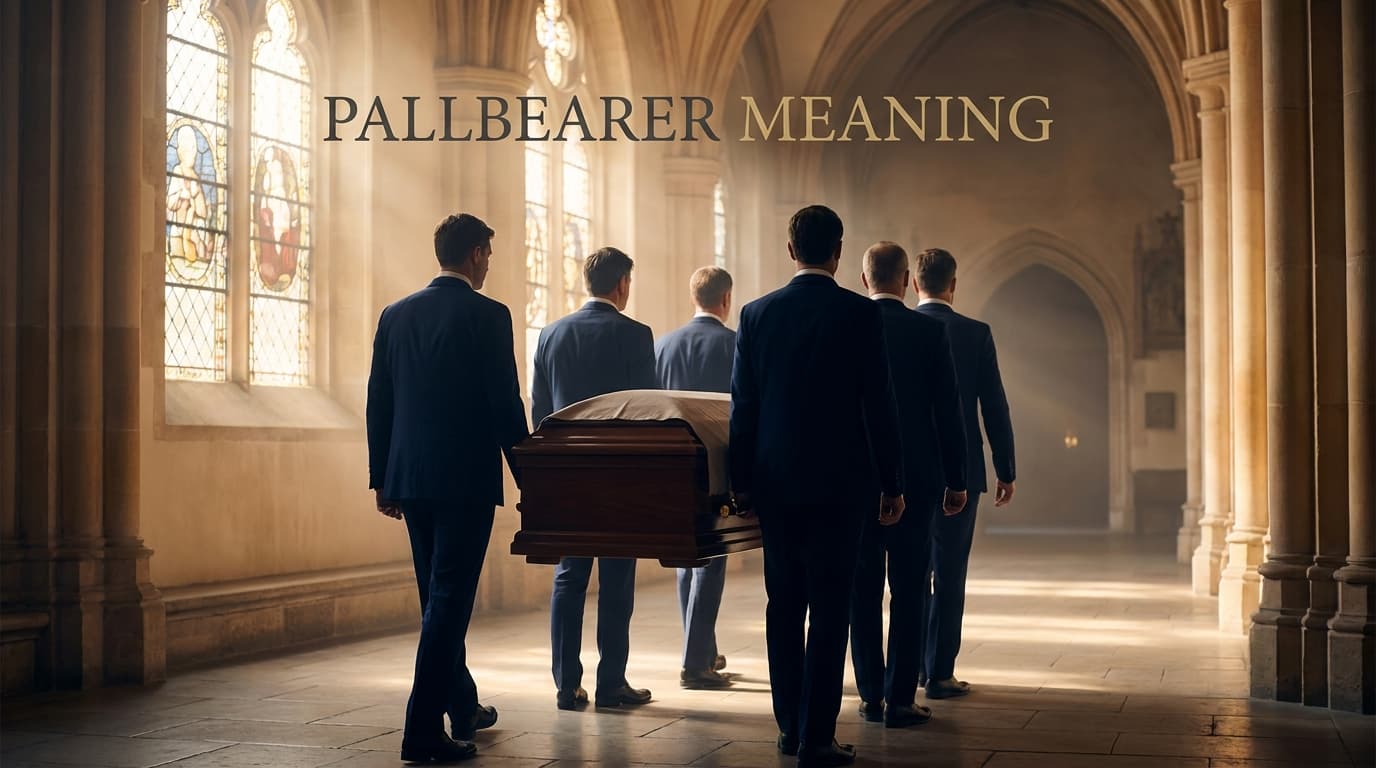
- Pallbearer meaning: a person who helps carry or escort the casket at a funeral. The word comes from the “pall,” the heavy cloth draped over a coffin, and appeared in print as early as 1710.
- Most funerals use six active pallbearers, sometimes eight. A useful rule of thumb is one pallbearer for every 25 pounds, and standard caskets weigh roughly 160 to 220 pounds.
- Honorary pallbearers do not lift the casket. They walk alongside the procession or carry a photo, flowers, or a keepsake. The honor is considered equal.
- There is no rule that pallbearers must be men. Women serve regularly. The only real requirements are physical capability, reliability, and emotional readiness.
- It is completely acceptable to decline. A gracious no and an offer to help another way is better than an unsteady yes.
What Does Pallbearer Actually Mean?
When a family sits down to plan a funeral, one question tends to surface earlier than expected: who will carry the casket? It sounds logistical. In practice it is one of the most personal decisions of the entire service, because the people chosen for that walk are the ones the family is quietly saying meant the most.
The pallbearer meaning is more literal than most people realize. A “pall” is the heavy cloth traditionally draped over a coffin, a custom that traces back to the Roman pallium, the cloak worn by soldiers, later shortened in medieval Christian practice to the cloth that covered a body before burial. A pallbearer is, quite simply, one who bears the pall. The word first appears in print around 1710, though the practice of shouldering a loved one’s body to their resting place is far older than the term for it.
Today the word covers two related roles: the active pallbearer, who physically carries or guides the casket, and the honorary pallbearer, who is publicly named and walks with the procession without bearing weight. Both appear in the printed order of service. Both are, by long convention, treated as equal honors. If you are working through a full funeral planning checklist, naming pallbearers usually sits alongside choosing readings, music, and the person who will deliver the eulogy.
A note on language: “pallbearer” and “casket bearer” are used interchangeably in most American funeral homes. In the UK and Ireland you will more often hear “coffin bearer.” The role is identical. If you are unsure which term applies, our guide to the difference between a casket and a coffin explains why the two words are not actually synonyms.
What a Pallbearer Actually Does
The job is less mysterious than it feels from the outside. A funeral director will walk everyone through it, usually in a five-minute briefing before the service begins, and no one is expected to have done it before.
The sequence of a typical service
Arrival and briefing. Pallbearers are asked to arrive early, often 30 to 45 minutes before the service. This is not a formality. A late pallbearer holds up the entire funeral, so dependability matters more than any other single quality when a family is choosing.
Loading the hearse. The casket is first lifted onto a church truck, a wheeled platform that carries most of the weight. Pallbearers guide the casket as the truck’s legs retract and it slides into the hearse. This is technique, not brute strength.
Carrying into the service. At the church, chapel, or funeral home, pallbearers lift the casket and carry it down the aisle, with the immediate family walking ahead of or behind them. They then take their seats, usually together, in a reserved row.
Carrying out and the procession. At the close of the service the pallbearers repeat the walk in reverse, returning the casket to the hearse for the drive to the cemetery. Their vehicles typically travel near the front of the funeral procession, directly behind the family.
Graveside. At the cemetery, pallbearers carry the casket from the hearse to the lowering device over the grave. This is often the hardest part physically, because the ground is uneven and the distance can be longer than expected.
Typical weight of a standard casket, before accounting for the person inside
How many pallbearers do you need?
Six is the standard. Eight is common for heavier caskets, larger builds, or long carries across a cemetery. The working guideline funeral directors use is roughly one pallbearer for every 25 pounds of total weight, which is why a 200-pound casket usually calls for eight people rather than six.
Casket weight varies more than most families expect. A simple pine casket runs around 150 pounds. Solid mahogany can reach 250. Metal caskets sit somewhere in between, and specialty or oversized caskets can exceed 400 pounds. If the family has not chosen a casket yet, this is worth raising early, because the material you choose quietly determines how many people you will need to ask.
Honorary Pallbearers: The Role Families Overlook
An honorary pallbearer is named in the program and recognized during the service, but does not carry weight. They may walk beside or behind the casket, or carry something meaningful in tribute: a framed photograph, a folded flag, a bouquet, a memory box.
This role solves several problems at once, and families who know about it tend to be grateful they did.
- It honors people who cannot lift. An 84-year-old brother, a friend recovering from surgery, a grandchild who is too young. The recognition is real; the physical demand is not.
- It expands the circle. Active pallbearers are capped by physics. Honorary pallbearers are not. Some families name two. Others name twenty. There is no ceiling, and the printed program can carry them all.
- It gives a graceful exit. Someone who is asked to be an active pallbearer but does not feel steady enough can be moved to honorary without any loss of standing.
Both categories are typically printed in the funeral program, usually side by side under a shared heading. Guests read those names. Decades later, families still read them.

Pallbearer roles at a glance: who carries, how many, and what to expect on the day.
Who Can Be a Pallbearer?
Let us dispatch the most persistent myth first. There is no tradition, rule, or religious requirement that pallbearers must be men. Women serve as pallbearers regularly and have for generations. Daughters carry their fathers. Sisters carry sisters. The assumption that the role is male is a habit, not a rule, and no funeral director will blink.
What actually matters is a short and practical list:
- Physical capability. Can this person share a share of 200 pounds, walk on grass and gravel, and stand for extended periods? Age is only relevant through this lens. A capable 17-year-old is a better choice than a struggling 60-year-old, and vice versa.
- Reliability. Will they arrive early, with transportation they can count on?
- Emotional readiness. Tears are expected and entirely normal. But a person who is likely to be overwhelmed mid-carry should be offered an honorary role instead, for their sake as much as anyone’s.
- Meaning. Beyond all of the above: who mattered? Close friends, siblings, adult children, grandchildren, colleagues, teammates, fellow veterans, members of a congregation. The list should read like a portrait of the person’s life.
If the person who died served in the military, the honor guard may provide uniformed body bearers at no cost to the family. Families can still name their own honorary pallbearers alongside them. Our guide to veterans’ burial and cremation benefits covers what the VA provides and how to request it.
Pallbearer Etiquette: What to Wear, What to Do, What to Say
Attire
Dress to blend in with the other mourners, not to stand out from them. That means a dark suit or a dark dress in a conservative cut. The one detail people forget is footwear: choose dark shoes that are sturdy and comfortable, because you will be walking on sidewalks, church tile, and then soft, uneven cemetery ground while carrying weight. Leather-soled dress shoes on wet grass are a genuine hazard. Our full guide to appropriate funeral attire covers the broader dress code, but for pallbearers, grip matters more than polish.
On the day
Arrive early. Silence your phone before you walk in, not after. Follow the funeral director’s instructions precisely, because they have done this thousands of times and are watching for hazards you cannot see. Lift with your legs, keep pace with the person diagonal from you rather than watching your feet, and do not rush. The walk is meant to be slow.
How to decline gracefully
Being asked is an honor. Saying no is still allowed, and a family will almost always understand. The kindest decline is honest, brief, and offers something in its place:
“Thank you for thinking of me. I would be honored to be part of the service, but I don’t think I’m steady enough to carry the casket. Could I help another way? I’d love to be there for you that day.”
A back injury, a recent surgery, an anxiety condition, or simply knowing your own limits are all sufficient reasons. Families remember the people who showed up, not the people who lifted. If you would rather contribute with words, our collection of eulogy examples and our guide to what to say when someone dies offer other ways to stand up for a family.
How to Ask Someone to Be a Pallbearer
Ask early, ask directly, and ask in person or by phone if you can. A text is acceptable when time is short, and time is often short.
- Make the list before you make the calls. Aim for six, with two names in reserve. People decline, travel plans fall through, and having a backup spares you a scramble on the morning of the service.
- Say why. “Dad talked about your fishing trips constantly. It would mean a lot to us if you’d carry him.” That sentence is the whole ask.
- Give them the facts. Date, time, where to arrive, how early, and roughly what the carry involves. Uncertainty is what makes people hesitate.
- Offer the honorary option in the same breath. “And if lifting isn’t something you can do, we’d love to name you as an honorary pallbearer instead.” This removes the sting from a no before it is even spoken.
- Tell the funeral director your final list. They will brief everyone and handle the choreography. If you have not chosen one yet, our guide to working with a funeral director explains what they take off your plate.
Not every service needs pallbearers at all. Direct cremation, a celebration of life held weeks later, or a graveside-only service may not involve a carried casket. If a hearse and a lowering device handle the casket entirely, the family can still name honorary pallbearers as a way of recognizing the people who mattered most.
Preserving the Names, Not Just the Day
Here is what happens to almost every funeral program. It is printed, it is handed out, it is read once, and then it is folded into a drawer. Ten years later a grandchild asks who those six men were who carried their grandfather, and no one is entirely sure anymore.
This is the quiet gap that digital memorials close. At Linkora, we build QR code memorials that connect a physical monument to a living online tribute, so the details that would otherwise fade get a permanent home. A memorial page can hold the pallbearers’ names and their relationship to the person who died, photographs from the service, the eulogy that was read aloud, and the stories that guests told afterward in the parking lot. Visitors scan the code etched into the headstone with an ordinary phone camera, and there is no app to download.
More than 500 families now use Linkora, with over 12,000 photos preserved and a 98% caretaker satisfaction rate. Families keep complete control over what is visible and to whom, because privacy on a memorial page is not a feature to be negotiated. If you are new to the idea, start with how Linkora works or browse memorial page ideas for inspiration on what to include.
Frequently Asked Questions
What is the meaning of pallbearer?
A pallbearer is a person who helps carry or escort the casket at a funeral. The name comes from the “pall,” the heavy cloth traditionally draped over a coffin, so a pallbearer literally bears the pall. The term dates to roughly 1710, though the practice of carrying a loved one to their burial place is ancient.
How many pallbearers are needed at a funeral?
Six is standard and eight is common for heavier caskets. Funeral directors often use a guideline of one pallbearer per 25 pounds of weight. Since standard caskets weigh roughly 160 to 220 pounds, a heavier casket usually calls for eight people. Naming two backups is wise.
What is the difference between a pallbearer and an honorary pallbearer?
Active pallbearers physically carry the casket. Honorary pallbearers are named and recognized in the funeral program, and may walk alongside the procession or carry a photo or flowers, but do not bear any weight. The two are considered equal honors, and there is no limit on how many honorary pallbearers a family can name.
Can a woman be a pallbearer?
Yes. There is no rule, tradition, or religious requirement limiting the role to men, and women serve as pallbearers regularly. The only genuine considerations are physical capability, dependability, and emotional readiness. Choose the people who meant the most to the person who died.
Is it rude to decline being a pallbearer?
Not at all. Declining is entirely acceptable, and families understand. Thank them for the honor, be honest about why (a back injury, emotional strain, travel), and offer to support the service another way. Many people who decline the active role accept an honorary one instead.
A Final Thought
Being asked to carry someone is the last physical act of service you can offer them. It is heavy in both senses, and that is rather the point. The walk is slow because it is supposed to be. The names are printed because they are supposed to be remembered.
Make sure they actually are. A monument records a name and two dates. A digital memorial records the people who stood beside it.